
✉ Join the Dispatch — a calm weekly note, every Thursday. Free.
The short answer: the room size quoted for an air purifier is often the room it can clean just once an hour, which is too slow for hay fever, dust allergies or smoke. American benchmarks from the Environmental Protection Agency (EPA) and the trade body AHAM work out at about five air changes an hour. For a UK room with a 2.4 m ceiling, divide the purifier’s CADR (clean air delivery rate, in m³/h) by 12 for the floor area in m² it suits at five changes an hour, or by 10 for about four.
Why “up to 108 m²” isn’t wrong, and isn’t your number
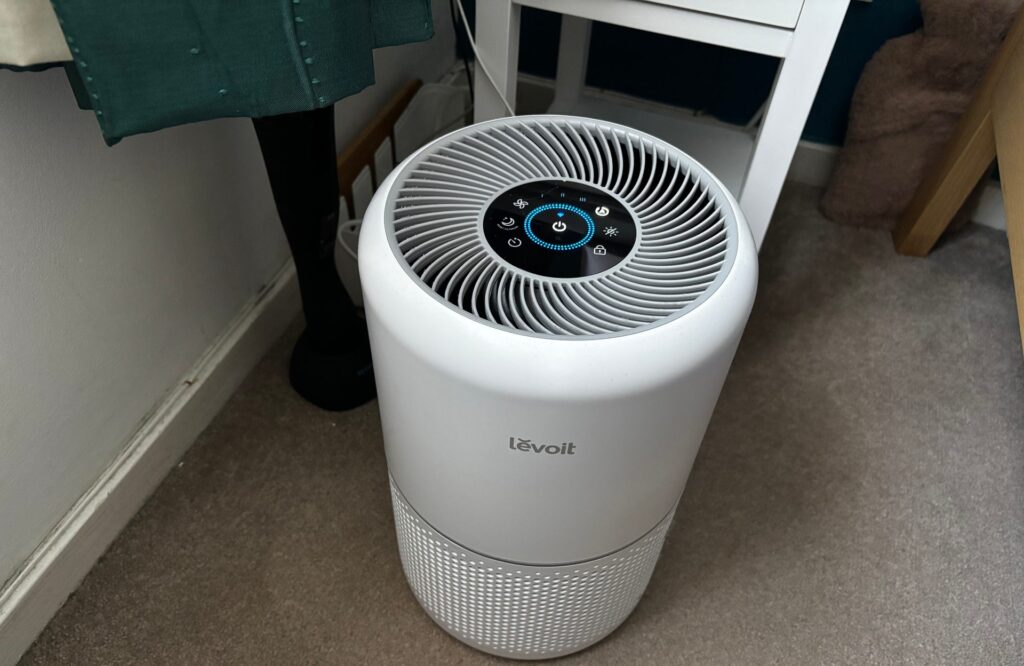
Levoit’s Amazon listing for the Core 300S gives a CADR of 258 m³/h and says it purifies rooms of up to 108 m² once an hour, or 54 m² twice an hour.
CADR is the volume of cleaned air a purifier delivers in an hour. Divide it by the ceiling height and you get the floor area it can get through once in that hour: 258 ÷ 2.4 = 107.5 m². That’s the 108 m², and twice an hour halves it to 54 m². Both figures check out, and to Levoit’s credit the listing says which rate it means. Not every listing does.
So the number isn’t a lie; it answers a question most of us aren’t asking. You want the air kept clean while pollen, dust and smoke keep arriving, and once an hour can’t keep up. Cleaned air mixes back into the rest, so the purifier re-filters some of it, while new particles come in through doors and windows and on clothes and pets.
AHAM’s modelling puts numbers on it: one air change an hour removes under half of the fine, smoke-sized particles in its model room, and 4.8 changes an hour remove about 80%.
How many air changes an hour do you need?
About five, and treat four as the least you’d settle for. Both benchmarks are American, and it’s worth saying so plainly:
- AHAM works out the suggested room size printed on purifiers carrying its Verifide seal at 4.8 air changes an hour, and recommends at least that in the room where a purifier is used.
- The EPA’s Guide to Air Cleaners in the Home asks for a minimum CADR of 65 cubic feet a minute per 100 square feet of floor, assuming an 8 ft (2.44 m) ceiling. That’s 3,900 cubic feet an hour through 800 cubic feet of room: about 4.9 changes an hour.
Four falls a little short of both, but not by much. On AHAM’s curve it removes about 76% of those fine particles, against 80% at 4.8. Two removes about 62%.
We haven’t found a UK health body with a figure of its own. The NHS’s hay fever advice doesn’t mention air purifiers, though it does suggest keeping windows and doors shut as much as possible, which suits a purifier too.
Two honest caveats. A well-sized purifier helps rather than cures: in the EPA’s summary, HEPA purifiers have improved some allergy and asthma symptoms in studies, but not always by much. And CADR measures particles only; for smoke smells, which are gases, the EPA points to activated carbon.
The sum, in one line
Air changes an hour = CADR (m³/h) ÷ (floor area in m² × ceiling height in m)
Or, for the room a purifier suits:
Floor area (m²) = CADR ÷ (ceiling height × air changes an hour)
With a 2.4 m ceiling, 2.4 × 5 = 12, hence dividing by 12; 2.4 × 4 = 9.6, which we’ve rounded to 10. We use 2.4 m throughout. It’s close to the 8 ft the American benchmarks assume, and a little above the 2.3 m minimum England’s space standard sets for new homes.
Two examples, each with a 2.4 m ceiling and a 200 m³/h purifier:
- A 4 m × 3.5 m bedroom is 14 m², or 33.6 m³ of air. 200 ÷ 33.6 = about 6 changes an hour. Plenty.
- A 5 m × 4.5 m living room is 22.5 m², or 54 m³. 200 ÷ 54 = about 3.7. Short: five changes an hour would need 54 × 5 = 270 m³/h.
If a listing gives CADR in cubic feet per minute (cfm), multiply by 1.7 for m³/h. If it gives only a room size and says that’s for once an hour, divide it by five for five changes an hour.
The CADR each room needs
Each figure is floor area × 2.4 m × changes an hour, rounded. Find your room and look for at least the CADR in your column.
CADR needed, in m³/h, with a 2.4 m ceiling
| Floor area | Roughly | 2 an hour | 4 an hour | 5 an hour |
|---|---|---|---|---|
| 9 m² | 3 × 3 m | 43 | 86 | 108 |
| 12 m² | 4 × 3 m | 58 | 115 | 144 |
| 16 m² | 4 × 4 m | 77 | 154 | 192 |
| 20 m² | 5 × 4 m | 96 | 192 | 240 |
| 25 m² | 5 × 5 m | 120 | 240 | 300 |
| 30 m² | 6 × 5 m | 144 | 288 | 360 |
Two an hour is the second figure some listings quote; for allergies or smoke, read the last two columns. For scale, England’s space standard asks for at least 11.5 m² for a double bedroom in a new home, and 7.5 m² for a single.
Worked example: the Levoit Core 300S
We’ve reviewed the Levoit Core 300S: our full hands-on review covers six weeks in a bedroom. Here it’s purely a worked example, using Levoit’s own figure of 258 m³/h:
- Five changes an hour: 258 ÷ (2.4 × 5) = 21.5 m²
- Four changes an hour: 258 ÷ (2.4 × 4) = 26.9 m²
So by the benchmarks it suits a room of about 21–27 m² (a 5 m × 5 m room, say) rather than the 108 m² on the listing.
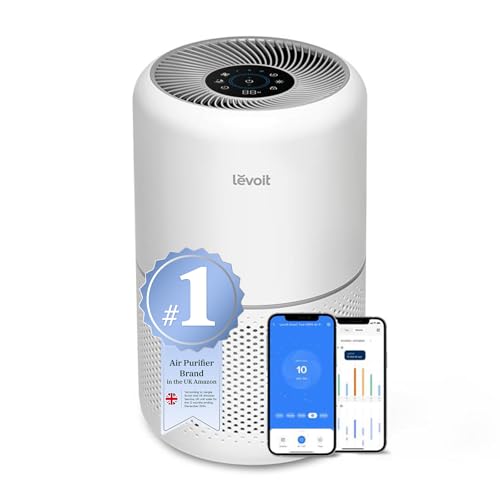
Levoit Smart HEPA Air Purifier for Bedroom Home, 258m³/h, 108m², Core 300S | Laser sensor with Auto Mode, App control, For allergy & pet homes, remove 99.97% Pollen/Dust/Odour
The same sum explains the 80 m² next to the Levoit in our air purifier guide, where it appears as the Levoit 80m² Air Purifier. That’s the plain Core 300, a different model from the 300S, listed at 187 m³/h, and 187 ÷ 2.4 = 78 m², its once-an-hour figure. At four to five changes an hour it suits about 16–19 m².
Four things that shrink the room a purifier can handle
- The fan setting. CADR is typically measured at the highest speed, and a purifier filters less air at lower speeds, the EPA notes. On a quiet or sleep setting, or in an auto mode that turns the fan down when the air reads clean, it’s handling a smaller room than the table suggests. Size for the setting you’ll really use, and let it run longer; what that costs is in our running costs index.
- Open-plan rooms and open doors. AHAM’s label says purifiers work best with doors and windows closed. In an open-plan room, the EPA says to count the whole space the purifier serves; a door left open to the landing has much the same effect.
- Taller ceilings. At 2.7 m every room size above falls by about 11%, so the Core 300S would suit roughly 19–24 m² rather than 21–27. Measure yours; the sum takes any height.
- The filter, and where it stands. Every filter needs regular replacement, the EPA says, because a clogged one won’t do its job. Keep the purifier clear of curtains and anything else that blocks the airflow.
Air purifier room size: your questions answered
How do I work out what size air purifier I need?
Multiply the room’s floor area in m² by its ceiling height in metres, then by five. That’s the CADR, in m³/h, for about five air changes an hour: for a 16 m² bedroom with a 2.4 m ceiling, 16 × 2.4 × 5 = 192 m³/h. Choose a purifier with at least that.
How many air changes per hour do I need for allergies?
About five, and treat four as the least you’d settle for. AHAM, the American appliance makers’ body, bases its suggested room sizes on 4.8 air changes an hour, and the US EPA’s sizing table works out at about 4.9. We haven’t found a UK health body with its own figure.
Is the room size on the box wrong?
Not necessarily. It’s often the room the purifier can clean once an hour, which is true but too slow for allergies or smoke; Levoit’s Core 300S listing, for one, says its 108 m² is for once an hour. Divide a once-an-hour room size by five. Room sizes on AHAM-verified purifiers already assume 4.8 changes an hour.
Does a purifier clean the whole room on its quiet setting?
Not at its full rate. CADR is typically measured at the highest fan speed, and the US EPA notes that a purifier filters less air at lower speeds. If you’ll run it quietly overnight, choose more CADR than the room strictly needs, and let it run for longer.
What if my ceiling is higher than 2.4 m, or the room is open-plan?
Use your own measurements; the sum works for any room. At 2.7 m, every room size falls by about 11%. For an open-plan space, count the whole area the purifier serves, as the US EPA advises, and treat a room whose door stays open the same way.
Related
- Our air purifier buying guide: the picks, with CADR in the comparison table
- UK Home Running Costs Index: what an air purifier costs to leave on all day, at the current price cap
Sources
- US Environmental Protection Agency, Guide to Air Cleaners in the Home, 2nd edition (EPA-402-F-08-004, July 2018; PDF): the sizing table and its 8 ft ceiling; CADR at the highest speed; lower speeds, run time, open-plan spaces, placement and filters; carbon filters for gases; the summary of allergy and asthma studies. American.
- Association of Home Appliance Manufacturers (AHAM), Portable Air Cleaners and Air Changes per Hour (October 2021): the 4.8 air changes an hour behind AHAM’s suggested room sizes, and its removal curve (under half at one change an hour, 62% at two, 76% at four, 80% at 4.8). American, and a manufacturers’ trade body.
- NHS, Hay fever (page last reviewed 21 March 2024).
- Department for Communities and Local Government, Technical housing standards: nationally described space standard (March 2015): bedroom floor areas, and the 2.3 m ceiling minimum, for new homes in England.
- Levoit Core 300S listing on Amazon UK, read 25 September 2026: CADR 258 m³/h; 108 m² once an hour, 54 m² twice an hour. The plain Core 300’s 187 m³/h and 80 m² are from its listing as shown in our air purifier guide on the same day.
Was this useful?