Autumn bulb planting is one of the most satisfying jobs in the gardening calendar. You put something dormant into cold ground, forget about it for months, and then in February or March it starts to emerge — tulips, daffodils, alliums, crocuses — each one a small reward for work done in October. The effort is low. The effect is disproportionately good. This is part of our wider garden and allotment guide.
✉ Join the Dispatch — a calm weekly note, every Thursday. Free.
Here’s what to plant, where to buy, and when to get it in the ground.
When to Plant Autumn Bulbs in the UK
Where to buy: we link to Thompson & Morgan, a long-established UK grower — tulip bulbs · daffodil bulbs · allium bulbs · crocus bulbs · snowdrops · muscari.
The general rule is: plant most spring-flowering bulbs from September through to November, before the first hard frosts. Daffodils go in earlier (September to October); tulips are better planted later (October to November) to reduce the risk of tulip fire disease. Alliums, crocuses, and snowdrops can go in throughout autumn. If the ground isn’t frozen, you can keep planting into December. Fritillaries go in during September or October, and as soon as you have them: their bulbs dry out quickly.
Our Favourite Bulbs to Plant This Autumn
Tulips: The Stars of Late Spring
Tulips are the most dramatic spring bulb, and the colour and form options are extraordinary. For cutting gardens, try ‘Café au Lait’ (soft creamy peach), ‘Black Parrot’ (deep purple, fringed petals), or ‘Menton’ (warm apricot pink). For reliable bedding, the Darwin Hybrid types and the single-late tulips are some of the most robust. Plant them 10–15cm deep (deeper on a cold or exposed site, where it guards against hard frost), in well-drained soil, in October or November.
Tulips can be lifted after flowering and stored over summer, or treated as annuals and replanted fresh each year. Many gardeners find it easier to simply replant — fresh bulbs give better results and the cost isn’t prohibitive if you buy in volume.
View tulip collections at Peter Nyssen →
Daffodils: Reliable, Cheerful, Naturalising
Daffodils are the most dependable of all spring bulbs. Plant them in September or October, leave them in the ground, and they come back every year — gradually multiplying and making a bigger display. For traditional yellow, ‘King Alfred’ and ‘Dutch Master’ are classics. For something more refined, the white-petalled ‘Thalia’ (multi-headed, fragrant) or the peachy-orange ‘Replete’ offer a change from the standard. In a lawn, smaller species like Narcissus cyclamineus naturalise beautifully.
View daffodil bulbs at Peter Nyssen →
Alliums: Architectural and Bee-Friendly
Alliums are the ornamental onions — tall, globe-headed flowers in shades of purple, white, and yellow that appear in late spring and early summer. They’re structural enough to look good in borders even when the petals fade to seed heads, and bees love them. ‘Purple Sensation’ and ‘Gladiator’ are reliable and widely available. For something more unusual, ‘Globemaster’ is enormous and very dramatic. Plant alliums 10–15cm deep in autumn in full sun and well-drained soil.
View allium bulbs at Peter Nyssen →
Crocuses: Early Colour and Wildlife Value
Crocuses are among the first bulbs to flower in late winter and early spring, often appearing while it’s still cold. They’re small but vivid, and they naturalise easily in lawns and grass. The Dutch crocus range — large-flowered in purple, white, and yellow — is the most visible. For a more subtle effect, species crocuses like Crocus tommasinianus spread readily under trees and in grass. Plant crocus corms 7–10cm deep in October.
View crocus corms at Peter Nyssen →
If you enjoy getting your hands in the soil and making the most of each growing season, you might like The Danbury Dispatch — our free Thursday email. It’s short, seasonal, and full of the sort of quiet growing tips that actually work in British gardens. No hard sell, no filler. You’re welcome to join us here.
Snowdrops: Plant ‘in the Green’ or Buy Dry Bulbs
Snowdrops are technically best moved or planted in the green — just after flowering in February, still with their leaves — but dry bulbs planted in autumn do establish, particularly in shaded, moist conditions. ‘Galanthus nivalis’ is the common snowdrop, but specialist forms like ‘S. Arnott’ (taller, fragrant) and ‘Flore Pleno’ (double-flowered) are worth seeking out. They naturalise beautifully under deciduous trees.
View snowdrop bulbs at Peter Nyssen →
Muscari (Grape Hyacinths): Low-Effort, High Reward
Muscari are some of the easiest bulbs you can grow — plant them in autumn, leave them alone, and they’ll come back year after year and gradually spread. The bright blue flower spikes look good alongside yellow daffodils or white tulips. ‘Valerie Finnis’ is a soft pale blue; ‘Blue Spike’ is the classic deep purple-blue. Plant 7–10cm deep in September or October.
View muscari bulbs on Peter Nyssen →
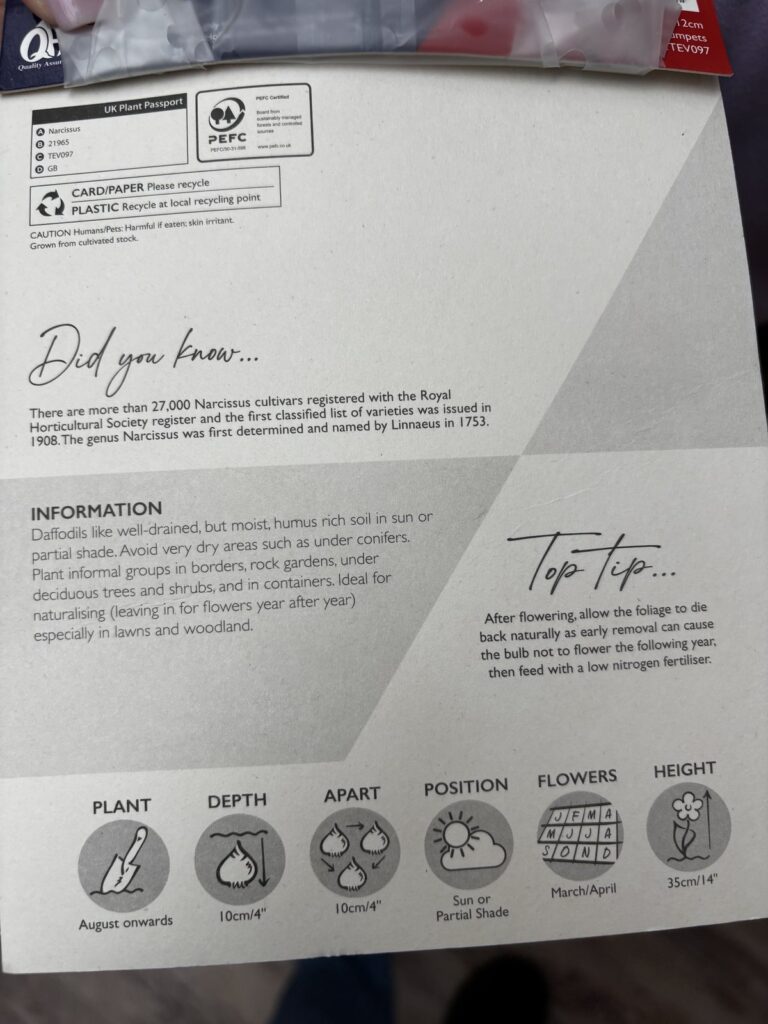
Depth is the thing people get wrong, and the answer is usually printed on the back of the packet — it just never gets turned over. The one above, on the rack at Tates in Newhaven on 29 August 2026, gives the whole recipe in six icons: plant from August onwards, 10cm deep, 10cm apart, sun or partial shade, flowering March to April, finishing at 35cm. Before you measure anything, turn the packet over — the grower has already answered it for that exact variety.
If you have a dog or cat: daffodil bulbs in particular, and tulips and alliums too, are poisonous to pets if eaten. Store unplanted bulbs out of reach and clear up any left on the soil after planting.
How Deep to Plant Spring Bulbs
The general rule is: plant bulbs at a depth of two to three times their own height. A tulip bulb 5cm tall goes in 10–15cm deep. A crocus corm 2cm tall goes in 5–7cm deep. Deeper planting protects bulbs from squirrels and frost.
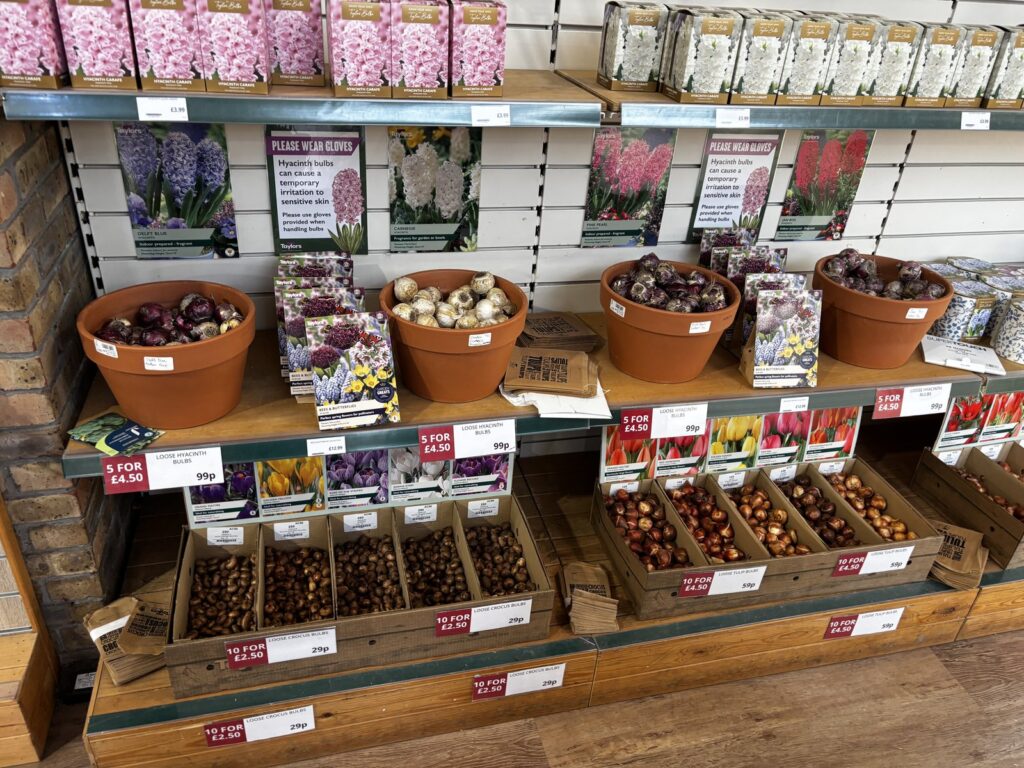
It is worth knowing what loose bulbs actually go for before you order online. At Tates in Newhaven on 29 August 2026, hyacinths were 99p each or five for £4.50 and tulips 59p each or ten for £4.50 — so the tulip multibuy takes about a quarter off the single price, while the hyacinth one saves under a tenth. Pre-packed collections ran higher: £5.99 a pack, or three for £12, a larger wall at two for £14, and a mixed pollinator collection at £12.99. Loose has one advantage the packets do not: the trays were labelled by variety — Grand Maitre, Jeanne d’Arc, Flower Record — so you can pick named crocuses singly rather than take an anonymous mix.
Soil and drainage: the thing that decides it
Bulbs rot in waterlogged ground, so drainage matters more than feeding. On heavy soil, work a handful of sharp grit into each planting hole (or across the whole bed), and raise the bed slightly if water sits on it. Bulbs don’t want rich soil: too much nitrogen gives leaves at the expense of flowers. If you feed at all, use a low-nitrogen, high-potash feed such as tomato food as the shoots come through in spring.
Bulbs in pots
Pots give you full control of drainage and position. Use a free-draining mix (roughly half general-purpose compost, half grit or perlite), check the pot has drainage holes, and plant at the proper depth even in a container. Lasagne planting, layering different bulbs at different depths in one pot, gives a run of flowers from February to May. Move pots of tulips under cover in a prolonged hard frost: terracotta can crack and the compost can freeze solid. Daffodils and crocuses are hardier and usually fine left out.
After the flowers
Leave the foliage for at least six weeks after flowering, however untidy it looks: the leaves are feeding next year’s flower back into the bulb. Tulips often fail to flower again in British gardens, so deadhead them straight after flowering (take off the seed head, leave the stem), give a high-potash feed and let the leaves die back fully. Lifting tulips to store somewhere cool and dry over summer, then replanting in autumn, gives more reliable results in a wet garden.
Quick planting checklist
- Pointy end up, flat end down.
- Depth: two to three times the bulb’s height.
- Grit under each bulb on heavy soil.
- Plant in groups of five or more for impact.
- No need to water in unless the soil is very dry: autumn rain usually does it.
- Wire mesh or sharp grit on the surface deters squirrels.
- Let the foliage die back naturally after flowering.
Where to Buy Good Bulbs
Quality matters with bulbs — larger, firmer bulbs produce more flowers. The best bulbs come from specialist Dutch suppliers and UK garden centres in September and October. Specialist online suppliers (Dutch Grown, Sarah Raven, Peter Nyssen) offer excellent quality at fair prices.
View bulb collections at Peter Nyssen →
View spring bulb collections at Thompson & Morgan →
Related Guides
- October Allotment Jobs UK
- Garlic Planting UK: The October Job Worth Doing
- Best Garden Tools UK
- Best Compost Bins UK
How We Research and Choose
These recommendations draw on more than 15 years of growing — the last three on an East Sussex allotment — alongside verified UK grower reviews and RHS variety guidance. The cultivar suggestions are chosen for proven reliability, how well they naturalise and their flowering time, and the planting depths follow the RHS rule of two to three times the bulb’s height.
Common Questions
When should I plant autumn bulbs in the UK?
Most spring-flowering bulbs should be planted between September and November. Daffodils and crocuses can go in from September. Tulips are best left until late October or November to reduce the risk of tulip fire disease.
How deep should I plant bulbs?
The general rule is two to three times the height of the bulb. So a 5cm bulb goes about 10–15cm deep. Plant with the pointed end facing up. If you are not sure which end is up, plant on its side — the shoot will find its way.
Can I plant bulbs in pots?
Absolutely. Use a good peat-free compost with some grit mixed in for drainage. Plant them slightly closer together than you would in the ground for a fuller display. Make sure the pot has drainage holes and protect from heavy frost over winter.
Do I need to dig up bulbs after flowering?
Most hardy bulbs like daffodils, crocuses, and snowdrops can be left in the ground to come back year after year. Tulips are the main exception — many varieties decline after the first year unless lifted, dried, and stored over summer.
Last reviewed: June 2026
Further Reading
📖 From the D&L Shop: Looking for a calmer way to organise your week? Our Calm Week Planner is designed for people who want structure without pressure — printable, fillable, and tablet-optimised versions included. £3.99. Browse the full shop →
— Gareth
🛡 Our standards: How we research · Editorial policy · Affiliate disclosure · Corrections · Last reviewed: June 2026

About Gareth
Gareth Isherwood is the editor of Danbury & Lovejoy. He has baked bread at home for 25+ years and has 15 years of growing experience across gardens, containers and other growing spaces, including an East Sussex allotment for the past three years. Read his full story →
Was this useful?