When a heatwave hits, the question isn’t just “fan or air conditioner?” — it’s “what will it do to my electricity bill?” We ran the numbers at the current UK price cap so you can decide with your eyes open. The short version: a fan costs about a penny an hour; a portable air conditioner costs roughly ten to fifteen times that, and over a pound a night once it’s cycling. Whether that’s worth it depends entirely on how badly you’re sleeping.
Running costs updated October 2026 against the current UK energy price cap.
The headline figure: at the October–December 2026 price cap (26.32p/kWh), a tower fan costs roughly 1–2p an hour to run. A portable air conditioner costs about 13–20p an hour — and around £1.05–£1.58 for an eight-hour night once you account for the compressor cycling. Over a two-week heatwave that’s about £15+ on the AC versus around £1.50 on a fan.
What each costs to run
| Appliance | Typical power | Cost per hour | Cost per 8-hour night |
|---|---|---|---|
| Tower / pedestal fan | ~50W (efficient DC fans far less) | ~1–2p | ~10–16p |
| Evaporative cooler | ~60–80W | ~2p | ~13–17p |
| Portable air conditioner | ~1,000W (cycles on/off) | ~13–20p | ~£1.05–£1.58 |
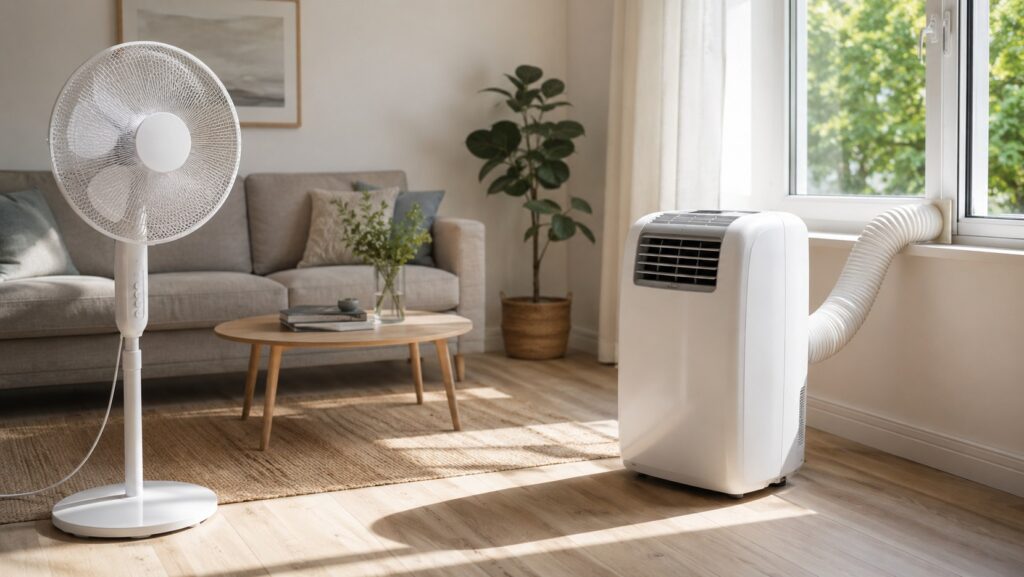
The gap is stark because the appliances do fundamentally different jobs. A fan just moves air — it doesn’t cool it, but moving air over skin feels several degrees cooler, for almost nothing. A portable air conditioner genuinely lowers the room temperature, which takes a compressor drawing around 1,000W — comparable to a small fan heater. An evaporative cooler sits in between: it adds moisture to cool the air slightly, sips electricity, but does little in the humid air of a British summer.
How we worked it out
Figures use the Ofgem price-cap electricity unit rate of 26.32p/kWh (1 October–31 December 2026, direct debit; electricity carries no VAT from 1 October 2026 to 31 March 2027). Costs assume an eight-hour overnight run. The portable-AC figure accounts for the compressor cycling on and off to hold a temperature rather than running flat out — the A-rated ~1,000W units in our buying guide use roughly 4–6kWh across a night, not the 8kWh a constant 1,000W draw would imply. Fan figures use 50W, typical for a tower or pedestal fan; efficient DC-motor fans run on far less again — the MeacoFan 1056 draws 9.5–23.5W, which is about 0.25p an hour on low and still under 1p an hour flat out. Your own rate may differ — check your latest bill for your unit price and scale accordingly.
So which should you use?
For most people, most of the time: a fan. At a penny or two an hour it’s the obvious first move, and a good one genuinely makes a hot room sleepable. See our pick of the best electric fans for UK homes.
For the genuinely unbearable nights — or a bedroom that bakes: a portable air conditioner. It costs more to run, but “more” is £1.05–£1.58 a night, not the small fortune people fear. Run it hard for twenty minutes to drop the room before bed, then ease it back, and the cost stays reasonable. Our guide to the best portable air conditioners covers what to look for and the running cost of each unit.
“People assume air conditioning is wildly expensive to run — it isn’t, but it’s on a completely different scale to a fan. A fan is a rounding error on the bill; a portable AC is something you run for the worst nights, not all summer. Knowing the real per-night figure is what lets you make that call honestly.”
— Gareth Isherwood, Danbury & Lovejoy
Sources
Rated wattages are taken from manufacturer specifications for representative UK models. All running-cost figures on this page apply the current electricity unit rate from Ofgem’s energy price cap to declared wattages. For wider appliance-energy context see the Energy Saving Trust’s home-appliance advice.
Was this useful?