
✉ Join the Dispatch — a calm weekly note, every Thursday. Free.
There is a particular kind of 2am arithmetic that only happens during a warm spell: lying awake, too hot to sleep, wondering whether the fan whirring away at the end of the bed is quietly costing a fortune. It is a fair question — energy prices have trained us all to be suspicious of anything with a plug. So we have run the numbers properly, against the current Ofgem unit rate, the same way we did for our slow cooker.
Quick answer: running a typical 50-watt pedestal fan for eight hours overnight costs about 11p at the current electricity rate of 26.32p per kWh. A full month of warm nights — every night, all night — comes to a little over £3. By the standards of almost anything else in the house, a fan is a quiet bargain.
Below: what different fans actually draw, the cost per night and per month for each, what the October price cap means for it, and how a fan compares with a portable air conditioner.
What wattage does a fan actually use?
The label on the box gives a maximum wattage, but most of us run a fan on its lower settings overnight, so real-world use is usually below the headline figure. As a guide:
| Fan type | Typical wattage | Notes |
|---|---|---|
| USB desk fan | 3–5W | Fine for a desk, not a bedroom |
| Small desk fan (9") | 25–35W | Enough for one sleeper close by |
| Pedestal fan (16") | 45–60W | The standard bedroom choice |
| Tower fan | 40–60W | Quieter spread, similar draw |
| DC motor fan (e.g. MeacoFan) | 2–14W | Remarkably frugal — see below |
| Large floor/industrial fan | 100–120W | Overkill for sleeping |
The cost per night, worked through
Electricity is billed per kilowatt-hour. The sum is simple: wattage ÷ 1,000 × hours × unit rate. At the current capped rate of 26.32p per kWh (1 October to 31 December 2026, direct debit average), eight hours overnight works out like this:
| Fan | Per hour | Per night (8 hrs) | Per month (30 nights) |
|---|---|---|---|
| USB desk fan (5W) | 0.1p | 1p | 32p |
| Desk fan (30W) | 0.8p | 6p | £1.90 |
| Pedestal fan (50W) | 1.3p | 11p | £3.16 |
| Tower fan (60W) | 1.6p | 13p | £3.79 |
| DC motor fan (14W max) | 0.4p | 3p | 88p |
| Floor fan (110W) | 2.9p | 23p | £6.95 |
Even the greediest fan on this list costs less per night than a first-class stamp. The pedestal fan most UK bedrooms rely on sits at about 11p a night — and if it runs on a lower speed, less than that.
What does the October price cap mean for a fan?
From 1 October to 31 December 2026 the Ofgem price cap sets the average electricity unit rate at 26.32p per kWh — the rate every figure on this page uses. For our 50W pedestal fan, that is about 11p a night, or about £3.20 for a month of warm nights. Electricity carries no VAT from 1 October 2026 to 31 March 2027, which makes this period hard to compare directly with earlier ones, so we don’t. Worth knowing; not worth losing sleep over. If you want the wider picture on the cap and what to do about it, our guide to the price cap covers it calmly, and our UK Home Running Costs Index prices up every other appliance in the house at the same rate.
Fan vs portable air conditioner
This is where the arithmetic gets interesting. A portable air conditioner draws around 1,000W, but the compressor cycles on and off rather than running flat out, so a realistic night is about 5kWh — roughly twelve times a pedestal fan, not the small fortune people fear. At the current rate that is about £1.32 a night, or a little under £40 a month of warm nights. That is not an argument against ever owning one: on the handful of genuinely sweltering nights a year, a portable unit does something a fan simply cannot, which is actually lower the room temperature. We have reviewed the best portable air conditioners for UK homes if you are weighing one up.
But for the ordinary run of warm summer nights, the honest answer is that a fan plus a few good habits — windows opened at the right times, curtains closed through the afternoon — gets most UK bedrooms comfortable for a fiftieth of the cost. Our guide to keeping a house cool without air conditioning walks through the routine.
How to work it out for your own fan
Find the wattage on the rating plate (usually on the base or the back of the motor housing). Then: wattage ÷ 1,000 × hours used × your unit rate. A 45W fan for 9 hours at 26.32p: 0.045 × 9 × 26.32 = about 10.7p. If you pay by prepayment meter or live in a region with a higher rate, the answer moves by a penny or so either way.
Five ways to spend even less
1. Use the timer. Most of us fall asleep within the first hour or two; a fan with a sleep timer that switches off at 2am halves the cost and you will rarely notice. 2. Drop a speed setting. The difference between speed 3 and speed 1 is often 20W or more — and at 2am, speed 1 is usually plenty. 3. Consider a DC motor fan. Models like the MeacoFan use a fraction of the power of a conventional motor — as little as 2–3p a night at full tilt.
Our Meaco fan guide compares the range. 4. Cool the sleeper, not the room. A fan pointed across the bed does more for comfort than one stirring the whole room. Pair it with a lighter summer duvet and the fan can work less hard. 5. Shut the heat out earlier. The cheapest cooling is the heat that never got in — our bedroom heatwave guide covers the afternoon routine that makes the night easier.
Which fan would we actually buy?
If you are starting from scratch, our guide to the best electric fans for UK heatwaves covers the field, and the best pedestal fans round-up focuses on the quiet ones — because at 2am, noise matters more than wattage. For the bigger picture on staying comfortable through a hot spell, the UK heatwave guide pulls everything together.
If you want a specific suggestion for a quiet bedroom fan, the one we would point a friend at is the Dreo 20dB Silent Tower. It is a tower rather than a pedestal, rated at 20dB on its lowest setting, with eight speeds, a sleep mode and an eight-hour timer — which, per the list above, is the single easiest way to halve what it costs you overnight.
Note: the Dreo 20dB Silent Tower stays our suggestion. Some Dreo towers sold alongside it are 28dB four-speed models rather than this 20dB eight-speed one, so check the model before you buy. Our best electric fans guide and pedestal fans guide have the other fans we rate.
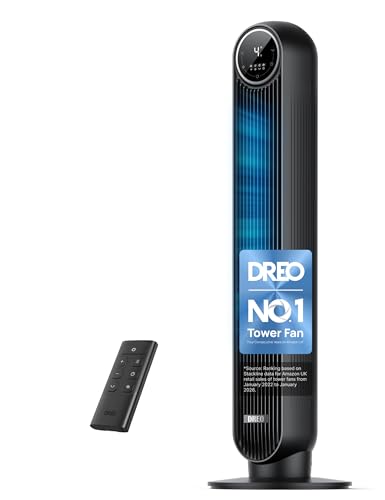
DREO 20dB Silent Tower Fan, 28 ft/s Velocity Electric Cooling Fan with Remote, 90° Oscillating 8 Speeds 4 Modes 8H Timer LED Display, 220-240V, Black
Frequently asked questions
Is it safe to leave a fan running all night?
A modern fan in good condition, placed on a stable surface with clear space around the motor vents, is designed for exactly this. The sensible precautions are the obvious ones: don’t drape anything over it, keep the blades and grille free of dust, and retire a fan whose cable or plug has seen better days. If you prefer extra reassurance, use the timer.
Does a fan use a lot of electricity?
No — fans are among the cheapest appliances in the house to run. A typical bedroom fan uses less electricity in a night than a kettle uses making two pots of tea. The expensive cooling appliance is the portable air conditioner, at roughly twelve times the draw over a night.
Is it cheaper to run a fan all night or just open the window?
An open window is free, so if the air outside is cooler than the bedroom — as it usually is after midnight — start there. The fan earns its 11p on the still, muggy nights when there is no breeze to invite in, or when street noise or pollen makes an open window unappealing.
The bottom line
At around 11p a night — call it £3 for a month of warm nights — a fan is one of the few comforts that costs less than it feels like it should. Spend your worry elsewhere, sleep with the fan on, and if you are choosing a new one, choose for quietness first and wattage second.
Was this useful?