

✉ Join the Dispatch — a calm weekly note, every Thursday. Free.
For deeper cooling pair with our recommended portable AC units or the quieter bedroom heatwave routine.
A good pedestal fan is the single most effective piece of cooling kit for a UK home that doesn’t want an air-con unit. It moves air across the whole room rather than just one chair, the better models stay quiet enough to sleep through, and a £60 fan will pay for itself over one warm summer in better sleep alone. This guide covers the five pedestal fans worth buying for UK homes in 2026 — from a sub-£45 budget pick that doesn’t sound like a hairdryer to a pedestal quoted at 20 dB on its lowest setting. Picks are chosen for noise level, oscillation pattern, and whether they will still be running quietly five summers from now.
Jump to a section
How we chose these pedestal fans
Pedestal fans get harder to buy every year. Listings throw out “9 speed settings” and “120° oscillation” without telling you what the lowest setting actually sounds like, and the cheap end of the market has converged on the same OEM Chinese factory output rebadged ten different ways. We picked the five fans below by looking at four things that matter for a British home: a published noise figure under 50 dB on the lowest speed (anything above turns into a sleep problem), a sturdy enough base to survive being knocked by a passing pet or child, oscillation that genuinely covers a room rather than just sweeping a 30° arc, and a track record of holding up across multiple summers in real owner reviews rather than the first week of unboxing footage.
One honesty note: a pedestal fan can’t cool a room — it can only move air. The cooling effect comes from the air evaporating sweat off your skin and from breaking up the warm stagnant layer near the ceiling. That makes a fan brilliant for an occupied room and useless for an empty one. If the heat is genuinely extreme — three weeks of 30°C plus — a portable AC is the right tool. For everything below that, a quiet pedestal fan is the answer.
The five pedestal fans worth buying
Best quiet bedroom pick
DREO 20 dB Silent Tower Fan

DREO 20dB Silent Tower Fan
Best for: light sleepers and bedrooms, and anyone who wants a fan quiet enough to sleep next to.
Dreo is the brand that quietly dragged the £80–£120 fan tier upmarket. The 20 dB Silent tower fan does what it says on the box — published noise figure of 20 dB on lowest, eight speeds with 90° oscillation, and an auto mode that steps the speed up and down for you. It runs on a DC motor, has a Sleep mode that mutes it and switches the display off, an eight-hour timer and a remote, and it is the quiet fan we would buy for a bedroom today. It is a tower rather than a pedestal, so it sits on the floor at a fixed height; if you need the head up at bed or sofa height, DREO’s 42-inch pedestal in pick 2 does that, and it quotes the same 20 dB.
What it doesn’t have: a long track record. Dreo as a brand is six or seven years old in the UK, and we don’t yet know how the 2026 generation will look in 2031. If you upgrade fans every five years that’s fine. If you want one to outlast a marriage, a Meaco is the safer call — see Meaco vs Dreo below.
View the DREO 20 dB Silent Tower Fan on Amazon
Best quiet pedestal
DREO 20 dB 42" Pedestal

DREO 20 dB Silent 42-inch Pedestal Fan
Best for: light sleepers who want the air at bed or sofa height rather than from the floor.
This is the pedestal version of the DREO in pick 1, and DREO quotes the same 20 dB for it, with a button on the remote that mutes the beeps so it doesn’t chirp when you change setting at night. The two are different fans, though. Pick 1 is a 36-inch tower that sits on the floor at one height; this is a bladed 42-inch pedestal whose height adjusts from 38 to 42 inches and whose head pivots through 90° as well as oscillating 90° side to side, so you can aim the air across a bed or over the back of a sofa. It has eight speeds and an auto mode that steps up one speed for every 1.5°C the room warms, an eight-hour timer, and both a top panel and a remote.
The blade and both grilles come off for cleaning, and there’s a holder for an aroma pad (three are in the box), which you can ignore if you’d rather not scent the room. It costs about the same as the tower usually does; choose the tower if you want something slim and fixed, and this one if you want to angle the air and raise it.
View the DREO 20 dB 42" Pedestal on Amazon
Best budget all-rounder
Belaco 16" Pedestal
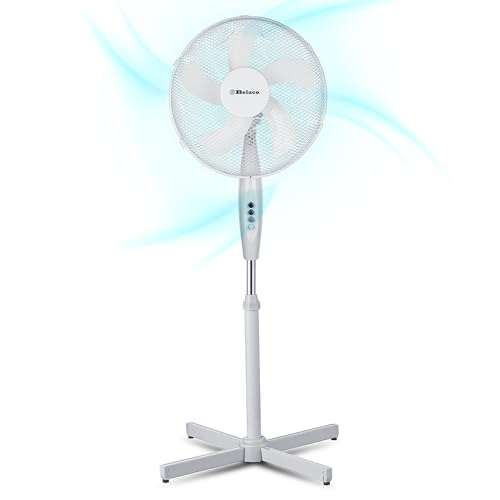
Belaco 16 Inch Pedestal Fan
Best for: a sub-£45 fan that doesn’t sound like a hairdryer.
Belaco is a budget British-market brand that does one thing competently: a plain, sturdy pedestal fan without the app, the display or the price. The 16" Pedestal is the budget pick of this guide: three speeds, 85° oscillation, an adjustable-height telescopic pole, and a published maximum of 45 dB — that is the loudest it gets, not the quietest, which is the more useful number and the one most listings will not give you. It moves a claimed 2,750 m³/h, which is plenty for a bedroom or a small living room. What you give up is the remote, the display and the timer: you change speed by walking over and pressing a button. For a fan that runs in the day rather than through the night, that is a fair trade.
View the Belaco 16" Pedestal on Amazon
Best budget fan with a remote
Belaco 16" Pedestal with Remote

Belaco 16 Inch Pedestal Fan with Remote and 8 Hour Timer
Best for: anyone who likes the plain Belaco in pick 3 but wants to change the speed from the sofa.
This is the same idea as the Belaco in pick 3 — a 16-inch pedestal with three speeds — with the three things that one leaves out: a remote, a digital display and a timer that runs for up to eight hours in half-hour steps. Belaco rates it at 45W and a claimed 2,803 m³/h of airflow through a five-blade head, which oscillates 85° side to side and tilts 30° up and down. It stands on a round base and has a 1.8m cord with a UK plug.
Belaco doesn’t publish a noise figure for this one, so we can’t put it alongside the DREOs as a bedroom fan; treat it as a daytime fan with a remote. It is about twice the price of the pick-3 Belaco, and the remote, display and timer are what that extra buys.
View the Belaco 16" Pedestal with Remote on Amazon
Best no-exposed-blades fan
PureMate 43" Tower Fan

Best for: households with small children or pets, and anyone who hates cleaning fan blades.
Listings sell this kind of fan as “bladeless”, so it’s worth being clear about what that means here. It isn’t a Dyson-style air multiplier: it’s a slim tower whose blades sit inside the column behind a grille, so there is nothing for a small hand to reach and nothing to dust on the outside. That is the reason most people buy one, and it makes a tidier shape in a living room than a chunky 16" pedestal.
The PureMate (model PM760) stands 109 cm tall on a 23 cm square footprint and is rated at 40W. It has three speeds and three modes — Normal, a Sleep mode that steps down to low over 30 minutes, and a “Baby” mode that rises and falls like a natural breeze — plus oscillation, a seven-hour timer and a remote. PureMate doesn’t publish a noise figure or an oscillation angle, so it can’t sit alongside the DREOs as a measured bedroom pick.
A tower like this moves less air than a bladed pedestal, so don’t expect it to outperform the fans above. What you’re paying for is the shape and the safety profile; there is no app, just the handset.
View the PureMate 43" Tower Fan on Amazon
Noise comparison: what the fan actually sounds like at night
| Fan | Lowest setting | Highest setting | Sleep-friendly? |
|---|---|---|---|
| DREO 20 dB 42" Pedestal | 20 dB | not published | Yes — joint quietest here |
| DREO 20 dB Silent Tower Fan | 20 dB | not published | Yes — joint quietest here |
| Belaco 16" Pedestal with Remote | not published | not published | Unknown — no figure published |
| Belaco 16" Pedestal | not published | 45 dB | Day use; light sleeper may notice at night |
| PureMate 43" Tower Fan | not published | not published | Unknown — no figure published |
For reference: 20 dB is a quiet bedroom with no fan; 30 dB is a whisper; 40 dB is light rain; 50 dB is a quiet office; 60 dB is normal conversation. Anything above 50 dB tends to disturb sleep for most people, though some prefer the white-noise effect.
Meaco vs Dreo: which quiet fan should you buy?
The two names that come up most when readers ask us about a quiet bedroom fan are Meaco and Dreo, and on paper they look the same: both publish a noise floor of about 20 dB on the lowest speed, both use a DC motor, and both sit in the £80–£120 band. The differences are in what surrounds that number.
Meaco is a British company with a long record in UK homes. The MeacoFan 1056 is the fan we rate as the quiet bedroom benchmark: around 20 dB on its lowest speed, and about 15W. Its Sefte range adds a 10-inch table fan and a cordless pedestal (the Sefte Pro). Our Meaco fan guide compares every model.
Dreo is the newer brand, six or seven years old in the UK, and it competes on features for the money: a brushless DC motor, eight speeds, an auto mode, and app and voice control on the smart models. The 20 dB Silent Tower in pick 1 and the 42-inch 20 dB pedestal in pick 2 are both well priced. What Dreo cannot yet offer is a ten-year track record.
Which one? For a bedroom fan you expect to keep for a decade, the Meaco 1056 is the safer buy and worth the wait. If you want app control, a tower shape, or the lower price today, Dreo is the better-specified fan for the money. Either is genuinely quiet enough to sleep beside; if you can, buy before the next warm spell rather than during it.
Pedestal fan setup that actually helps
- Place it across the room from the bed, not next to it. A fan blowing directly on you all night dries your throat and dehydrates you. Place it 2–3m away pointing across the bed, with oscillation on, so air moves over you rather than at you.
- Open windows on opposite sides of the house. A fan placed near an open window in the cooler side of the house, pointing inward, plus an open window in the warmer side creates a cross-breeze. This is the single most effective UK cooling trick and most households never try it.
- Use the oscillation, even if you don’t like it. A fixed-direction fan only cools the strip of air in front of it. Oscillation breaks up the stagnant warm layer near the ceiling and against the walls — that’s where the cooling effect comes from in a still room.
- Run it on lowest speed overnight. Most people set the fan too high and then can’t sleep. Lowest speed, oscillation on, 2m away — that’s the configuration that drops perceived bedroom temperature by 2–3°C without waking anyone.
- Pair with a cool-shower routine. A 30-second cool shower before bed drops your core temperature by half a degree; the fan then keeps it there. We cover the full overnight cooling routine in our bedroom heatwave guide.
- Clean the blades twice a season. A dusty fan blade moves less air and rebalances itself, which is when the rattle starts. A wipe with a damp cloth every six weeks keeps the air output up and the noise figure down.
FAQ: Pedestal fans (UK)
Are pedestal fans better than tower fans?
For air movement per pound, yes — a 16" pedestal fan moves substantially more air than a tower fan of similar wattage, because the larger blade and grille can shift more cubic metres per minute. Tower fans win on appearance and on placing-against-a-wall in a small space. If cooling efficiency is the priority, get a pedestal.
How quiet is "quiet" for a fan?
Genuinely quiet means under 30 dB on the lowest setting — quieter than a whisper. Both Dreo 20 dB fans here achieve this. Most fans labelled “silent” are 40–50 dB, which is closer to light rain than silence. Check the published dB figure on the lowest setting, not the marketing claim.
Does running a fan overnight cost much in electricity?
No — a typical pedestal fan draws 30–60 W on its lowest setting, which is around 1–2p per hour at 2026 UK rates. A full overnight run costs less than a tea bag.
Can a pedestal fan cool a hot room?
Not directly. A fan moves air without changing its temperature — the cooling effect comes from air evaporating moisture off your skin. In a 32°C room with no air movement, a fan will still help you feel cooler by 3–5°C. But it won’t drop the actual air temperature. For that you need a portable AC unit.
Are bladeless fans worth the money?
For households with toddlers or pets, yes — the safety profile is genuinely different. For everyone else, the bladed equivalent moves more air per watt and costs less. The PureMate 43" tower in pick 5 is the value pick if you want no exposed blades; the Dyson Cool tower fan is the design-statement option but moves no more air than the budget Belaco.
What size pedestal fan do I need?
For a standard UK bedroom (12–18m²), a 16" head is the right size. For a living room or open-plan kitchen-diner, a 16–20" head will move enough air. Don’t oversize for a bedroom — a bigger fan is harder to position discreetly and rarely runs above its lowest setting anyway.
The bottom line on UK pedestal fans
If you sleep lightly and want a fan you can run at 20 dB next to the bed, the DREO 20 dB Silent Tower Fan is the one to buy today — a DC motor and a published 20 dB floor, with a slightly less proven brand history. If you want the head up at bed height, DREO’s 20 dB 42" Pedestal quotes the same 20 dB, adjusts from 38 to 42 inches and pivots to aim the air. The Belaco 16" Pedestal is the honest budget call for a daytime fan, and the Belaco 16" Pedestal with Remote adds a remote, display and timer for about twice the price. For households with small children, the PureMate 43" Tower Fan keeps its blades out of reach and trades some air output for it, with a remote rather than an app.
Last reviewed: 12 October 2026
A pedestal fan is the cheapest way to feel cooler, but it has limits. See the full UK Heatwave Guide 2026 for when a fan stops being enough.
— Gareth
Sources
Height range, airflow, rated wattage and noise figures are taken from manufacturer specifications and cross-checked against verified UK buyer reviews. Running costs apply the current unit rate from Ofgem’s energy price cap to declared wattages. Advice on staying cool safely follows NHS guidance on coping in hot weather.
Was this useful?