
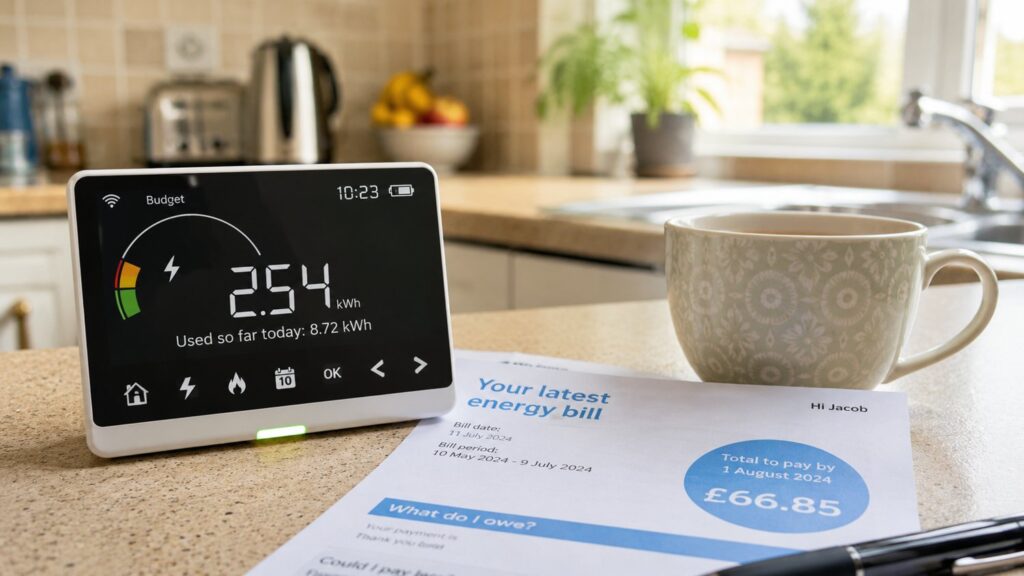
The UK energy price cap is one of those things that gets mentioned constantly in news coverage but rarely explained properly. Most people have a vague sense that it limits what energy companies can charge, but the details — what it actually caps, how it’s calculated, and what it means for your bill — tend to get lost in the coverage.
Here’s a plain-English explanation of how it works, why your bill still varies despite it, and what to do if energy costs are genuinely causing you difficulty.
The price cap right now: 1 October to 31 December 2026
For a typical household paying by Direct Debit, the cap is £1,723 a year from 1 October, up 4% from £1,663 over the summer. These are the capped rates, averaged across Great Britain:
| Unit rate | Standing charge | |
|---|---|---|
| Electricity | 26.32p per kWh | 54.83p a day |
| Gas | 7.97p per kWh | 29.68p a day |
One change matters more this winter than the 4%: there is no VAT on electricity from 1 October 2026 to 31 March 2027. The government has cut it from 5% to zero, on every tariff, capped or not. Gas still carries 5%. So if you compare what an electric heater or tumble dryer costs to run this winter with a figure from earlier in the year, part of the difference is the VAT, not the appliance.
Your own rates depend on your region and how you pay. Ofgem lists them by area.
What the price cap actually limits
Despite the name, the energy price cap does not limit the total amount you pay for energy. It limits the unit rates and standing charges that suppliers can charge — which means your actual bill will still vary based on how much energy you use.
Specifically, Ofgem (the energy regulator) sets a maximum price per kilowatt-hour (kWh) for gas and electricity, and a maximum daily standing charge. Suppliers cannot charge more than these rates on standard variable tariffs. If you use more energy, you pay more — the cap just prevents the rate per unit from exceeding a certain level.
The figures you see reported in the media — “the price cap rises to £1,723” — represent what a typical household (since July 2026, Ofgem’s definition is 2,500 kWh of electricity and 9,500 kWh of gas a year) would pay at the capped rates. It’s a benchmark figure, not a ceiling on your personal bill.
How often does it change?
The price cap is reviewed quarterly — in January, April, July, and October. Each review sets new maximum unit rates based on wholesale energy market prices, network costs, and other factors. This means your tariff rates can change four times a year if you’re on a standard variable tariff.
When wholesale gas prices rise sharply (as happened in 2021–2022), the cap tends to rise. When wholesale prices fall, the cap can decrease. However, there can be a significant lag between wholesale price movements and the cap adjustment, which is why the cap sometimes feels out of step with energy market news.
Does the price cap apply to all tariffs?
No. The price cap applies to standard variable tariffs (SVTs), which is the default tariff most households are placed on if they don’t actively choose a fixed deal.
Fixed-rate tariffs are not covered by the price cap. If you lock in a fixed deal, your rates are set by the contract terms you agreed — they could be above or below the cap, depending on when you fixed and what the market was doing at the time.
Whether a fixed deal beats the cap changes from month to month, so compare the unit rates and standing charges side by side before you sign. Whether to fix depends on your view of where prices are heading and your appetite for predictability versus flexibility.
Why your bill might still feel high
Even with a price cap in place, energy bills remain one of the largest household expenses for many UK families. Several factors explain why costs still feel high despite the regulation:
- Standing charges have risen substantially — the fixed daily charge you pay regardless of usage has increased significantly in recent years. At this winter’s average capped rates, standing charges alone come to about £310 a year for a home with both gas and electricity, before using a single unit of energy. Standing charges cover network maintenance and policy costs.
- Older, poorly insulated homes use more energy — the UK has one of the oldest housing stocks in Europe, and many homes lose heat quickly. The same temperature requires more gas in a draughty Victorian terrace than in a modern insulated flat.
- The cap is set for a “typical” household — families with more people, those who work from home, or those using electric heating will typically exceed the “typical” usage figure and therefore pay more than the headline cap figure.
Support available if you’re struggling
If energy costs are causing genuine financial difficulty, several support mechanisms exist in the UK:
The Warm Home Discount — a one-off £150 off your electricity bill for eligible households. It reopens for winter 2026 to 2027 this October. In England and Wales it is usually applied automatically if you qualify; in Scotland you may need to apply to your supplier. GOV.UK explains who qualifies.
Priority Services Register — if you have a medical condition, disability, or are of State Pension age, you can register with your energy supplier for additional support including advance notice of planned outages and free meter moves. This is free and available from all suppliers.
Energy supplier hardship funds — most major UK energy suppliers maintain discretionary funds for customers in genuine difficulty. These can provide bill credits or debt write-offs. Contact your supplier directly and ask what hardship support is available.
ECO4 scheme — government-funded home insulation and heating upgrades for households on qualifying benefits or low incomes. Can include free loft insulation, cavity wall insulation, or boiler replacement. It is open until 31 December 2026, when the government’s Warm Homes Plan takes over. Check eligibility via the government website or contact your local authority.
Debt repayment arrangements — if you’ve fallen behind on energy bills, suppliers are required by Ofgem to offer affordable repayment plans rather than immediate disconnection. If you’re struggling, contact your supplier before the debt grows — they’re obliged to work with you.
What you can do regardless of the cap
The price cap sets a ceiling on rates but doesn’t reduce your consumption. The most effective thing most households can do to reduce bills remains the same regardless of what the cap is set at: use less energy through better habits, draught-proofing, smarter heating scheduling, and appliance efficiency.
A typical household that cuts its gas use by 15% saves about £115 a year at this winter’s capped rate. That saving persists regardless of where the cap moves in future quarters.
💰 From the D&L Shop: Ready to take control of your household budget? Our Household Budget Reset is a 5-page printable workbook covering income, outgoings, spending, and savings goals — £3.99. Also free: the Weekly Budget Meal Planner to cut your food bill. Browse the full shop →
🛡 Our standards: How we research · Editorial policy · Affiliate disclosure · Corrections · Last reviewed: October 2026

About Gareth
Gareth Isherwood is the editor of Danbury & Lovejoy. He has baked bread at home for 25+ years and has 15 years of growing experience across gardens, containers and other growing spaces, including an East Sussex allotment for the past three years. Read his full story →
Was this useful?