
Some of the links below are affiliate links: if you buy through them we may earn a small commission at no extra cost to you. As an Amazon Associate I earn from qualifying purchases. We only suggest things we would recommend to a friend — see our affiliate disclosure and how we research.
✉ Join the Dispatch — a calm weekly note, every Thursday. Free.
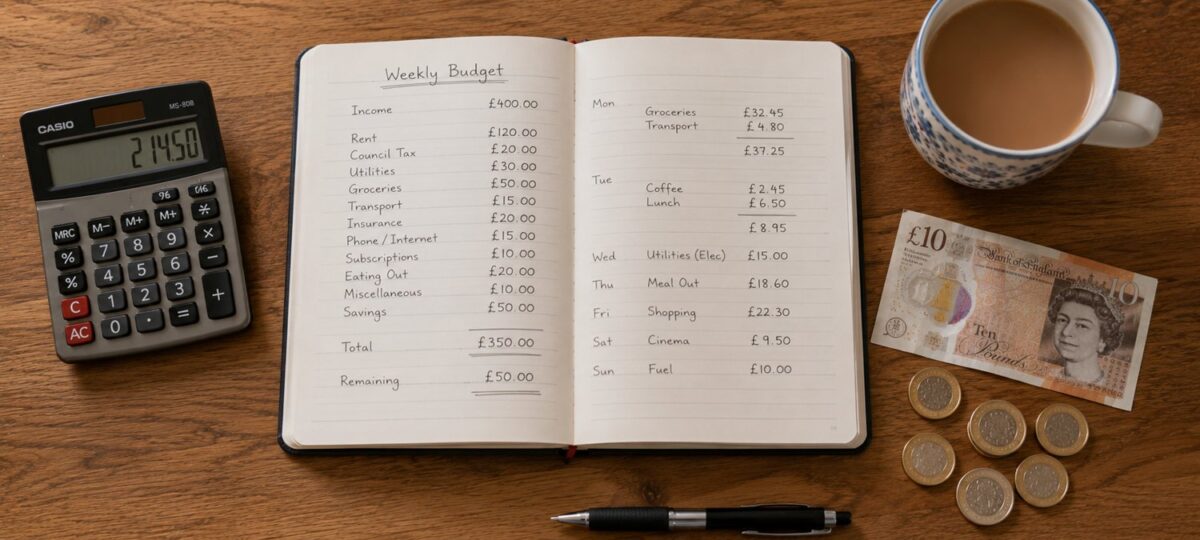
Creating a weekly budget in the UK is one of the most useful financial habits you can build — simple, consistent and far more effective than a monthly overview alone.
A monthly budget looks tidy on paper but often falls apart in practice. The problem is that most people don’t think in months — they think in weeks. Rent arrives monthly, but grocery shops happen weekly. The school run is daily. When everything is abstracted into a monthly total, it’s easy to lose track of where you actually stand.
A weekly budget is more immediate and, for most people, much easier to manage. Here’s how to build one that reflects your real life.
Why Weekly Budgeting Works Better Than Monthly
Weekly budgeting has a few key advantages. First, the time horizon is short enough that small decisions feel meaningful. If you know you have £80 left for the week, spending £15 on a takeaway feels consequential in a way it doesn’t when you’re thinking in monthly totals.
Second, it matches natural shopping patterns. Most UK households do a main shop once a week, making it straightforward to align your budget with that rhythm. For the broader picture, see our UK household budgeting guide. Third, if a week goes badly, you start fresh on Monday rather than writing off the whole month.
Before You Start: A 20-Minute Glance, Not an Audit
Before building anything, it helps to see where the money is actually going now. Open your banking app and scan the last 30 days. You’re not judging yourself, you’re spotting patterns: your three biggest spending categories (often rent or mortgage, food, transport), any surprises (subscriptions, top-ups, takeaways), and any bills that fluctuate (energy, water, childcare, petrol). This baseline is what makes the steps below feel realistic rather than theoretical, and it usually turns up at least one thing you’d half-forgotten about.
Step One: Calculate Your True Weekly Income
Start with your actual take-home pay after tax, National Insurance, and any pension contributions. If you’re paid monthly, divide by 4.33 (not 4) to get your average weekly figure. Many people use 4 and end up short — there are 52 weeks in a year, not 48.
If your income varies — freelance work, zero-hours contracts, variable overtime — use a conservative estimate based on your lowest recent weeks rather than your best. It’s always better to budget for less and have money left over than to budget for more and run short.
If you have a partner, decide whether you’re combining income into one household budget or keeping some money separate. Either works — what matters is being clear and consistent about the split.
Step Two: Identify Your Fixed Weekly Costs
Some expenses are the same every week regardless of what you do. These go into your budget first because you have no choice about them.
Monthly bills — rent or mortgage, council tax, broadband, subscriptions — need to be converted to a weekly equivalent. Divide the monthly total by 4.33. So if your fixed monthly outgoings come to £1,000, that’s roughly £231 per week that’s already committed before you make any decisions.
Also include any annual expenses you tend to forget until they hit. Car insurance, TV licence, home insurance, MOT — divide the yearly total by 52 and treat that as a weekly fixed cost. Building a sinking fund for these throughout the year means they don’t derail you when they arrive.
Step Three: Set Your Variable Spending Envelopes
Once fixed costs are covered, what’s left is your discretionary budget — the money you actively decide how to spend each week. The most common categories for UK households are:
- Groceries — including household supplies, toiletries, and cleaning products
- Transport — fuel, public transport, parking
- Eating out and takeaways — often worth separating from groceries to see clearly what’s being spent
- Personal spending — clothes, haircuts, small treats, things that are yours alone
- Children’s expenses — if applicable: school meals, clubs, birthday parties, uniform replacement
Set a realistic weekly amount for each category — not an aspirational one. Look at what you’ve actually been spending for the last month or two and start from there. You can always tighten later, but starting with an impossible target just leads to abandoning the budget.
Step Four: Protect Your Savings First
If saving money is one of your goals — building an emergency fund, paying off debt, saving for something specific — treat it like a fixed cost, not an afterthought. Decide on a weekly saving amount and move it out of your current account on payday, before you start spending.
Even a small, consistent amount matters more than an unpredictable large transfer when things happen to go well. £10 every week is £520 a year. £25 a week is £1,300. The habit matters as much as the amount.
A simple approach: set up a standing order to a separate savings account that goes out the same day your pay lands. You don’t see it, so you don’t spend it.
If you’re starting from nothing, don’t wait until the split feels perfect. A simple beginner’s goal is a first buffer of roughly £250–£1,000, built in small weekly amounts: enough that one unexpected cost doesn’t have to become new debt, and something to build on once the rest of the budget is in place.
Step Five: Track Mid-Week, Not Just at the End
A budget only works if you check in with it regularly. A quick mid-week review — Wednesday evening is a good habit — lets you adjust your behaviour for the rest of the week rather than simply recording what went wrong on Sunday night.
If you’re halfway through the week and have spent 70% of your grocery budget, that’s useful information. You might plan cheaper meals for the rest of the week or hold off on a non-essential shop. You can only make those adjustments if you’re paying attention.
The tools don’t matter much — a spreadsheet, a notes app, or a physical notebook all work. If you’d like something that connects to your bank accounts automatically, Emma is worth a look — it pulls in your transactions via open banking so you can see exactly where you stand without manual entry. What matters is looking at the numbers regularly enough that they feel real.
If recording things after the fact never quite sticks, try the opposite approach: split your discretionary money into pots at the start of the week (Monzo and Starling both do this natively; with a traditional bank, two or three accounts with clear purposes works just as well) and spend only from those pots. There’s nothing to record, because you can see what’s left, and when a pot runs low, that’s the whole system telling you to ease off.
Handling Irregular Weeks
Some weeks are unavoidably more expensive than others — a birthday, a school trip, a car service. The key is to anticipate as many of these as possible. At the start of each month, scan the calendar for anything unusual in the weeks ahead and adjust your weekly budgets accordingly. A week with a birthday doesn’t have to break the budget if you’ve planned for it.
For genuinely unexpected costs, a small buffer within your weekly budget helps absorb shocks. Many households find that keeping £20–£30 unallocated each week — a “miscellaneous” or “buffer” line — reduces the stress of minor surprises without requiring a rethink of the whole budget every time something small comes up.
Stop the Everyday Leaks
Overspending is rarely one big mistake; it’s usually a string of small, unremarkable ones. Two habits catch most of it. First, go through your bank statement for recurring charges and ask of each one: have you used it in the last month, and would you sign up for it again today at this price? If not, cancel it — you can always resubscribe if you genuinely miss it. Second, add a short pause before any non-essential purchase over a threshold that feels right for you, by adding it to a list and waiting 24 hours rather than buying on the spot. Often the urge fades; when it doesn’t, you buy it as a considered choice instead of an impulse.
A Short Monthly Reset
Alongside the weekly check-in, it’s worth a slower pass once a month or so — a single week rarely tells the full story, and some things only show up when you zoom out.
- Total the last two or three months of statements into broad categories (housing, food, transport, subscriptions, eating out, everything else), without judging as you go: it usually turns up how much subscriptions add up to, and how much a single month can vary.
- If you pay a fixed direct debit for energy or anything else, log in and check whether you’re in credit: suppliers don’t always flag it.
- If the month leaves you with spare room, move it straight into a buffer before it gets spent by default.
A Simple Starting Template
If you’re not sure where to start, here’s a rough template for a household with £500 weekly take-home pay:
- Fixed costs (rent, bills, subscriptions converted to weekly): £200
- Savings/debt repayment: £50
- Groceries: £80
- Transport: £40
- Eating out: £30
- Personal spending: £50
- Buffer/miscellaneous: £25
- Remaining/rollover: £25
Adjust every line to match your actual situation. The proportions matter less than the honesty — a budget that reflects what you actually spend is more useful than a theoretical ideal you’ll never achieve.
Related Guides
Last reviewed: April 2026
💰 From the D&L Shop: Ready to take control of your household budget? Our Household Budget Reset is a 5-page printable workbook covering income, outgoings, spending, and savings goals — £3.99. Also free: the Weekly Budget Meal Planner to cut your food bill. Browse the full shop →
🛡 Our standards: How we research · Editorial policy · Affiliate disclosure · Corrections · Last reviewed: April 2026

About Gareth
Gareth Isherwood is the editor of Danbury & Lovejoy. He has baked bread at home for 25+ years and has 15 years of growing experience across gardens, containers and other growing spaces, including an East Sussex allotment for the past three years. Read his full story →
Was this useful?