There is a particular sinking feeling that comes with the words “temporary use ban”. You picture the tomatoes you’ve nursed since March quietly giving up, the pots crisping at the edges, a whole summer’s work undone by a fortnight of sun. It needn’t go that way. A hosepipe ban changes how you water, not whether you can — and with a little triage most of a garden comes through fine. Here’s how we manage it.
What a hosepipe ban actually stops you doing
A hosepipe ban — properly a Temporary Use Ban — restricts watering with a hosepipe or sprinkler and things like filling a paddling pool or washing the car with a hose. What it almost never stops is watering by hand. A watering can or a bucket is fine, and so is water you’ve collected yourself. Rules vary slightly by water company and the penalties are real, so check your supplier’s exact wording — but for the gardener the headline is simple: the hose goes away, the watering can comes out, and rainwater becomes precious.
- Still allowed: watering cans, buckets, water collected in a butt, and (usually) drip systems fed from stored rainwater.
- Not allowed: hosepipes, sprinklers, soaker hoses on the mains, filling pools and ponds with a hose.
- Always check: your own water company — some bans carve out exceptions for new turf, blue-badge households or registered growers.
Decide what to save — and what to let go
The mistake is trying to keep everything alive equally. You can’t, and you don’t need to. Spend your water where losing the plant would actually hurt. Containers and growbags first — they have no reserves and dry out within a day. Then anything edible and anything planted this year, which hasn’t had time to put roots down. Established shrubs and perennials can be left to fend for themselves; they’ll sulk and recover. And the lawn — let it go brown. A brown lawn is not a dead lawn. It is dormant, and the first proper rain brings it back green within a week or two. Watering grass in a drought is the purest waste of a watering can there is.
Make every watering can go further
Once the hose is off, technique is everything. The goal is to get water down to the roots and keep it there, not to wet the surface and watch it evaporate by lunchtime.
- Water early or late. First thing or after the sun’s off the beds — midday watering mostly feeds the air.
- Deep and infrequent beats little and often. A good soak every few days sends roots down; a daily splash keeps them shallow and thirsty.
- Water the soil, not the plant. Aim the can at the base. A cut-down plastic bottle sunk next to thirsty plants delivers water straight to the roots.
- Mulch everything. A few centimetres of compost, bark or even grass clippings over damp soil can halve how fast it dries out.
- Re-use household water. Washing-up water (let it cool, go easy on anything with bleach), the cold run-off while you wait for the hot tap, the bath — all fine on ornamentals and fruiting plants. Keep heavily soapy water off seedlings and anything you eat raw.
A water butt is the single best investment for a summer like this, and the time to plumb one in is now — even a few days of collected rain buys you a fortnight of hand-watering. If you’re growing through it, our notes on watering an allotment through a heatwave go into the day-to-day of keeping crops productive when it’s genuinely dry.
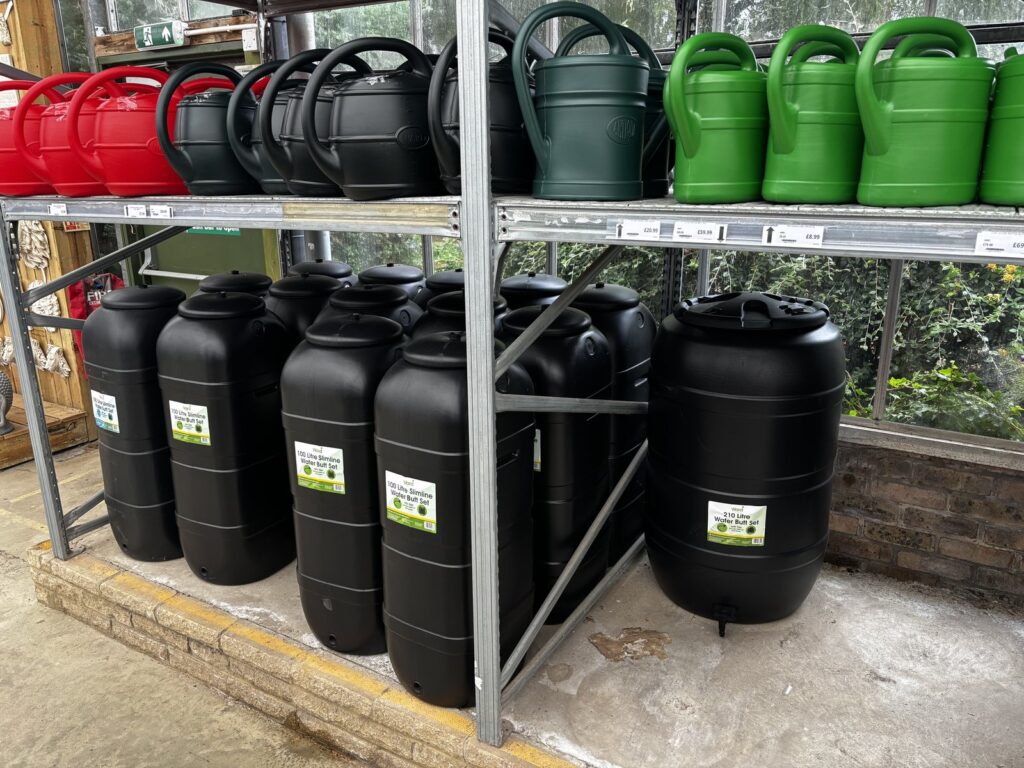
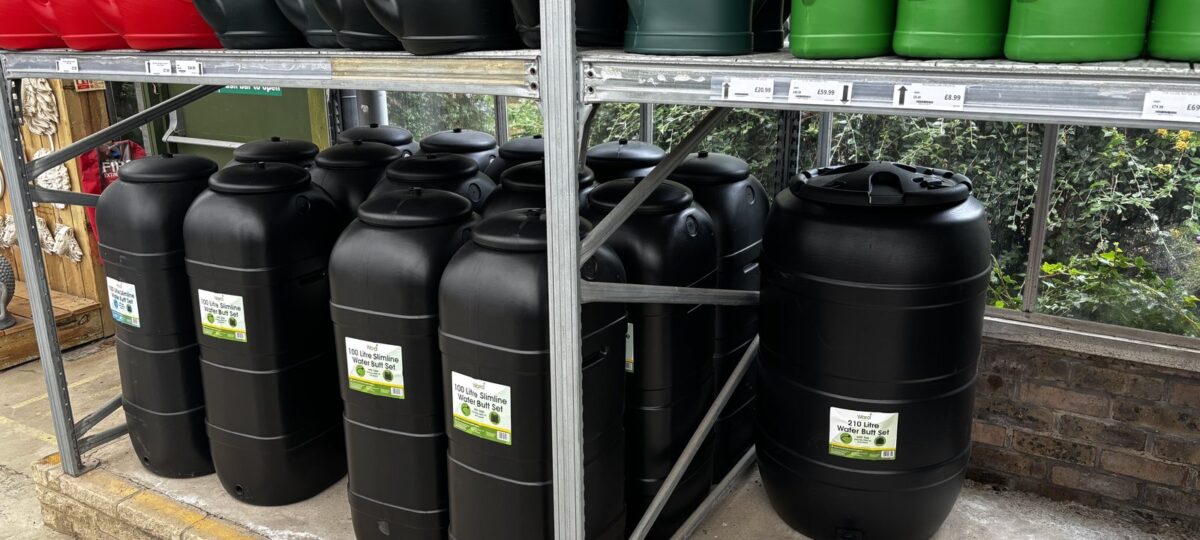
It helps to know roughly what that costs before you go. Looking at the display above — Tates in Newhaven, on 29 August 2026 — the butts came in two sizes — a 100-litre slimline, narrow enough to tuck down the side passage of a house, and a squat 210-litre — and both were sold as sets with the tap included, which matters, because a butt with no tap is just a bin. Water butt kits were ticketed at £34.99 and £59.99, the larger of the two reduced from £69.99. Watering cans on the shelf above ran from £7.99 to £20.99. In other words a butt is about the price of three decent cans.
One thing the photograph shows that a product listing never does: the tap sits low on the barrel, and with the butt standing straight on the ground there is nowhere near enough clearance to get a watering can underneath it. You need to raise it — a proper stand, or a couple of paving slabs and some blocks — and it is worth sorting that out at the same time rather than discovering it once the thing is full and far too heavy to move. Prices are what we saw on the day and will drift; treat them as a guide to the ballpark rather than a quote.
Pots and growbags need their own plan
Containers are the first casualties of any ban and the hardest to keep going by hand, because they dry from every side. Group them together out of the worst of the midday sun so they shade each other and you’re not trekking across the garden with a can. Stand them in saucers or trays so a deep evening water has somewhere to sit and soak back up overnight. If you’re planning next year’s growing around a future of hotter, drier summers, it’s worth choosing your containers with water in mind: pots that hold moisture longest, and self-watering ones, take the daily panic out of a heatwave.
None of this is glamorous, but it works. Triage hard, water the roots, mulch the lot, and let the lawn do its brown thing — and you’ll come out the other side of the ban with a garden that barely noticed.
A ban lands hardest in the school holidays, when everyone is home and the garden is being used.
Was this useful?