The cylinder vacuum is the British design icon. Numatic’s Henry has been made in Somerset since 1981 and still outsells most modern formats. Miele and Sebo make the German equivalents at the premium end. The format suits hard floors, stairs, awkward corners, and households that want a vacuum they’ll keep for twenty years rather than replacing every five. This guide covers the picks worth your money and why cylinder still beats upright in specific situations.
How we chose these cylinders
We compared motor power alongside hose and wheel quality, which is where cheap cylinders fail, required complete-seal HEPA, weighed carrying weight against capacity, and set a realistic price floor around £100. These are researched picks, not first-hand reviews, and we don’t accept payment for placement. Read our full methodology →
What a cylinder vacuum actually is
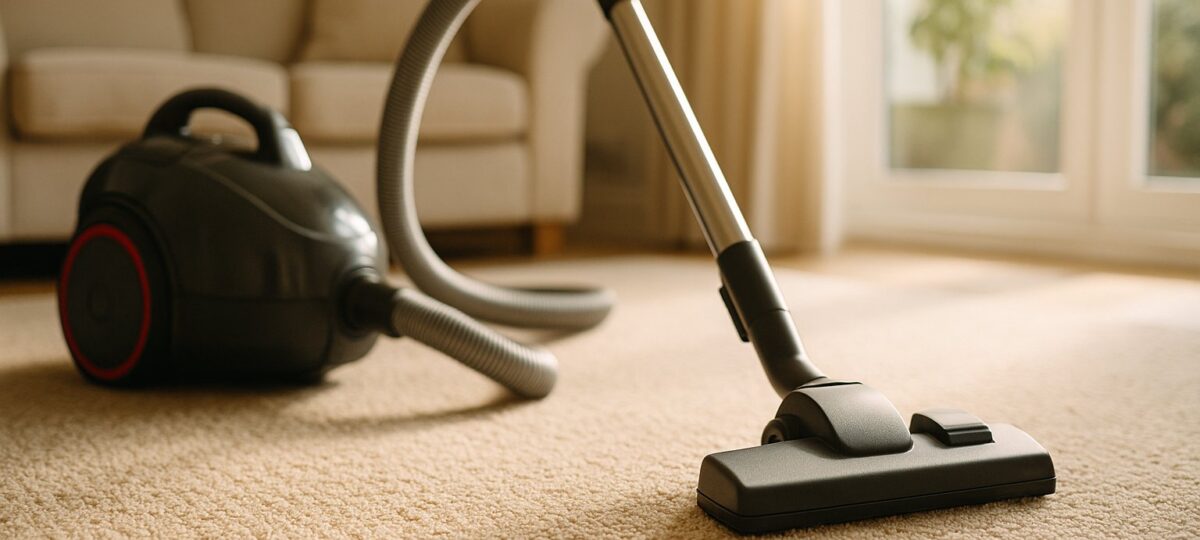
A cylinder vacuum (also called a canister vacuum in some markets) puts the motor and dust collection in a wheeled body that you pull along behind you. The cleaning head is connected by a long flexible hose with a wand and switchable attachments. You hold the wand, not the body.
The format pre-dates the upright but has refused to die for good reason. The wheeled body is lighter to manoeuvre than holding an upright; the long hose reaches stairs, ceilings and awkward corners that an upright struggles with; the larger dust capacity means less frequent emptying; and the simpler mechanism means longer service life. The trade-off is storage — a cylinder vacuum has more parts that need to live somewhere when not in use.
When cylinder wins
Hard floors. A cylinder with a hard-floor brush is the best tool for kitchen tile, hardwood, laminate. Less aggressive than an upright (which can scratch), more thorough than a stick cordless.
Stairs. The body sits on a step, the hose reaches the next step or two without moving the body. Lighter than carrying an upright up and down.
Mixed-surface homes. Carpet and hard floor in the same room, multiple flooring types throughout. The cylinder’s interchangeable heads suit this better than a single-head upright.
Households that keep equipment for decades. A Henry HVR200 lasts indefinitely with care. Replacement parts are everywhere. The annualised cost over 20 years is negligible.
Above-ground cleaning. Ceilings, cornicing, top of wardrobes, lampshades. The long wand and attachments reach where an upright doesn’t.
Wet/dry workshop use. The Henry Wet&Dry and similar models handle small spills, sawdust, paint, water — useful for garage and workshop.
The picks
Some of the links below are affiliate links: if you buy through them we may earn a small commission at no extra cost to you. As an Amazon Associate we earn from qualifying purchases. We only suggest things we would recommend to a friend — see our affiliate disclosure and how we research.
Quick Picks

Henry XL Plus NRV370 Cylinder Vacuum Cleaner, 15 Litre, 620W, Red and Black

Henry Pet PET160 Bagged Cylinder Vacuum Cleaner, 6 Litre, 620W, Green

SEBO Airbelt E1 Komfort +Boost, 92624GB, Cylinder Vacuum, 890W, Dark Blue | Power. Precision. Performance

Bosch Series 2 Bagless Cylinder Vacuum Cleaner, BGS05BU2GB, Turquoise | With Mini AirTurbo Nozzle, Suitable for Hardfloor, Carpet & Car, Compact & Lightweight, 700W, 1.5L
1. Numatic Henry XL Plus NRV370 — Best Overall (~£140)
Henry XL Plus NRV370 Cylinder Vacuum Cleaner, 15 Litre, 620W, Red and Black
The British icon and genuinely brilliant. Made in Somerset, the Henry XL Plus pairs a 15-litre bagged capacity with a 620-watt motor in the iconic red body, so whole-house cleans need far fewer bag changes; the trade-off is a larger body to carry around. A 12.5m cable reaches several rooms from one socket, a sized-down tool handles stairs, pet beds and upholstery, and the self-seal bag tab keeps emptying dust-free. The design is deliberately simple — no fragile features to break, every part replaceable, the same basic vacuum your parents may have owned. A vacuum you can pass to your children.
Affiliate link — we may earn a small commission at no extra cost to you.
Check price on Amazon →
2. Henry Pet PET160 — Best for Pets (~£140)
Henry Pet PET160 Bagged Cylinder Vacuum Cleaner, 6 Litre, 620W, Green
Henry’s pet model keeps the 620-watt motor and the bagged design, with a self-seal tab so the bag locks the dust in when you empty it, in a smaller 6-litre drum. It adds the two things a pet home needs: a pet brush for lifting hair from carpets and stairs, and a charcoal MicroFresh filter that tackles lingering pet odours. It usually costs about the same as the XL Plus at pick 1, so choose the XL Plus for the bigger drum, and this one when pet hair and smells are the main job.
Affiliate link — we may earn a small commission at no extra cost to you.
Check price on Amazon →
3. Numatic WV470 Commercial Wet & Dry — Best for Workshops (~£236–£257)

Numatic L922 Professional Wet 'N' Dry Vacuum Cleaner, WV470 | Heavy-duty professional build delivers powerful suction to tackle spills and debris in demanding workspaces.
A commercial-grade Numatic wet & dry (the L922 / WV470), built for the kind of mess a domestic vacuum should never meet: workshop spills, sawdust, garage debris and standing water. It ships with a wet & dry accessory kit and carries the same rugged Numatic build that makes these machines last. At around £236 to £257 it is a step up in price from the old domestic pick, but it is genuinely commercial kit — the right buy if you run a workshop or garage, or renovate regularly.
Affiliate link — we may earn a small commission at no extra cost to you.
Check price on Amazon →
4. Sebo Airbelt E1 Komfort +Boost — Best Premium (~£348)
SEBO Airbelt E1 Komfort +Boost, 92624GB, Cylinder Vacuum, 890W, Dark Blue | Power. Precision. Performance
Our premium pick: a German cylinder vacuum that is especially well suited to hard floors. The Airbelt E1 Komfort +Boost runs an 890-watt motor with variable power and a boost setting, so you can ease off on delicate surfaces or lift for stubborn dirt. The AIRBELT soft bumper protects walls and furniture, a 3.5-litre Ultra Bag handles hygienic disposal, and S-Class filtration removes 99.97% of particles down to 0.3 microns. Backed by a 5-year parts-and-labour warranty. The right buy if your home is mostly hardwood, tile or laminate with little carpet.
Affiliate link — we may earn a small commission at no extra cost to you.
Check price on Amazon →
5. Bosch Series 2 BGS05BU2GB — Best Bagless Cylinder (~£100)
Bosch Series 2 Bagless Cylinder Vacuum Cleaner, BGS05BU2GB, Turquoise | With Mini AirTurbo Nozzle, Suitable for Hardfloor, Carpet & Car, Compact & Lightweight, 700W, 1.5L
The budget route into a bagless cylinder. This compact, lightweight Bosch runs a 700-watt motor with a 1.5-litre dust container, using AirCycle cyclonic separation to spin dust out of the airflow before returning the air to the room. A mini AirTurbo nozzle handles upholstery and stairs, and a 9-metre cleaning radius covers most rooms. Not in the same league as the Sebo, but a fraction of the price. The right buy if you want cylinder convenience without ongoing bag cost.
Affiliate link — we may earn a small commission at no extra cost to you.
Check price on Amazon →
What to skip
Cheap cylinder vacuums under £80. The motors are underpowered, the hoses kink, the wheels break. The £140 Henry is the realistic floor for a bagged cylinder, and the £100 Bosch for a bagless one.
Bagless cylinder vacuums without sealed HEPA. Defeats the point of HEPA filtration. Look for “complete seal” certification.
Lightweight cylinders under 4kg. Usually means smaller motor and weaker suction.
Cyclone cylinders that don’t have a brush bar option. Cyclone vacuums need active agitation on carpet. Without a motorised brush, they perform poorly on carpets.
Bagged vs bagless
The honest comparison. Bagged means less dust release during emptying (better for allergies), more consistent suction (the bag doesn’t reduce airflow as it fills), and longer filter life. But you have to buy bags (£10–£20 per pack of five, typically 2–6 months of use). Bagless means no ongoing cost, see-through chamber so you know when it’s full, but every emptying releases a small dust cloud and the cyclonic chamber needs occasional cleaning.
For most households the choice doesn’t matter much. For allergy sufferers, bagged is the safer bet. For households who prioritise lower ongoing cost, bagless is.
Henry-specific care notes
Henry vacuums are designed to last decades but only if you do the obvious maintenance. Empty after every use (the bag should not exceed 75% full). Replace the dust bag when the fill indicator shows red. Wash the pre-filter (the foam ring around the motor) every 3 months. Replace the HEPA filter every 2 years. Don’t pick up wet material with the HVR200 (only the Wet&Dry model handles wet).
If a Henry breaks (the brush bar belt is the only common failure), parts are available from Numatic directly and most vacuum repair shops. A replacement belt is £4 and takes ten minutes to fit. A Henry returned to factory condition every five years will outlive its owners.
Some of the links below are affiliate links: if you buy through them we may earn a small commission at no extra cost to you. As an Amazon Associate we earn from qualifying purchases. We only suggest things we would recommend to a friend — see our affiliate disclosure and how we research.
✉ Join the Dispatch — a calm weekly note, every Thursday. Free.
Related guides
- Vacuum Cleaners Hub — the complete category guide
- Best Cordless Vacuum Cleaners UK 2026 — the modern alternative
- Best Robot Vacuums UK 2026 — the hands-off alternative
Was this useful?