
Japanese knives are sharper than European knives. The harder steel takes a finer edge, holds it longer, and feels noticeably more precise to use. The trade-off is that the same hardness makes the steel more brittle — Japanese knives can chip on bone, frozen food, or pumpkin skin where a German knife would just dull. This guide is for the UK cook ready to take the step up: what makes Japanese steel different, the picks worth your money at three price points, and what to avoid.
✉ Join the Dispatch — a calm weekly note, every Thursday. Free.
Prices in the headings are a rough guide. Each product card shows the live Amazon price and stock, so tap through to check before you buy.
How we chose these knives
We separated genuine forged and layered steel from decorative etching sold as “Damascus”, compared blade types (gyuto, santoku, nakiri) against what a UK home cook actually preps, looked at steel hardness and how it is maintained, and favoured traceable sellers over marketplace listings. These are researched picks, not first-hand reviews, and we don’t accept payment for placement. Read our full methodology →
Why Japanese knives are different
Harder steel. European knife steel typically sits at 56–58 HRC (Rockwell hardness scale); Japanese knife steel runs 60–63 HRC. The harder steel takes a thinner edge angle (10–15° per side versus 17–20° for European) and holds that edge for two to three times longer between sharpenings.
Thinner, lighter blades. Japanese knives are generally thinner across the blade and weigh less than equivalent European knives. They cut more by precision than by mass, which suits vegetable prep particularly well.
Different shapes. The Japanese knife family includes shapes that don’t have European equivalents — the santoku (all-rounder, flatter blade), nakiri (vegetable cleaver, fully rectangular), petty (small utility), gyuto (Japanese take on the chef’s knife). Each has a specific cutting motion it suits.
Single-bevel vs double-bevel. Traditional Japanese knives (yanagiba for sashimi, deba for fish breakdown) are single-bevel — sharpened on one side only. Most kitchen Japanese knives sold in the UK are double-bevel (sharpened on both sides) and behave more like a sharper European knife.
The trade-offs. Brittleness is the main one — Japanese steel chips where European steel would dull. Don’t cut frozen food, don’t cut through bone, don’t twist the blade sideways through dense food. Maintenance is the other — Japanese steel rusts more easily, especially the high-end carbon steels. Dry the knife immediately after washing.
The shapes worth knowing
Gyuto (21–24cm). Japanese chef’s knife. Same use case as a European chef’s knife but lighter and sharper. The default pick if you want a single Japanese knife.
Santoku (16–18cm). All-rounder shorter than a gyuto, with a flatter blade better suited to vegetable prep. Popular as an alternative to a chef’s knife for cooks who do more chopping than rocking.
Nakiri (16–18cm). Rectangular vegetable cleaver. The flat blade is excellent for slicing herbs, dicing onions, and the precision vegetable work that suits Japanese cooking. Niche but excellent at its job.
Petty (12–15cm). Small utility knife. Sits between a paring and a chef’s knife — useful for boning a chicken, cutting a single steak, or doing precision work where a paring is too small and a chef’s is too big.
Sujihiki (24–27cm). Japanese slicer/carving knife. Long, narrow blade for slicing roast meat or large fish thinly.
The picks
Some of the links below are affiliate links: if you buy through them we may earn a small commission at no extra cost to you. As an Amazon Associate I earn from qualifying purchases. We only suggest things we would recommend to a friend — see our affiliate disclosure and how we research.
Best Japanese Knife Under £100
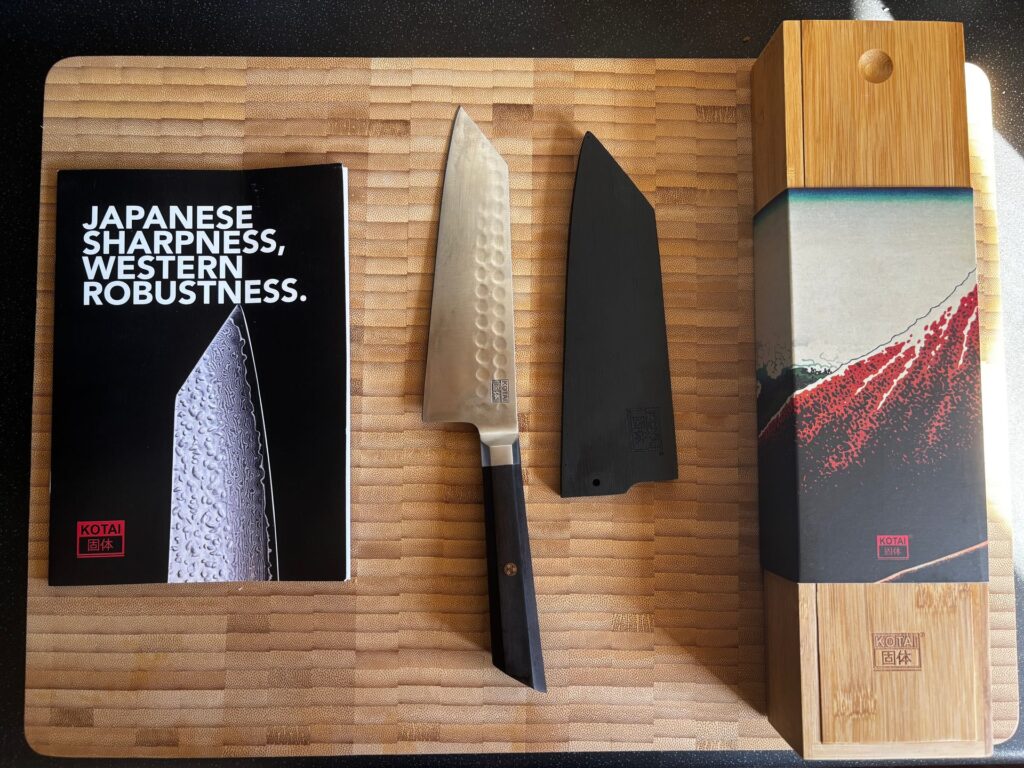
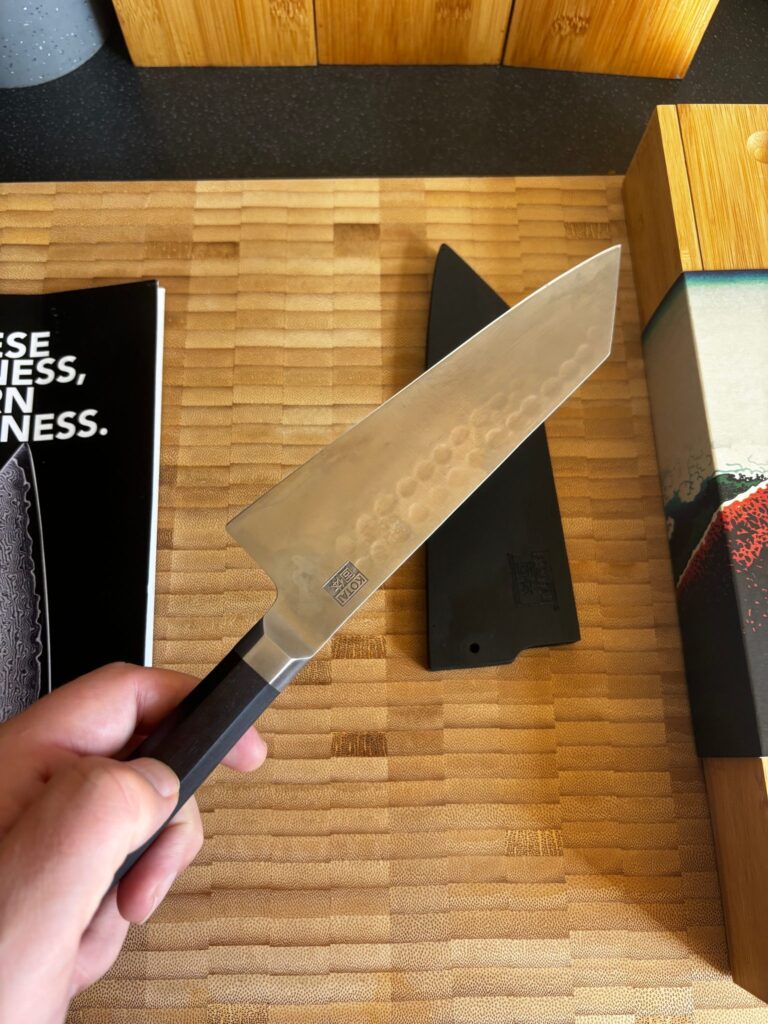
Kotai Bunka 17cm

KOTAI | Bunka Santoku Knife | 17 cm Blade | Multi-Purpose Knife | Hand Sharpened and Forged | Ultra-Sharp 440C Japanese Stainless Steel | Ebonywood Handle | Full Hidden Tang
Newer brand sold direct via Kotai’s UK distribution. Japanese AUS-10 steel, pakkawood handle, Bunka shape (between a gyuto and a santoku — flatter than a gyuto, with a slight reverse-tanto tip that’s excellent for precision work). It costs more than a budget gyuto, but the finish is better, the look more modern, and the flatter bunka profile is easy to learn on if you chop more than you rock.
Affiliate link — we may earn a small commission at no extra cost to you.
Check price on Amazon →
Best Single-Piece Stainless
Global G-2 20cm Cook’s Knife
Global’s iconic design — single-piece stainless steel, hollow handle filled with sand for balance, distinctive dimpled grip. Made in Japan, Cromova 18 steel. The all-steel handle is a love-it-or-hate-it thing — try one in a shop if you can. Holds an edge dramatically longer than any German knife. The right pick if you want a Japanese knife that’s still robust enough for everyday use and easy to clean.
Affiliate link — we may earn a small commission at no extra cost to you.
Check price on Amazon →
Best Performer
Mac Mighty MTH-80 8-inch

Mac Knives | Professional Series Chef's Knife with Dimples 8 inch [MTH-80]
Cult favourite among professional cooks for the simple reason that the steel is exceptional — Japanese molybdenum-vanadium that takes a razor edge and holds it for months. Lighter than most Damascus knives, less heirloom-looking, but objectively performs at the top of the chef’s-knife category. Worth it if you cook seriously and don’t care about the visible Damascus pattern.
Affiliate link — we may earn a small commission at no extra cost to you.
Check price on Amazon →
Best Vegetable Knife
Global G-5 Vegetable Knife 18cm

Global Vegetable Chopping Knife 18cm, Japanese Cromova 18 Stainless Steel | G-5: Flat edged kitchen knife perfect for large vegetables and joints of meat, professional chefs knife, hand wash only.
If you do a lot of vegetable prep — and especially if you cook a lot of Asian food — a nakiri-style vegetable knife is the single best specialist knife you can add. Flat blade, slight tap-cut motion, dramatically faster than a chef’s knife for slicing herbs, dicing onions, or handling delicate veg. Global’s G-5 is the same one-piece Cromova 18 construction as the G-2 above, with an 18cm flat-edged blade; if you already like the G-2’s all-steel handle, the two make a matching pair.
Affiliate link — we may earn a small commission at no extra cost to you.
Check price on Amazon →
What to skip
“Damascus” knives under £50. Real Damascus is folded forged steel with hundreds of layers; cheap “Damascus” is decoration etched onto a single-piece blade. Performs no better than plain stainless. Real Damascus starts at around £100.
Cheap Japanese-branded knives from marketplace sellers. Genuine Tojiro, Global, Shun and Mac are sold through known UK distributors. Mystery Japanese knives at suspiciously low prices on Amazon Marketplace are often counterfeit or use generic stainless rather than real Japanese steel.
Single-bevel knives unless you specifically know you want one. Yanagiba, deba, usuba — these are professional sushi-chef knives requiring specific technique. Beautiful objects but not for everyday cooking.
Care that matters more than for European knives
Hand-wash and dry immediately. Japanese steel rusts more easily, especially carbon steel (not stainless). Don’t leave a Japanese knife wet in the sink, even for an hour.
Never put in the dishwasher. Detergent and heat destroy the edge.
Don’t cut frozen food, bones, or pumpkin skin. The harder steel chips. Use a European knife or a cleaver for these.
Sharpen on a whetstone, not pull-through. Pull-through sharpeners are too aggressive and remove too much steel. A King 1000/6000 combination stone is the budget pick; Naniwa or Shapton stones are the upgrades. Sharpen every 3–6 months depending on use.
Hone with a ceramic rod, not steel. Steel honing rods are too aggressive for Japanese edges. A MinoSharp ceramic rod (the brown one Global recommend) is what most Japanese-knife users use.
Japanese knife FAQs
Are Japanese knives better than German ones?
They’re sharper and thinner, cut with less effort and hold an edge longer, thanks to harder steel. The trade-off is fragility: that hard steel can chip on bone or frozen food, where a tougher German knife shrugs it off. For precise vegetable and protein work a Japanese knife wins; for rough, heavy jobs a German one is more forgiving.
What’s the difference between a gyuto, santoku and bunka?
A gyuto is the Japanese take on a Western chef’s knife — a long, curved all-rounder like the Global G-2. A santoku is shorter and flatter, good for choppy downward cuts. A bunka (like the Kotai) is similar but with a pointed reverse-tanto tip for finer detail work.
Do Japanese knives chip easily, and how do I look after one?
They can chip if used on bone, frozen food or a hard board, so keep them to boards and softer ingredients. Hand-wash and dry immediately — never the dishwasher — and hone gently. Treated properly, a good Japanese knife will outlast you.
Can you sharpen a Japanese knife with a normal pull-through sharpener?
Best not to. Pull-through sharpeners grind a coarse Western angle that ruins the fine Japanese edge. Use a whetstone (a 1000/6000 combo is ideal) or send it to a specialist — the thin, hard steel rewards proper sharpening and punishes shortcuts.
Which Japanese knife should a beginner buy?
The Kotai Bunka is an easy first Japanese knife: genuinely sharp, with a flatter blade that is forgiving to learn on and far less of a worry than a £150 one. Master it before trading up to a Mac or Global.
Related guides
- Kitchen Knives Hub — the complete category guide
- Best Kitchen Knives UK 2026 — the all-rounder roundup including German and Japanese picks
- Buying Guides — the wider equipment guide
Sources
Steel type, hardness, blade geometry and edge angles are taken from manufacturer specifications and cross-checked against verified UK buyer reviews. Guidance on handling and storing kitchen knives safely follows RoSPA kitchen-safety guidance.
🛡 Our standards: How we research · Editorial policy · Affiliate disclosure · Corrections

About Gareth
Gareth Isherwood is the editor of Danbury & Lovejoy. He has baked bread at home for 25+ years and has 15 years of growing experience across gardens, containers and other growing spaces, including an East Sussex allotment for the past three years. Read his full story →
Was this useful?