Dried mushrooms are one of the great undervalued larder foods. A small jar of dried chestnut mushrooms, properly rehydrated into a stew or risotto, delivers more flavour than three times their weight in fresh ones. The drying process concentrates the umami compounds — glutamates, particularly — so that a small handful of dried mushrooms transforms a dish in a way fresh ones never quite do.
After fifteen years cooking from a kitchen garden and the last three on a Sussex allotment, drying mushrooms — both shop-bought and the occasional foraged windfall — has become one of those quiet kitchen habits that earns its keep year after year.
What you’ll need
- 500g fresh mushrooms (any variety; see below)
- A dry brush or kitchen cloth
- A sharp knife
- A food dehydrator with a 50–60°C setting
- Clean glass jars for storage
The single most important rule for drying mushrooms: don’t wash them. Mushrooms absorb water like a sponge, and washed mushrooms take 50% longer to dry, often unevenly. Brush dirt off with a soft brush or wipe with a barely-damp cloth. Anything more is overkill.
If you don’t yet have a dehydrator and you’re choosing one with mushroom work in mind, our 2026 UK round-up reviews five models — for mushrooms specifically, even airflow matters more than tray count. Cheap dehydrators with one hot tray will dry the bottom-tray mushrooms perfectly and leave the top-tray ones underdone.
Which mushrooms to dry
Different mushrooms suit different uses. The four worth drying:
- Chestnut mushrooms: the workhorse. Deep flavour, easy to find, cheap when on offer. The default for stews and risotto.
- Button mushrooms: less complex but reliable. The cheapest dried mushroom you can make.
- Shiitake: expensive fresh but transformative when dried. The umami delivery is unmatched. Worth buying when you spot them.
- Oyster mushrooms: drier than most fresh varieties, so they dehydrate quickly. Subtle, good for delicate dishes.
If you forage, treat identification with the seriousness it deserves; the wild varieties worth drying are ceps, chanterelles and trompettes des morts. Three rules: pick only what you’re 100% certain of, dry them within hours of picking, and never dry damaged or older specimens.
Method
- Brush clean. Soft brush or barely-damp cloth. Don’t wash. If you must rinse, do so very briefly and pat completely dry.
- Trim stems. Remove woody bases. The tender part of the stem dries fine alongside the cap. Save the woody trimmings — see below.
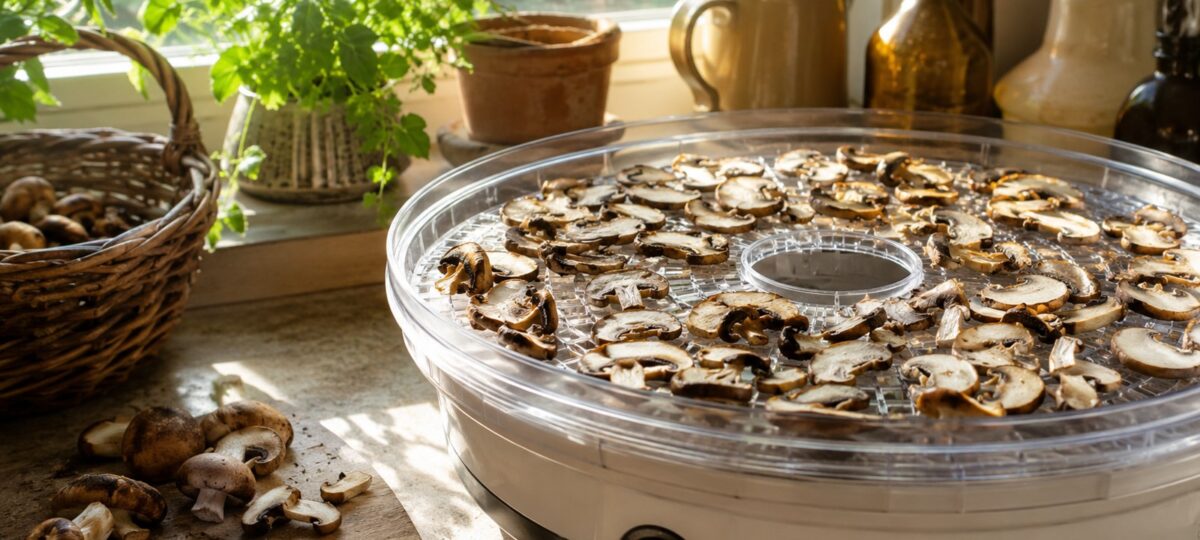
- Slice 5mm thick. Even thickness is critical. Thicker pieces case-harden; thinner become powder.
- Spread on trays. Single layer, no overlap. Mushrooms shrink dramatically — you can pack a tray reasonably tight without overlap.
- Dehydrate at 55°C for 4–8 hours. Button mushrooms: 4–5 hours. Chestnuts: 5–7. Shiitake: 6–8. Forest varieties: variable.
- Check at the halfway point and rotate trays. Even good dehydrators have small temperature variations across trays.
- Test for doneness. A finished dried mushroom is light, crisp, snaps cleanly when bent. There’s no moisture flex. Pick one up — it should feel almost weightless.
- Cool fully on the tray for 30 minutes before packing into jars.
For the per-variety temperature reference, the dehydrator temperature & time guide covers mushrooms in context of everything else worth drying.
What about woody stem trimmings?
Save them. The woody bases of chestnut and shiitake mushrooms — too tough for direct cooking — dry beautifully and grind into a powder that becomes mushroom stock concentrate. Dry the trimmings alongside the slices (they take the same time), cool, and blitz in a spice grinder. A teaspoon transforms a soup. Better than any shop-bought mushroom stock cube.
Storage
- Condition for 5–7 days in a loose jar. Shake daily. Moisture beads on the glass mean another 2 hours in the dehydrator.
- Seal in an airtight jar in a cool dark cupboard.
- Shelf life: 9–12 months. Mushrooms keep longer than most dried foods because they’re low-sugar.
- Powdered mushroom stock: 6 months in a small jar.
A 500g batch of fresh mushrooms gives you roughly 50g of finished dried mushroom — enough for a small kilner jar. That’s about ten generous portions in stews and risottos.
How to rehydrate
Three ways depending on what you’re making:
1. Hot-water soak (the classic). Cover with boiling water in a heatproof bowl. Leave for 20–30 minutes. Lift the mushrooms out with a slotted spoon. Keep the soaking liquid — it’s intensely flavoured mushroom stock and should go into the same dish.
2. Cold-water soak. Slower (1–2 hours) but extracts more flavour into the soaking liquid. Best for risottos where the liquid becomes the cooking medium.
3. Direct into the cooking. For long-cooked stews and braises, dried mushrooms can go in dry. They’ll rehydrate in the cooking liquid across the cook. Add at the start, not the end.
A 10g handful of dried mushrooms rehydrates to roughly 100g — enough for two portions.
What to make with them
The classics that earn the dehydrator its keep:
- Mushroom risotto. Dried porcini are the traditional choice, but chestnut works beautifully. Soak in stock, use the stock as the risotto liquid.
- Beef stews. A small handful of dried mushrooms in a beef bourguignon, oxtail or any long-cooked beef braise adds a savoury depth nothing else gives.
- Mushroom-and-thyme bread. Soaked, chopped finely, kneaded into a sourdough or yeasted loaf with dried thyme from the herb cupboard.
- Quick weeknight pasta. Dried mushrooms, garlic, butter, parsley, the soaking liquid reduced down. Twenty minutes, very good.
- Mushroom stock, made from the powdered woody trimmings — better than any cube.
A note on safety
Properly dried mushrooms keep almost indefinitely. The risk isn’t drying or storage — it’s the fresh mushroom you started with. If a fresh mushroom looks slimy, smells off, or is past its prime, don’t dry it. Drying concentrates everything, including any spoilage compounds. Start with mushrooms you’d happily eat fresh.
For foraged varieties: identification first, drying second. There’s no benefit to drying a mushroom you’re not certain of. The drying process doesn’t neutralise toxins.
Why this matters in a British kitchen
Mushroom imports — particularly the dried wild varieties — are expensive. A 30g jar of dried porcini in a supermarket costs £6–8. The equivalent dried weight of fresh chestnut mushrooms, dried at home, costs perhaps £1.50 and delivers very similar flavour intensity. Across a year of cooking — stews, risottos, sauces, soups — that gap adds up to real money saved on a single small kitchen habit.
For the rest of the dehydrator work worth doing across the seasons — fruit, herbs, vegetables, tomatoes — the wider dehydrator buying guide covers which models handle mixed-load drying without flavour transfer between batches.
Was this useful?