


✉ Join the Dispatch — a calm weekly note, every Thursday. Free.
A food dehydrator is one of those appliances that quietly pays for itself if you grow your own — or if you regularly find yourself binning a tray of slightly soft apples or a bag of herbs that’s gone over. I’ve put together six well-reviewed UK dehydrators across the price range, with a clear sense of which one fits which kitchen.
How we chose these dehydrators
We compared drying evenness across trays, which is where cheap models fail, then usable tray area against batch size, temperature control range for jerky as well as fruit, timer and auto-shutoff, and noise over a long overnight run. These are researched picks, not first-hand reviews, and we don’t accept payment for placement. Read our full methodology →
At a glance
| Model | Best for | Spec | Price tier | Why it’s on the list | |
|---|---|---|---|---|---|
| Cooks Professional 9-Tray | Harvest gluts, biggest batches | 500W, 9 trays, digital | £££ | Most capacity per pound on this list | Check price → |
| Nebula 6-Tray Stainless | Daily use, jerky, allergen care | 400W, 6 SS trays, 35–70°C, 48h timer | £££ | Only stainless trays at this price point | Check price → |
| Andrew James 6-Tray | Mid-range, UK warranty support | 550W, 6 trays, 40–70°C, 48h timer | ££ | Most power per pound; UK after-sales | Check price → |
| Aigostar 5-Tier | Small kitchens, herbs & fruit | 240W, 5 trays, 35–70°C, 99h timer | ££ | Lowest start temperature on this list | Check price → |
| HOMCOM 5 Tier | Tight budget, trial run | 245W, 5 trays, 40–70°C, no timer | £ | Cheapest here | Check price → |
| Excalibur 5 Tray Digital | Serious batch drying, no tray rotation | 5 shelf trays, digital timer & thermostat | £££ | The shelf-type serious driers graduate to | Check price → |
What to know before you buy
The first decision is stackable round-tray versus shelf-type. Stackable dehydrators (round trays pushed up a central column) are cheaper, smaller, and easier to store, but the trays nearest the heat source dry faster than those at the top, so you rotate part-way through a long run. Shelf-type machines (rectangular, like a tiny oven) use a rear-mounted horizontal fan that pushes air evenly across all trays — they cost more, take more counter space, but they’re the better tool if you’re doing meat, where uneven drying is a food safety issue rather than just an inconvenience.
Wattage and temperature range matter more than tray count. UK home dehydrators sit between 240W (compact) and 550W (mid-size); higher wattage doesn’t mean better, it means faster drying of dense items like beef jerky. The minimum useful temperature range is 35–70°C — that covers delicate herbs at the low end and the 70°C floor that the FSA recommends for safely dehydrating meat. Anything that can’t reach 70°C, take off the meat list before you buy. A digital timer is the other genuinely useful feature: without one, you’re checking on the machine periodically, and the eight-to-twelve-hour runs that fruit and meat actually need become tedious.
Running costs are very reasonable. At UK electricity rates around 26.32p per kWh (the October–December 2026 price cap), a 500W machine running for eight hours uses roughly 4 kWh — about £1.05 per batch. A 250W compact machine for the same time costs around 53p. For context, that’s less than a single shop-bought bag of dried mango, and one allotment apple glut run will fill several jars. The payback on a mid-range dehydrator comes inside a season if you actually use it.
The picks
Best for large batches
Cooks Professional 9-Tray
If you’re processing an allotment harvest or batch-drying fruit through autumn, this is the machine that pays back fastest. Nine trays at around 29×23 cm each gives you ~6,000 cm² of drying surface — comfortably enough to handle an apple tree’s worth of slices in two or three runs, or several days of herbs in a single afternoon. The 500W motor and digital control panel with adjustable temperature and timer give you the flexibility to run anything from low-temperature herbs to higher-temperature jerky, and the included nine BPA-free silicone non-stick sheets are a genuinely useful inclusion at this price (they’re £15–20 sold separately).
This is a stackable design, so the usual caveat applies: rotate trays part-way through a long run for even drying, particularly with denser foods. The trade-off for the lack of stainless-steel trays is the price: you’re paying significantly less than the shelf-type machines that match it on capacity. If counter and cupboard space allow, this is the one I’d buy for a productive garden or allotment household.
- Type: Stackable (vertical airflow)
- Trays: 9, BPA-free plastic + 9 silicone sheets included
- Wattage: 500W
- Controls: Digital panel, adjustable temperature and timer
- Price tier: £££ (see the card for today’s price)
Check current price on Amazon →
Best stainless build
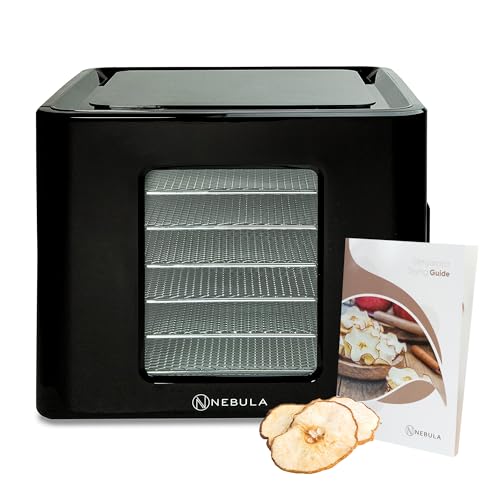
Nebula 6-Tray Stainless
The Nebula is a shelf-type machine with six dishwasher-safe stainless steel trays (30×25 cm each), a rear-mounted fan for even drying without rotation, and a transparent door so you can monitor a long run without opening it and losing the temperature. The 35–70°C range covers the full useful span, and the 48-hour digital timer is the largest among the shelf-types here. The build quality is the headline: stainless trays don’t retain smells or stain from acidic fruit, and they outlast plastic trays by a significant margin if you’re going to use the machine regularly.
It costs more than any of the stackables here, but it’s also the one that will still be working in a decade. For anyone who plans to dehydrate jerky or biltong frequently (where stainless trays make cleaning much easier), or anyone with sensitivity to plasticisers, this is the obvious choice. 400W is on the lower end for a shelf-type but the airflow design compensates — drying times are competitive with the 500–600W stackables.
- Type: Shelf/box (horizontal rear-mounted fan)
- Trays: 6 stainless steel, 30×25 cm, dishwasher safe
- Wattage: 400W
- Temp range: 35–70°C
- Timer: Digital touch panel, up to 48 hours
- Price tier: £££ (see the card for today’s price)
Check current price on Amazon →
Best mid-range
Andrew James 6-Tray Digital
Andrew James is a UK-based brand with accessible customer support — useful when you want a warranty claim that doesn’t involve a generic Amazon listing. This is a rectangular shelf-style machine with six stackable trays (height-adjustable, so you can fit thicker items like biltong strips), 550W of power, a digital thermostat covering 40–70°C, and a 48-hour timer. At its 550W rating it costs up to about 14p an hour at the current 26.32p per kWh price cap, less once the thermostat is cycling; the brand’s own figure of around 3p an hour is well below what that wattage supports.
Compared to the Nebula above, you give up stainless steel trays (these are BPA-free plastic) and the temperature floor goes from 35°C to 40°C — which removes some of the most delicate herb-drying work, though most kitchen herbs dry fine at 45°C. What you gain is more power, UK warranty support, and a noticeably lower price. For most UK households who want a shelf-type dehydrator without crossing into stainless-trays territory, this is the sensible middle.
- Type: Shelf/box (rectangular, horizontal airflow)
- Trays: 6 BPA-free plastic, height-adjustable
- Wattage: 550W
- Temp range: 40–70°C
- Timer: Digital, up to 48 hours
- Price tier: ££ (see the card for today’s price)
Check current price on Amazon →
Best compact
Aigostar 5-Tier
The Aigostar is the right machine if counter space is tight and you mostly want to dry herbs, fruit, and the occasional small batch of veg. It’s a stackable design with five transparent trays (around 30×22 cm), a 240W hot-air circulation motor, and a digital panel with two genuinely useful features: a 35°C floor temperature (lower than most at this price, ideal for herbs and flowers) and a 99-hour timer (overkill for most uses, but handy for long low-temperature runs). The trays stack at two heights — 1.5 cm or 2.8 cm spacing — which gives more flexibility with thicker items than most stackables manage.
The 240W motor means longer drying times for dense items: a batch of beef jerky that runs 6–8 hours on the Andrew James will take closer to 10–12 hours here. For fruit, herbs, and vegetables it’s perfectly capable, just slower. The trays are dishwasher-safe and the unit is quiet enough to run overnight without disturbing anyone sleeping nearby. A solid choice for one- or two-person kitchens where the dehydrator needs to come out, get used, and go back in a cupboard.
- Type: Stackable (vertical airflow)
- Trays: 5 transparent, dishwasher-safe, adjustable stacking height
- Wattage: 240W
- Temp range: 35–70°C
- Timer: Digital LED, up to 99 hours
- Price tier: ££ (see the card for today’s price)
Check current price on Amazon →
Best budget
HOMCOM 5 Tier
The HOMCOM is the cheapest sensible way into dehydrating. It’s a stackable design with five 31×23 cm trays, a 245W heater and a dial that sets the temperature anywhere from 40–70°C, which reaches the 70°C you need for meat. It’s the same physical size as the Aigostar (roughly 32×25 cm on the counter) and uses about the same wattage. What you give up at this price is any timer: HOMCOM lists none, so you switch it off yourself at the end of a run, and on a stackable you rotate the trays part-way through.
The honest framing: this is a try-it-and-see machine. If you’re new to dehydrating and not sure whether you’ll use it weekly or twice a year, the HOMCOM lets you find out without committing to one of the dearer machines. HOMCOM rates the trays for 5 kg in total, and it needs no assembly. If you outgrow it, you’ve spent less than a full-price Cooks Professional on the lesson. If you don’t, you’ve got a perfectly capable dehydrator for herbs, fruit and veg.
- Type: Stackable (vertical airflow)
- Trays: 5, 31×23 cm, 5 kg total load
- Wattage: 245W
- Temp range: 40–70°C (dial)
- Timer: None
- Dimensions: 26H × 32W × 25D cm
- Price tier: £ (see the card for today’s price)
Check current price on Amazon →
Best shelf-type upgrade
Excalibur 5 Tray Digital
The Nebula and the Andrew James are shelf-types too, but the Excalibur is the serious shelf-type that the buying advice above keeps gesturing at. A rear fan pushes air horizontally across five square shelves — Excalibur’s “Parallex” drying — so every tray dries at the same rate and you never rotate mid-run. The front door comes off entirely, which makes loading and checking trays a one-hand job rather than an unstacking ceremony, and the digital panel pairs a timer with a proper adjustable thermostat (up to 74°C, comfortably past the 70°C meat-safety threshold).
The honest framing: it costs far more than anything else on this list, and if you dry a few trays of apple rings each autumn it is cheerful overkill — buy the Aigostar and a bag of apples. It earns its keep at allotment-glut scale: weekly batches, jerky runs, a dozen trays of tomatoes in September. Excalibur has been the reference brand for home drying for decades, and this is the machine people tend to end up with after the second cheap stackable gives out.
- Type: Shelf-type (horizontal “Parallex” airflow)
- Trays: 5 square shelves, fully removable front door
- Controls: Digital timer + adjustable thermostat (to 74°C)
- Price tier: £££ (see the card for today’s price)
Check current price on Amazon →
An alternative: Cosori Double Stack air fryer, with a Dry setting
Disclosure: VeSync, the company behind Cosori, sent us this air fryer free of charge for review. We paid nothing for it. They had no say over this guide. We earn a commission if you buy through our links.
Not a dehydrator, and not one of the picks above, but it is the machine I actually dry in. If you only dry a few apples at a time and you’d use an air fryer anyway, it can save you buying a second appliance. Its Dry function runs from 35°C to 95°C with a timer up to 48 hours, which covers every setting in our temperature and time guide except traditional biltong. That wants 30–40°C for days, below this machine’s floor and past its timer.

Cosori Double Stack Air Fryer 8.6L, Turbo Tower Compact, 37.5% Less Space | Top Heating, 2 DC Motors, Faster Cooking, Ceramic Coating, PFAS-Free, Perfect for Family Meals
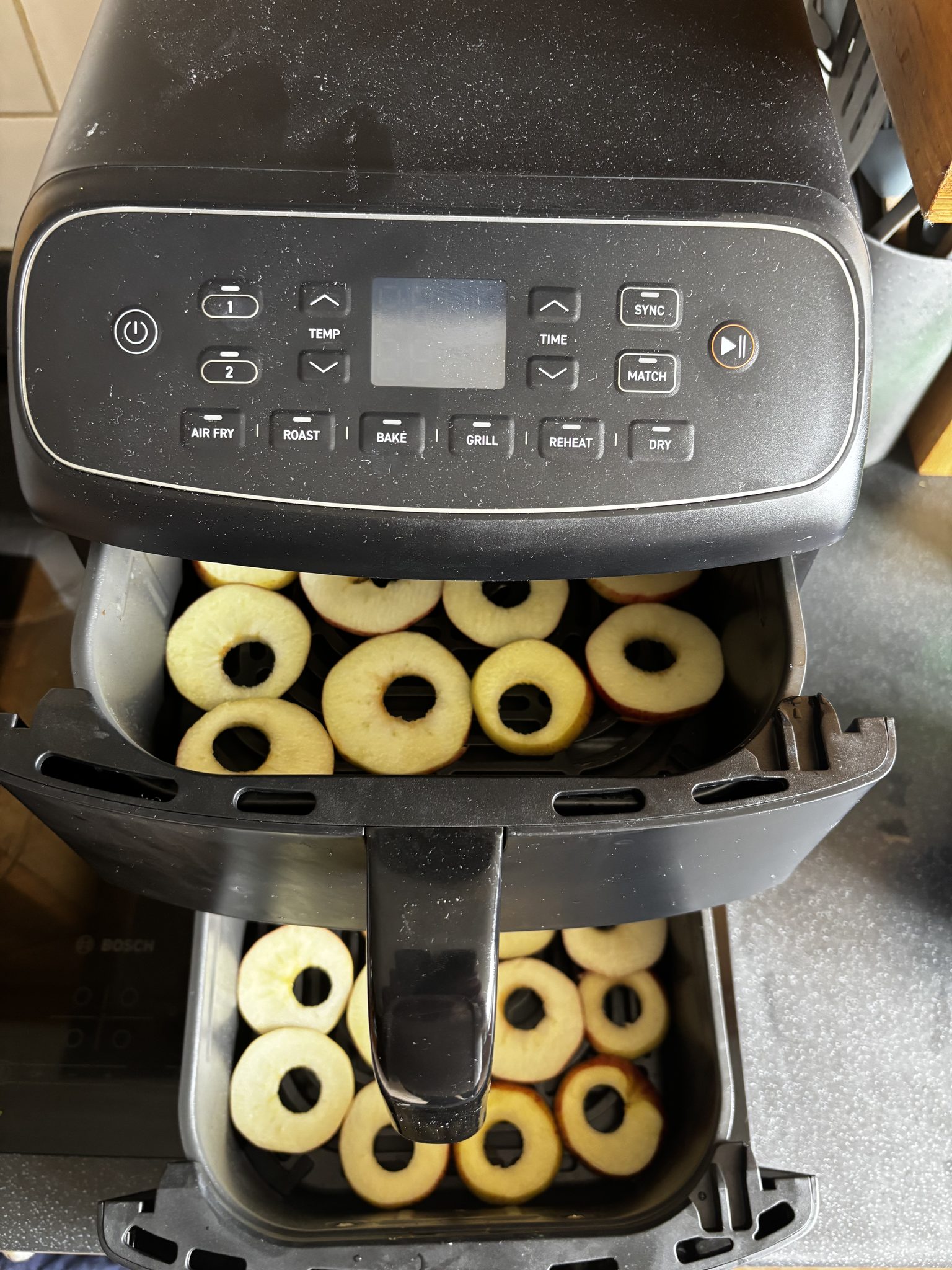
I dried apple rings in it in September: 6mm rings, skin on, 55°C, both drawers in a single layer. 373g of prepared rings went in and 52g came out after seven hours, roughly a seventh of the weight. They came out crisp rather than pliable, so on this machine start checking at four hours, not six. I’ve made beef jerky in it too.
The limit is space. About a dozen rings fit in each drawer, so six small apples filled both, and a kilogram of apples is a little over two full loads, each taking most of a day. For an autumn glut, any tray dehydrator above will do the batch in one go. The full method is in drying apple rings in an air fryer, and everything else is in our Cosori Double Stack review.
How I chose these
I don’t own any of the dehydrators on this list: my own drying (apple rings and beef jerky) is done in an air fryer’s Dry setting. What I have done is filter Amazon UK’s available dehydrators on the specs that actually decide quality (real wattage, real temperature range, build material of trays, timer length, brand support) and check each candidate’s reviews for the failure modes that matter — fan dying after a season, plastic trays warping, temperatures running hot or cold. Each pick fills a distinct use case, so a single list serves six different kitchens.
We don’t quote prices in the text, because Amazon’s prices on small appliances move from day to day: the cards show today’s price, and the price tier column is the durable guide (£ is roughly under £35, ££ £35–60, £££ over £60). If a listed model is suddenly out of stock or priced well outside its tier, look at the comparison table for an alternative.
Frequently Asked Questions
How long does it take to dehydrate food?
Rough drying times at the typical temperature for each food type: herbs 2–4 hours at 35–45°C; sliced fruit 6–12 hours at 55–65°C; vegetables 6–10 hours at 55°C; beef jerky 4–8 hours at 70°C. Thickness matters more than the temperature setting — slice fruit at 3–5 mm for consistent drying, and a mandoline pays for itself fast if you’re doing apples or pears regularly. Always check the first run of a new food rather than setting a timer and walking away.
Can I dehydrate meat safely?
Yes, if the machine reaches 70°C and you handle the prep correctly. The UK Food Standards Agency recommends 70°C as the minimum dehydration temperature for meat to eliminate harmful bacteria — all six machines on this list meet that. Many food safety guides also recommend pre-heating meat strips in an oven at 160°C for 10 minutes before transferring to the dehydrator, to ensure the surface temperature has been hit. Trim all visible fat first — fat doesn’t dehydrate and turns rancid in storage, ruining the batch.
Stackable or shelf-type — which should I buy?
Shelf-type (rectangular, horizontal fan) is the better tool if you’re doing meat regularly or processing big batches that need even drying without tray rotation — the Nebula and Andrew James are the shelf-types on this list. Stackable (round-tray, vertical fan) is fine for fruit, herbs, and vegetables, costs less, takes less counter space, and stores easier — the Cooks Professional, Aigostar, and HOMCOM are stackables. If you’re undecided, a shelf-type rewards you more over time but a stackable gets you started sooner.
Are food dehydrators expensive to run?
No. At UK electricity rates of roughly 26.32p per kWh (the October–December 2026 price cap), a 500W dehydrator running for eight hours uses about 4 kWh — around £1.05 per batch. A 250W compact machine for the same duration costs around 53p. Given that one batch typically preserves 1–2 kg of food that would otherwise spoil, the running cost is trivial compared to the food savings.
What foods reward a dehydrator most?
Three categories pay back fastest: seasonal gluts (apples, pears, plums, tomatoes — anything where you’ve got more than you can eat fresh), herbs (mint, rosemary, thyme, sage all dry beautifully in a few hours), and mushrooms (which reconstitute brilliantly in stews and risottos all winter). Once you’re confident, beef jerky and biltong are the next obvious step — see our homemade beef jerky recipe and biltong guide for the methods we use. What I’ve actually dried so far is apple rings and beef jerky, both in an air fryer rather than a dehydrator. In a dehydrator, the seasonal run is late-summer tomatoes, autumn apples (the method, settings and all), herbs cut back hard in summer, and mushrooms for winter stews. If you’re not sure what setting suits each food, our temperature and time guide lists them all.
🍲 From the D&L Shop: Want a system for cooking through what you grow or buy in bulk? Our Batch Cooking Planner gives you a weekly prep schedule, aisle-organised shopping lists, a freezer tracker and practical tips — 5 pages, £3.99. Free: the Weekly Budget Meal Planner. Browse the shop →
Recipes worth making in your dehydrator
- Homemade beef jerky recipe UK — topside or silverside, soy and Worcestershire marinade, the simplest jerky method that consistently works at home.
- How to make biltong at home UK — traditional South African vinegar cure and coriander rub, adapted for a dehydrator at lower temperature for that air-dried texture.
You might also like our kitchen & food hub for more allotment-to-larder guides, and our best pressure cookers UK review if you’re building out a slow-living kitchen kit.
Further reading: our guides to the best ice cream makers and best blenders.
— Gareth
Food dehydrator FAQs
What temperature should I use to dehydrate food?
As a rough guide: herbs and leafy greens at 35–40°C, fruit and vegetables at 50–60°C, and meat for jerky at 65–70°C. A model with an adjustable thermostat and a wide range (the picks here span 35–70°C) lets you dry delicate herbs low and slow without cooking them, then push higher for jerky.
How many trays do I actually need?
For herbs, fruit leathers and occasional batches, a 5-tray dehydrator is plenty and stores more easily. If you’re preserving garden gluts or making jerky regularly, step up to 6–9 trays so you’re not running three loads back to back. Stackable models let you add trays later; shelf/cabinet models fix the capacity from the start.
Are stainless steel trays worth it over plastic?
For most home drying, plastic (BPA-free) trays are perfectly fine and keep the price down. Stainless steel is worth paying for if you dry a lot of acidic fruit, care about allergen cross-contamination, or simply want trays that won’t stain or warp over years of use. On this list, the Nebula is the pick with stainless trays.
How much does a food dehydrator cost to run?
Most home models draw 240–550W — far less than an oven. At roughly 26.32p/kWh, a 400W dehydrator running for 8 hours costs about 84p. Because you tend to run big batches on one long cycle, the cost per jar of dried fruit or bag of jerky is small, and lower-wattage models are cheaper still for delicate, longer dries.
Is a cheap food dehydrator worth buying?
For a first try, yes — a sub-£35 5-tray model will happily dry apple rings, herbs and fruit leathers. The limits show up with big batches and jerky: cheaper units have fewer trays, less even airflow and often no timer, so you rotate trays by hand. If you catch the preserving bug, a mid-range digital model with a timer and a UK warranty pays for itself in convenience.
Sources
Tray counts, temperature ranges, rated wattages and timer specifications are taken from manufacturer datasheets and cross-checked against verified UK buyer reviews. Drying temperatures are given with reference to Food Standards Agency guidance on cooking food safely. Running-cost figures apply the current unit rate from Ofgem’s energy price cap to declared wattages.
Last reviewed: 4 September 2026
🛡 Our standards: How we research · Editorial policy · Affiliate disclosure · Corrections · Last reviewed: 4 September 2026

About Gareth
Gareth Isherwood is the editor of Danbury & Lovejoy. He has baked bread at home for 25+ years and has 15 years of growing experience across gardens, containers and other growing spaces, including an East Sussex allotment for the past three years. Read his full story →
Method posts using your dehydrator
The methods below cover how to dry each food group well — fruit, herbs, vegetables, tomatoes, mushrooms. Each one is a quiet larder project worth returning to season after season, and together they make the dehydrator earn its counter space.
- Dehydrator temperature & time guide UK — what setting and how long for every food worth drying — the reference chart used by every method post in this cluster.
- How to dry apples in a dehydrator UK — 6mm rings at 55°C for 6-10 hours — the easy lemon-water method for jars of dried fruit that keep for a year.
- How to make sun-dried tomatoes UK — the dehydrator method that works in British weather — plum or cherry tomatoes, dry-pack and oil-pack storage with a safety note.
- How to dry mushrooms in a dehydrator UK — 5mm slices at 55°C for 4-8 hours — why not to wash them, what varieties are worth drying, and the woody-stem trick for homemade mushroom stock.
Was this useful?