Biltong occupies a different category from jerky, even though the end result — dried cured beef — might sound similar on the surface. Where jerky is marinated and heat-dried, biltong is cured in vinegar, rubbed with spices, and air-dried over several days. The process is slower and less technical, but the result has a depth of flavour and a texture that’s quite unlike anything you’d get from a dehydrator alone. It’s been gaining a steady following in the UK over the past decade or so, and once you’ve made a batch yourself, it’s easy to see why.
I came to biltong relatively late — a South African friend brought some to the allotment one afternoon and that was that. The recipe that follows stays close to traditional, adapted slightly for ingredients that are easy to find in the UK.
Some of the links below are affiliate links: if you buy through them we may earn a small commission at no extra cost to you. As an Amazon Associate I earn from qualifying purchases. We only suggest things we would recommend to a friend — see our affiliate disclosure and how we research.
✉ Join the Dispatch — a calm weekly note, every Thursday. Free.
Disclosure: This post contains affiliate links. If you buy through them, I may earn a small commission at no extra cost to you. I only include products I’d genuinely consider using.
The right cut of beef
The traditional choice for biltong is silverside, which is widely available in UK supermarkets and butchers and has the right balance of leanness and texture. Topside also works well. You want a lean, relatively large-grained cut — unlike jerky (which is often sliced against the grain for tenderness), biltong is traditionally sliced with the grain, which gives the finished product its characteristic pull-apart, fibrous texture.
For your first batch, work with around 500–700 g. This gives you enough to get a feel for the process without committing too heavily if the drying conditions aren’t quite right first time. Ask the butcher to cut it into strips about 2–3 cm thick and 4–5 cm wide — or do it yourself with a sharp knife. The strips can be longer than jerky since they hang rather than lie flat.
Fat on biltong is more acceptable than on jerky — some traditional recipes actively encourage leaving a thin fat cap on one side of the strip. That said, for a first batch I’d keep fat to a minimum until you’re confident in your drying setup, as fat is the most likely source of spoilage.
The traditional cure and spice rub
The vinegar cure is what distinguishes biltong from every other dried meat. It partially dehydrates the surface, raises the acidity to inhibit bacterial growth, and contributes a subtle tang that carries through to the finished product. Malt vinegar suits a UK-made biltong — it’s traditional, widely available, and gives a slightly deeper flavour than white wine vinegar. Some recipes use apple cider vinegar, which is milder and also works well.
The spice rub is where biltong gets its character. Coriander seed — coarsely ground — is the defining spice. Everything else is secondary. Salt and pepper are essential; brown sugar adds a very slight sweetness that balances the vinegar. Some recipes include bicarbonate of soda in the rub, which firms the surface slightly and was useful in the days before refrigeration. It’s fine to leave it out for simplicity.
For 500–700 g of beef strips:
- 3–4 tbsp malt vinegar (or apple cider vinegar)
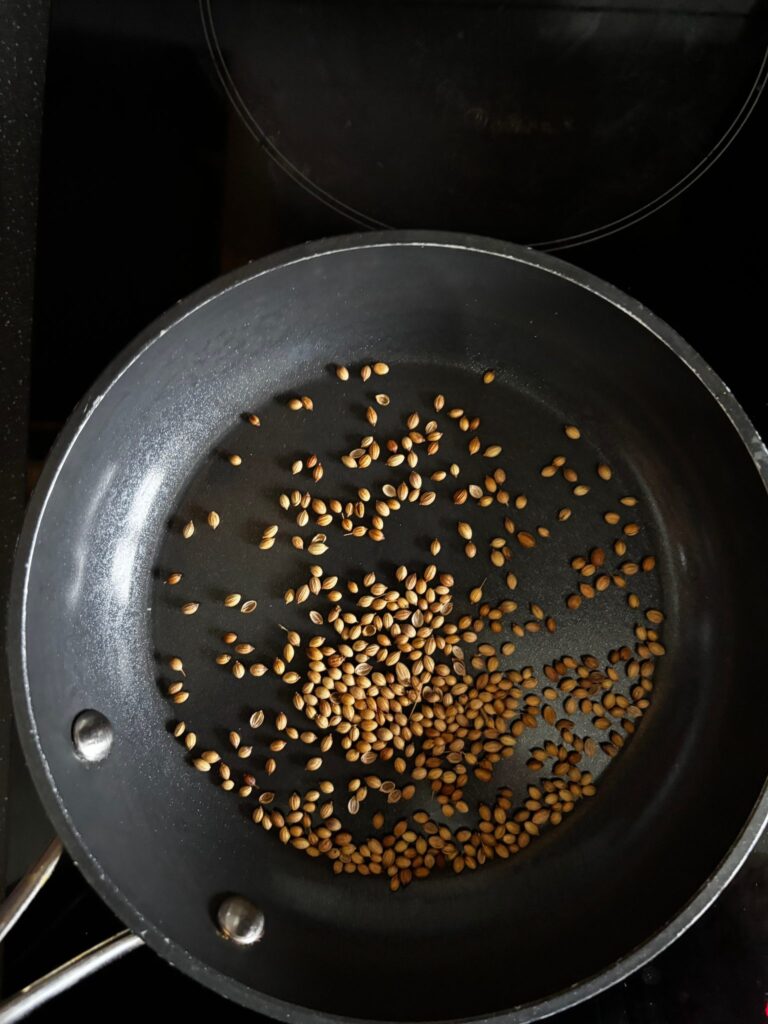
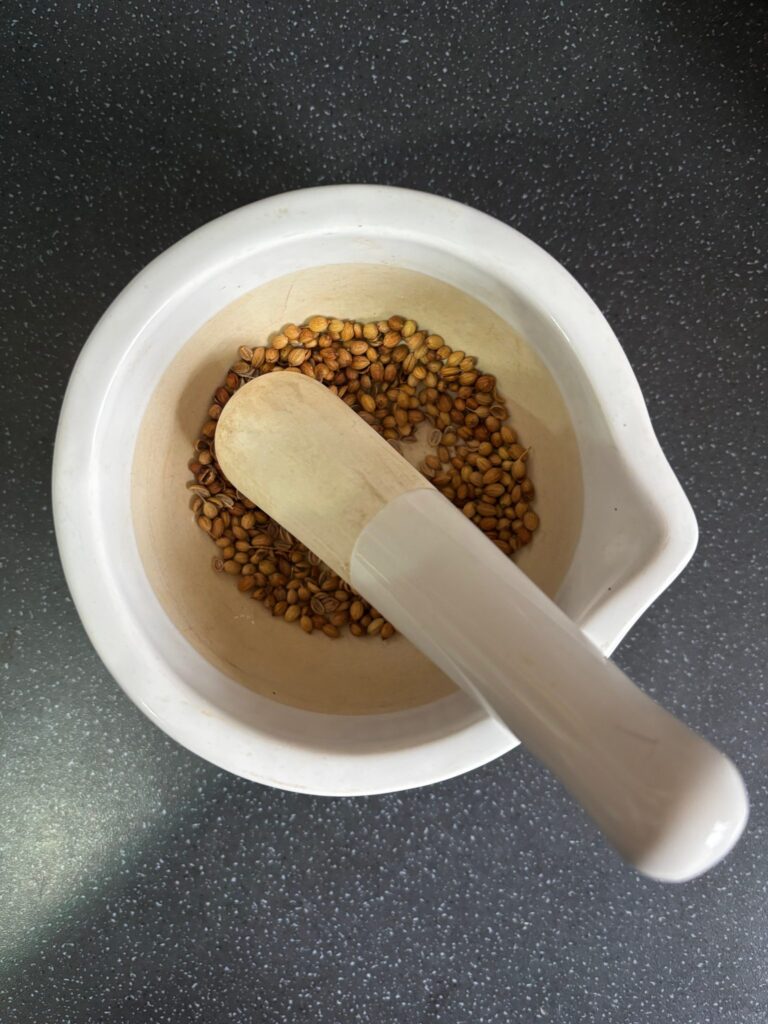
- 2 tbsp whole coriander seeds, lightly toasted and coarsely ground
- 1½ tsp fine salt (or to taste)
- 1 tsp coarse black pepper
- 1 tsp brown sugar
- ½ tsp garlic powder (optional)
Wet the beef strips all over with the vinegar — brush it on or pour it into a shallow dish and turn the strips through it. You’re not marinating for flavour here, just surface treatment, so a minute or two per side is sufficient. Shake off the excess, then coat each strip generously with the spice rub, pressing it in. Lay the strips on a rack and refrigerate, uncovered, for 30 minutes to an hour to form a slightly tacky surface — this helps the spices adhere during drying.
Traditional Biltong
A traditional South African biltong cured in malt vinegar and rubbed with coriander — air-dried over several days for a deeply flavoured, pull-apart result.
Ingredients
- Silverside or topside beef, cut into strips 2–3 cm thick700 g
- Malt vinegar (or apple cider vinegar)4 tbsp
- Whole coriander seeds, toasted and coarsely ground2 tbsp
- Fine salt1½ tsp
- Coarse black pepper1 tsp
- Brown sugar1 tsp
- Garlic powder (optional)½ tsp
Method
- Trim excess fat from the beef, leaving only a thin cap if you prefer a traditional finish. Slice with the grain into strips roughly 2–3 cm thick and 4–5 cm wide.
- Brush or turn the strips in malt vinegar until all surfaces are lightly coated. Shake off the excess — you don’t want the meat sitting in a pool of vinegar, just wetted.
- Mix the dry spice rub: toasted coriander, salt, pepper, sugar, and garlic powder if using. Press the rub firmly onto all surfaces of each strip. Place on a rack, uncovered, in the fridge for 30–60 minutes to form a tacky surface.
- Hang the strips using a biltong hook, butcher’s hook, or a bent paperclip through the top of each strip. Hang in your biltong box or a cool, well-ventilated spot with good airflow. If using a dehydrator, use the lowest temperature setting (around 35–40°C) with good airflow.
- Dry for 3–5 days depending on thickness and your preferred texture. Check daily. The outside will darken significantly and feel firm; the inside should be slightly yielding but not soft or moist when the strip is squeezed firmly.
- Once at your preferred dryness, remove, wrap loosely in paper, and rest for a few hours before slicing. Slice thinly across the grain to serve. Store in a paper bag or loosely sealed container — biltong needs to breathe slightly to prevent moisture building up.
Making biltong in an air fryer
You don’t need a biltong box. I made my last batch, on 12 October, in the Cosori Double Stack, a two-drawer air fryer that VeSync, the company behind Cosori, sent me free of charge to review. I earn a commission if you buy one through the link at the end of this section, and my full review of the Cosori Double Stack covers everyday cooking in it.
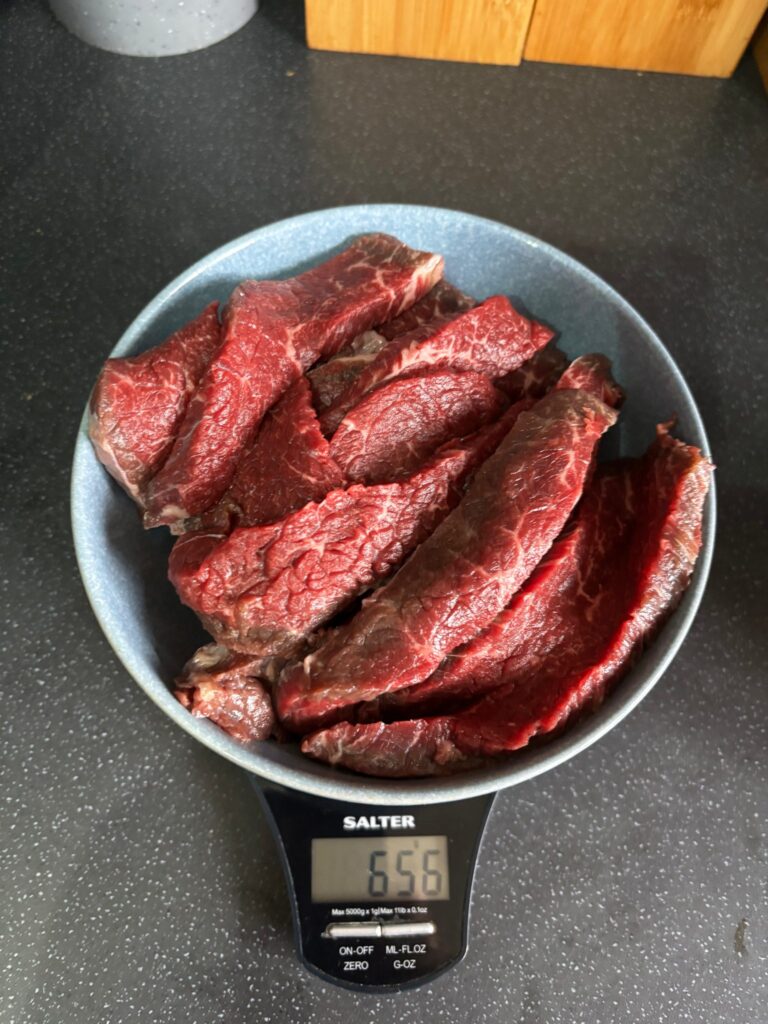
It was 656 g of topside from the freezer, defrosted and cut into strips.
The cure was the one in the recipe above: malt vinegar, then the rub of toasted coriander, salt, coarse black pepper and brown sugar. I left out the garlic. Then the strips had their uncovered rest in the fridge.
Then dry at 55°C. I laid the strips in a single layer across both drawers and set the Dry programme to 55°C. That’s warmer than the 35–40°C suggested for a dehydrator below, so it’s a matter of hours rather than days. I set 12 hours and stopped it at about nine. I didn’t move or turn them.
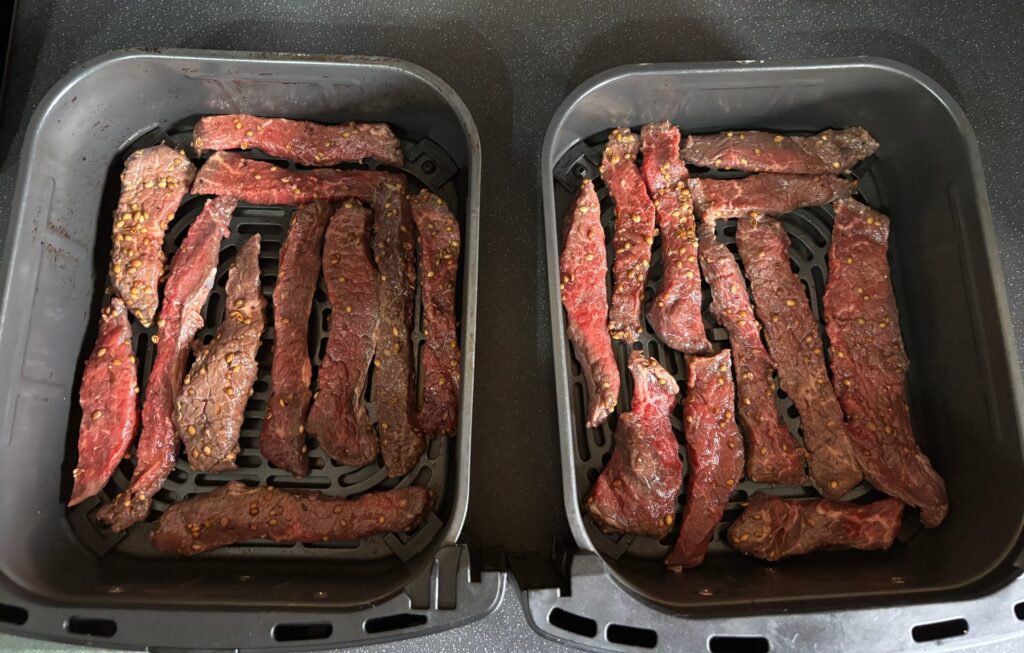
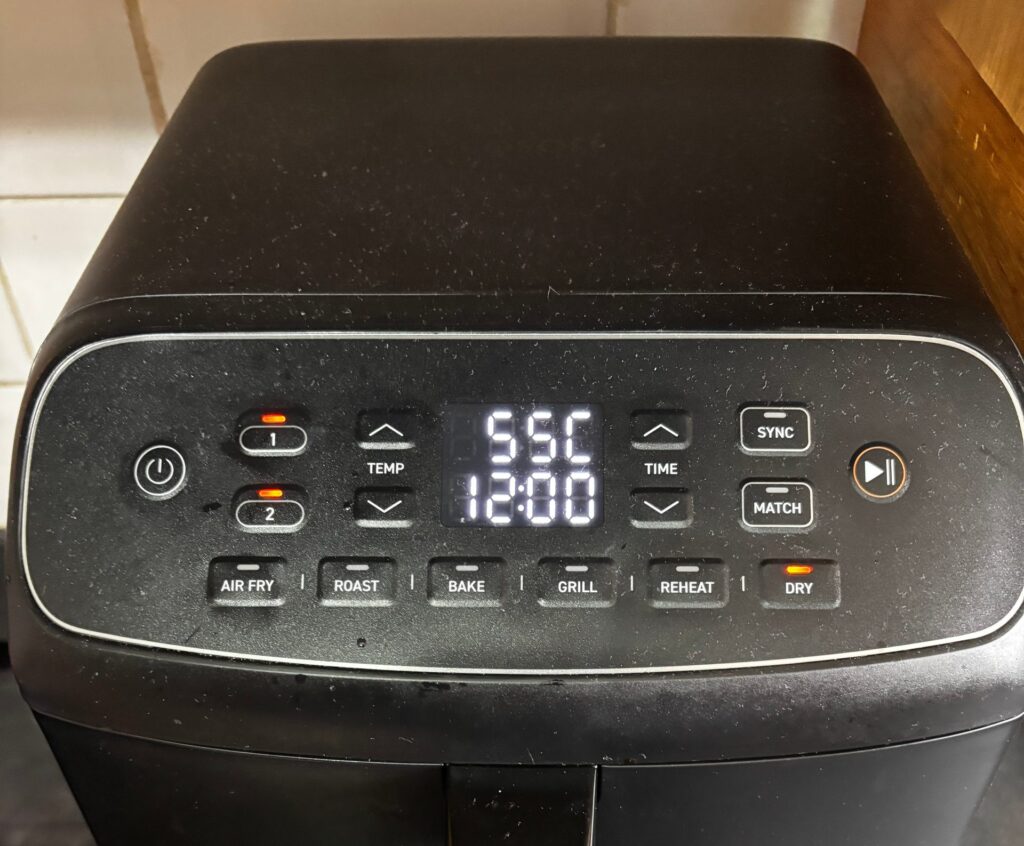
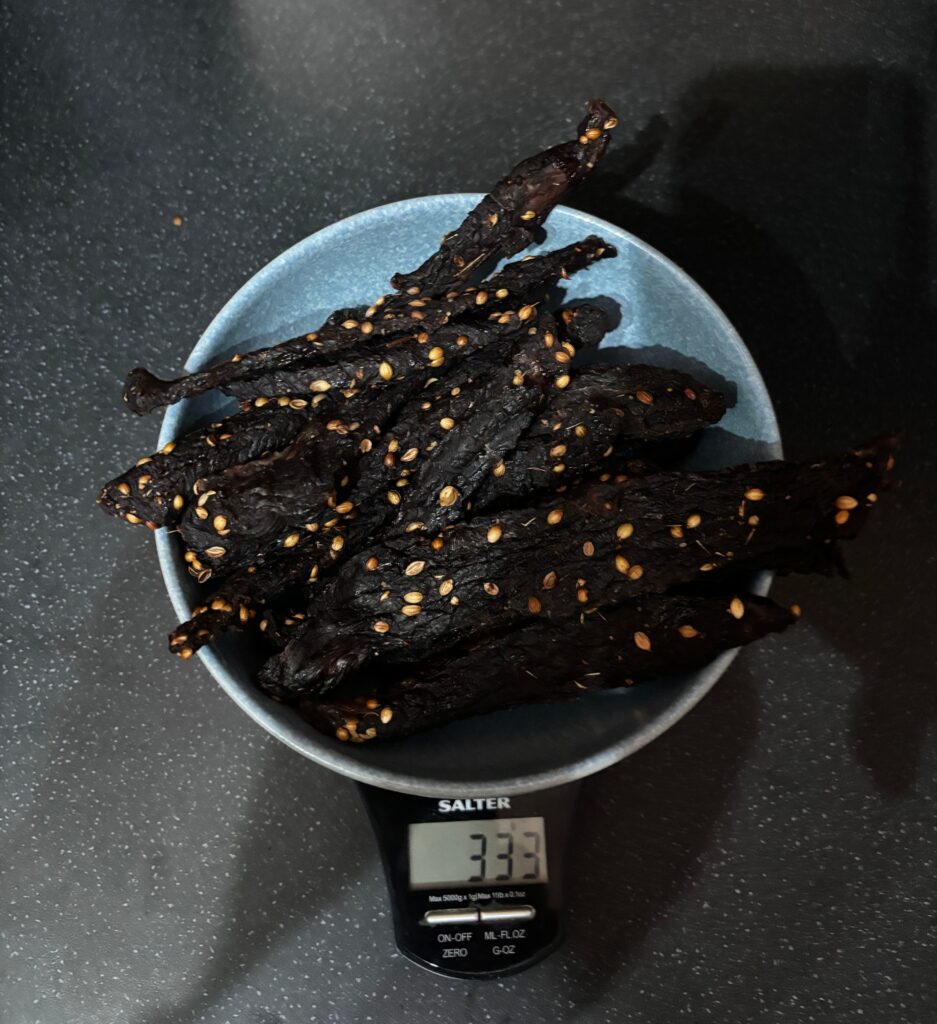
It came out at 333 g, so the beef lost about half its weight. That’s a little less than the recipe card’s ~400 g from 700 g, so I’d allow roughly 350 g of biltong from 700 g of beef if you dry it like this.
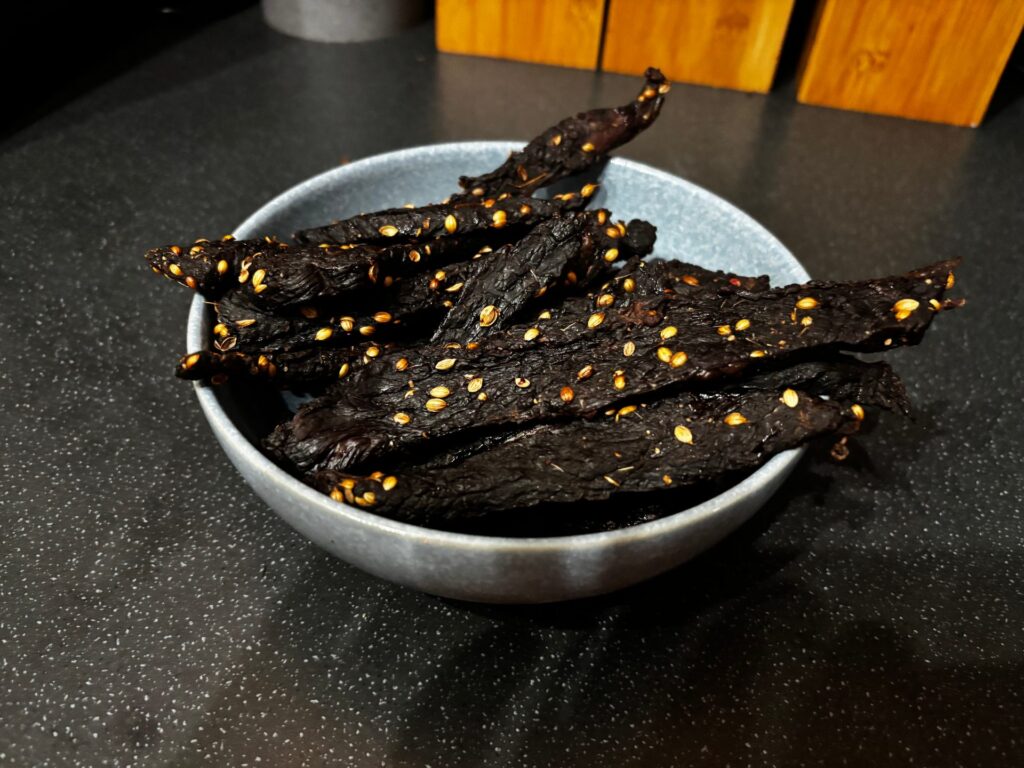
The same air fryer makes beef jerky, which needs a heat step and a hotter setting. If drying is the main thing you want a machine for, a dehydrator still takes a bigger batch in one go.

Cosori Double Stack Air Fryer 8.6L
Drying methods: biltong box vs food dehydrator
Traditionally, biltong is air-dried — hung in a dry, well-ventilated space with a mild airflow to prevent moisture building up. In a South African climate, this happens naturally; in the UK, conditions are less reliable, which is why a dedicated biltong box is the most consistent option for home use.
A biltong box is simply a wooden or plastic box with a light bulb (40W is standard) for gentle warmth, and ventilation holes covered with mesh to keep insects out. The bulb raises the internal temperature just enough to encourage drying without cooking the meat — typically around 30–35°C. Hooks suspended from the top allow the strips to hang freely with airflow all around them. You can buy purpose-built biltong makers in the UK, or build your own from a wooden crate and a lamp fitting.
Browse biltong makers on Amazon UK
A food dehydrator also works well for biltong, particularly if you already own one for making jerky or drying herbs and fruit. The key difference is that biltong wants a lower temperature than jerky — around 35–40°C rather than 70°C — so make sure your dehydrator has an adjustable temperature dial that goes low enough. Some entry-level models run hotter than ideal. The drying time in a dehydrator is considerably shorter than traditional air-drying: typically 6–10 hours depending on thickness, rather than several days.
Browse food dehydrators on Amazon UK
For more on choosing a dehydrator, see our guide to the best food dehydrators UK, which covers the main options at different price points.
Whole coriander seeds are worth buying rather than using pre-ground — toasting them briefly in a dry pan before coarsely crushing brings out a depth of flavour that’s central to a good biltong rub.
View whole coriander seeds on Amazon UK
Malt vinegar in a larger bottle is useful to have on hand — you go through more than you’d expect across a few batches, and it’s one of those storecupboard staples with a dozen other uses.
View malt vinegar on Amazon UK
How to know when your biltong is ready
The best guide is the squeeze test. Take a strip between thumb and forefinger and squeeze firmly from the sides. Well-made biltong should feel firm throughout, with a slight give — it shouldn’t be rock-hard all the way through (over-dried) or have a distinctly soft, yielding centre that feels clearly wetter than the outside (under-dried).
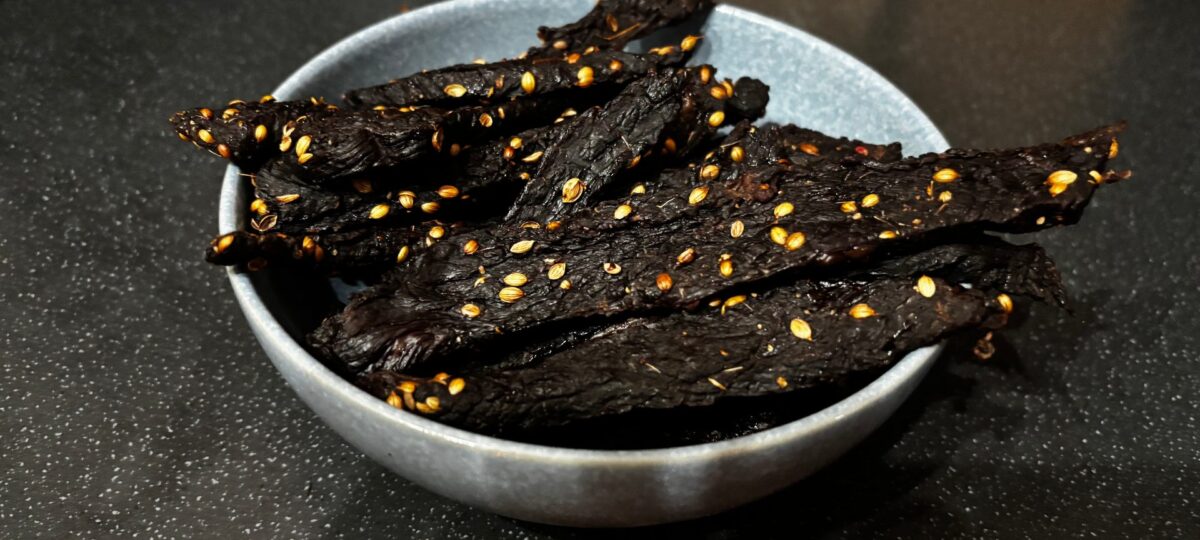
The colour is also a reliable indicator. The outside will turn a deep reddish-brown to near-black as it dries. Cut into a thicker strip and the interior should be a dark red-brown — the pinkness of the raw meat will have gone. If the interior is still bright pink or red and feels wet, it needs more time.
Many biltong enthusiasts have a strong preference for a slightly wet biltong — softer, darker, with more give — which is popular in South Africa. Others prefer a drier, firmer result that slices more cleanly. There’s no single correct answer; it’s a matter of drying a batch and learning where you want to stop next time.
How long does biltong keep?
Properly dried biltong keeps well. At room temperature in a paper bag or loosely sealed container with a little airflow, it will last 1–2 weeks — the paper is important, as sealed plastic traps moisture and can cause surface mould. In the fridge, loosely wrapped, it will keep for several weeks without any loss of quality. Freezing is also an option for longer storage; vacuum-seal first for best results.
Browse vacuum storage bags on Amazon UK
The main enemy of biltong in storage is condensation — avoid sealed plastic containers at room temperature, and don’t put it in the fridge without wrapping it loosely first. If you spot surface mould, it can usually be wiped off with a cloth dampened in vinegar if the mould is only surface-level and the biltong was otherwise dried correctly, but use your judgement: if it smells off, it’s done.
If you enjoy making your own dried meat, the homemade beef jerky recipe is a natural companion to this one — a different method, a different texture, and a different flavour profile, but equally satisfying to make in a batch and genuinely useful to have in the larder.
🛡 Our standards: How we research · Editorial policy · Affiliate disclosure · Corrections

About Gareth
Gareth Isherwood is the editor of Danbury & Lovejoy. He has baked bread at home for 25+ years and has 15 years of growing experience across gardens, containers and other growing spaces, including an East Sussex allotment for the past three years. Read his full story →
For per-food temperatures and times beyond this method, the dehydrator temperature & time guide is the reference chart used across the whole cluster.
Was this useful?