
There’s a moment in late September on every allotment plot with an apple tree where the windfalls start outpacing the eaters, the cookers, the crumbles and the freezer. I’ve been growing my own for fifteen years, the last three on a Sussex allotment, and a dehydrator is one of the best ways through an apple glut without buying yet another freezer. I don’t own one: my own apple rings were done in an air fryer’s Dry setting (here’s how that went).
Dried apple rings store for a year in a jar, take fifteen minutes to prep, and don’t compete with anything else you’re cooking for oven space. This is the method.
What you’ll need
- 1 kg apples (any eater; Bramleys also work but stay slightly tarter)
- Juice of 1 lemon
- 1 litre cold water
- A food dehydrator (any household model with a 50–60°C setting)
- A sharp paring knife or an apple corer
- A mandoline or steady hand for slicing
A mandoline isn’t essential, but even slice thickness is the single biggest factor in how the batch turns out. 6mm is the sweet spot. Thicker takes too long; thinner becomes apple crisps rather than apple rings.
If you don’t yet have a dehydrator and you’re choosing one for autumn glut work, our 2026 UK round-up reviews five models at different price points — the 9-tray models are the ones that earn their keep on an allotment season.
No dehydrator at all? An air fryer with a Dry setting will do a smaller batch: drying apple rings in an air fryer.
Method
- Mix the lemon water. Squeeze the lemon into a litre of cold water in a large bowl. This is what stops the apples browning while you slice the rest.
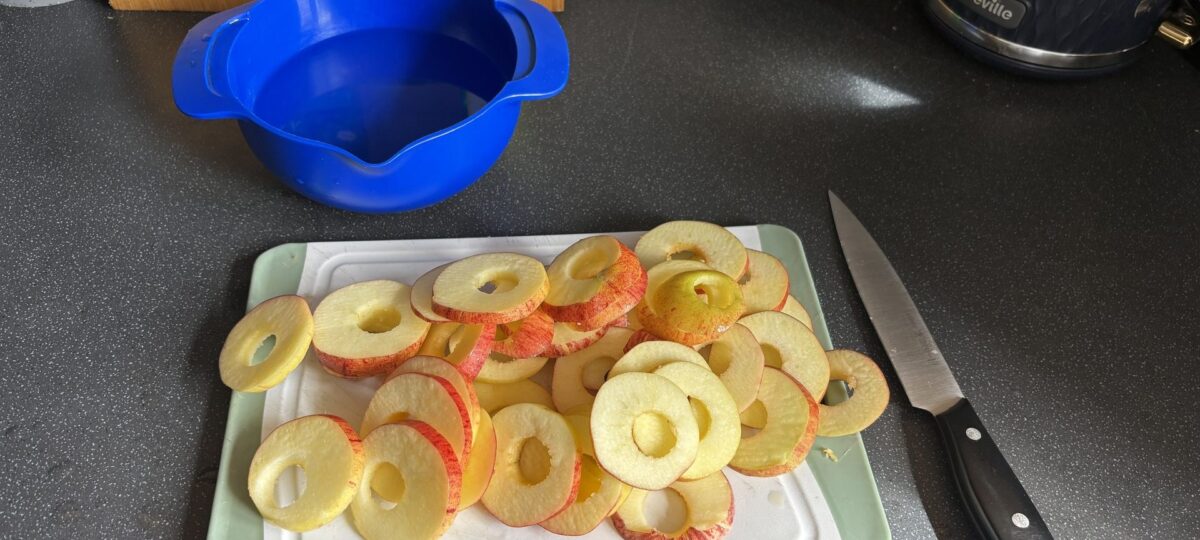
- Core and slice. Core each apple, then slice into 6mm rings. Drop the rings straight into the lemon water as you go.
- Soak briefly. Once all the apples are sliced, leave them in the lemon water for 5 minutes. Any longer doesn’t help.
- Drain and pat dry. Lift the rings out and pat between two tea towels. Wet rings drip onto the tray below.
- Arrange on trays. Single layer, no overlap. Air needs to move around each ring.
- Dehydrate at 55°C for 6–10 hours. Time depends on humidity, slice thickness and your specific machine. Start checking at 6 hours.
- Test for doneness. A finished ring is pliable but leathery — bend one in half, look for any pockets of moisture. If wet, return for another hour.
- Cool fully before jarring. Warm fruit in a jar creates condensation. 30 minutes on the rack.
For the full temperature reference on apples and other fruit at different thicknesses, the dehydrator temperature & time guide breaks down what to expect.
Windfalls too bruised to slice cleanly are not wasted — they are the right candidates for fruit leather, where the shape of the fruit stops mattering.
The lemon water question
Lemon water serves two purposes. The acid prevents enzymatic browning, which is what turns cut apple flesh from white to tan in minutes. And the brief soak draws a tiny amount of moisture out before drying starts.
You can skip it and the apples will still dry. They’ll just be a deeper brown colour and slightly less sweet. For storage they’re identical. For looks — and for kids who turn their nose up at brown food — lemon water is worth the extra step.
Some recipes use salt water instead. It works, but apples end up faintly savoury. Lemon is better for sweet eating.
Which apples work best
- Eaters (Cox, Gala, Braeburn, Discovery): the obvious choice. Sweet, hold their shape, dry to a clean apple flavour.
- Russets: the most interesting to dry. The skin is edible after drying and adds a nutty depth.
- Cookers (Bramley): work, but go softer and tarter. Better for fruit leather than rings.
- Windfalls: fine if you cut around the bruises. Cut a little wider than the obvious damage — bruised tissue carries fungal spores even when it looks clean.
Mix varieties if you have them. Jars of mixed-variety dried apple have a complexity that single-variety jars don’t.
Storage
- Condition for 5–7 days in a loose jar. Shake daily. Any moisture on the glass means another hour in the dehydrator.
- Seal in an airtight jar, ideally vacuum-sealed if you have the equipment.
- Store in a cool, dark cupboard. Direct sunlight fades the colour and shortens shelf life.
- Shelf life: 9–12 months sealed.
Dried apples never quite recapture the texture of fresh fruit when rehydrated, so plan to eat them dry. As snacks, in granola, chopped into porridge, or simmered in cider with cinnamon for a winter compote.
What to do with the dried apples
Three ways to use them through the year:
- As snacks straight from the jar. Far better than shop-bought, which are usually sweetened.
- In porridge. Add chopped pieces at the start of the cook so they soften.
- In bread. A handful of chopped dried apple in a basic sourdough or yeasted loaf — particularly with cinnamon and walnuts — is one of the great autumn bakes.
A 1 kg batch of fresh apples gives you about 150 g of dried rings — enough for a medium kilner jar. Two batches per weekend through October and you’ll be set for the winter.
A note on case-hardening
If your apple rings come out hard on the outside but still moist when you bite in, the temperature was too high. Drop 5°C next time. Apples want low and slow — 55°C for ten hours is better than 65°C for six. The extra electricity cost is pennies; the difference in finished texture is significant.
For everything else worth drying through the autumn — pears, plums, mushrooms, herbs — the wider dehydrator buying guide covers which models handle the bigger autumn batches best.
Was this useful?