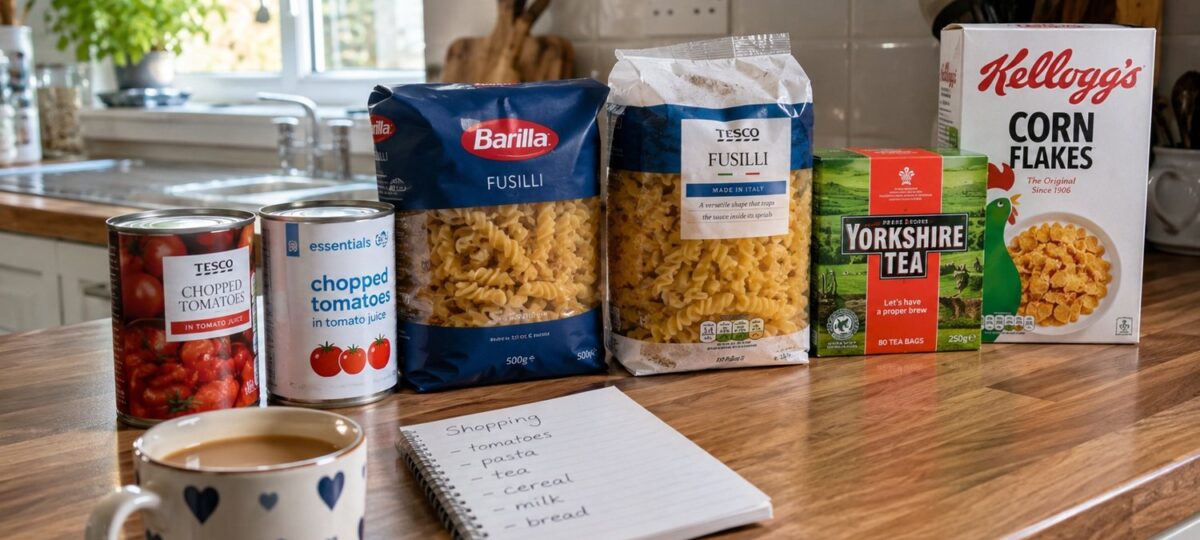
Supermarket own-brand products are one of the most reliable ways to reduce a food bill without changing what you eat. The gap between a branded product and a supermarket own-label equivalent has narrowed considerably in the past decade — in many categories, the own-brand version is made in the same factory, to the same specification, with a different label. In others, the branded product genuinely is better. Knowing which is which saves money without sacrificing the things that actually matter.
Where Own-Brand Always Wins
There are categories where the branded premium buys you essentially nothing except the packaging and the advertising budget behind it. Switching to own-brand in these areas is straightforward and the saving is real:
- Tinned vegetables and pulses — tinned tomatoes, chickpeas, lentils, kidney beans, sweetcorn. The contents are functionally identical. The own-brand version is typically 20–40% cheaper.
- Dried pasta and rice — commodity products with no meaningful quality difference between brands at the everyday level. Own-brand pasta at Aldi or Lidl is often better quality than mid-range branded pasta at full-price supermarkets.
- Plain flour, sugar, salt, and basic baking ingredients — no difference in the product; significant difference in price.
- Frozen vegetables — frozen peas, sweetcorn, spinach, and mixed vegetables are often frozen closer to harvest than “fresh” equivalents and nutritionally comparable. Own-brand versions are considerably cheaper.
- Milk, butter, and basic dairy — own-brand milk and butter from major supermarkets is the same product, often from the same dairies, at a lower price.
- Eggs — free-range own-brand eggs are equivalent to branded free-range eggs. The welfare standard is what matters, not the name on the box.
- Cleaning products, washing up liquid, and laundry basics — the performance difference between Fairy and a supermarket own-brand washing up liquid is negligible for most washing up tasks. The price difference is significant.
- Over-the-counter medicines — paracetamol, ibuprofen, antihistamines. The active ingredient is identical; only the branding and packaging differ. Own-brand paracetamol is typically one-fifth the price of branded equivalents.
Where Branded Sometimes Justifies the Premium
There are categories where branded products have a genuine, consistent quality advantage — or where the own-brand equivalent is noticeably worse in a way that matters to the dish:
- Olive oil — quality varies significantly. A good own-brand extra virgin olive oil from a major supermarket is fine; very cheap versions often have less flavour and may be blended. For finishing dishes, the branded or premium own-brand version earns its keep. For cooking, the cheaper version is perfectly adequate.
- Soy sauce and Asian condiments — Kikkoman soy sauce has a noticeably more complex, less salty flavour than most own-brand equivalents. If you use it regularly, the premium is worth paying.
- Cheese for cooking vs. eating — own-brand mature cheddar for cooking is fine; for a cheeseboard, a named variety makes a difference.
- Chocolate for baking — own-brand dark chocolate varies considerably. For recipes where chocolate is the main flavour, the cocoa percentage and quality matters. For something where it’s a minor ingredient, own-brand is fine.
The Discount Supermarkets vs. Big Four
Aldi and Lidl own-brand products now routinely win blind taste tests against both branded and major supermarket own-brand equivalents. Their cheese, meat, fresh produce, and bakery sections in particular have a strong track record in Which? and consumer testing. For households open to doing the majority of their weekly shop at a discount supermarket there is still a saving, but it has narrowed and it has moved. Tesco and Sainsbury’s now price-match hundreds of Aldi lines, and in August 2026 Morrisons committed to matching or beating its rivals across more than 500 everyday staples — on any matched line the gap is, by definition, nil. Where the saving survives is the aisles nobody matches: fresh meat, fresh produce, and protected-name goods. On 30 August 2026 we priced 500g of Aldi’s 10% beef mince at £4.39 against £4.95 for Tesco’s 15% — the discounter cheaper, on a leaner cut.
A practical approach: do the main shop at Aldi or Lidl, then pick up specific branded items — the things where the brand genuinely matters to you — from a larger supermarket as needed. This captures most of the saving without requiring you to abandon the few brands you genuinely prefer.
The Taste Test Habit
The most reliable way to know whether a branded product is worth the premium in your household is to try the own-brand version and see if anyone notices. For most products, in most households, the answer is no — the preference for the branded version is a habit or a bias rather than a genuine flavour difference. Run the experiment with one or two products per week and let the results guide the switch. You’ll find your own list of things worth paying for, and a much larger list of things that aren’t.
For more on reducing the food bill, see our guides to reducing the food bill without sacrifice and shopping for a family under £60 a week. The full budget cooking section is at Budget Cooking.
Was this useful?