There is something quietly satisfying about knowing your rice will be perfect every time — no burnt bottom, no soggy clumps, no hovering over a saucepan. A good rice cooker earns its place on the worktop precisely because it removes the guesswork, freeing you up to get on with the rest of a meal or simply step away from the kitchen entirely. For anyone who leans into batch cooking as a way to make the week feel a little calmer, it is one of the most useful appliances you can own.
Quick answer: Worth it if you cook rice several times a week or batch-cook it — the payoff is consistent results and not having to watch the pan, plus keep-warm. If you make rice only once a fortnight, a good saucepan and a little practice will do. Our best overall is the Yum Asia Sakura; fuzzy-logic models handle brown rice and other grains far better than basic on/off cookers. (figures reviewed July 2026)
Prices and stock checked 6 October 2026. Every pick below was re-checked against live Amazon on this date — figures shown were correct when checked; tap through for the current price.
Part of our Countertop Cookers Hub — the complete guide to pressure cookers, slow cookers, air fryers, soup makers, rice cookers and bread makers for UK kitchens.
How we chose these rice cookers
We compared capacity in cooked rather than uncooked cups, whether fuzzy-logic control genuinely improves consistency at the price, keep-warm behaviour over hours, and correct UK voltage and plug — a common problem with imported models. These are researched picks, not first-hand reviews, and we don’t accept payment for placement. Read our full methodology →
Some of the links below are affiliate links: if you buy through them we may earn a small commission at no extra cost to you. As an Amazon Associate I earn from qualifying purchases. We only suggest things we’d recommend to a friend — see our affiliate disclosure and how we research.
✉ Join the Dispatch — a calm weekly note, every Thursday. Free.
Quick Picks
Before You Buy: What UK Shoppers Should Know
Capacity is the first thing worth thinking through honestly. Most rice cooker capacities are quoted in uncooked cups — and a standard rice cooker cup is roughly 180ml, not the 240ml mug you might reach for in the kitchen. A 1-litre cooker typically handles around three of these cups of uncooked rice, which doubles to a generous amount once cooked. For a single person or couple batch cooking for the week, something in the 0.5 to 1-litre range is usually plenty. Families, or anyone cooking for guests regularly, will want to look at 1.8 litres and above.
Fuzzy logic is a term that comes up often and is worth understanding. Basic rice cookers use a simple thermostat: they heat until the water is absorbed and then switch to keep-warm. Fuzzy logic models use a small computer chip to monitor temperature and adjust cooking time and heat dynamically, meaning they can cope better with different rice varieties, quantities, and even altitude. The difference in everyday use is most noticeable with brown rice, sushi rice, or when cooking at the smaller or larger end of the cooker’s capacity range. If you mostly cook standard long-grain or basmati, a basic model will do you fine. If you cook a variety of grains or specifically want reliable brown rice results, fuzzy logic is worth the extra cost.
Keep-warm is one of the features UK buyers most underestimate. In a batch cooking routine, being able to cook a large pot of rice in the afternoon and have it still perfectly edible at dinnertime — or even the next morning — is genuinely useful. Most decent cookers keep rice warm for at least eight hours without it drying out or going hard.
UK Voltage and Grey Imports: What to Check
This is the one that catches UK buyers out, so it is worth a moment. The UK mains runs at 220–240V, but a surprising number of rice cookers — particularly Japanese fuzzy-logic models — are sold on Amazon Marketplace as grey imports wired for the 100–120V used in Japan and the US. Plug one of those into a British socket and it either will not work properly or will not work at all without a bulky step-up transformer, and the manufacturer’s warranty rarely covers UK use. Before you buy, check the listing specifies a UK three-pin plug and a 220–240V (50Hz) rating, and treat an unusually low price on a premium Japanese brand as a warning sign. Every cooker we recommend here is sold new by Amazon UK or by the brand’s own UK store rather than as a marketplace import, and the two Yum Asia listings state 220–240V with a UK plug.
Rice Cookers Compared at a Glance
| Model | Best for | Capacity | Fuzzy logic | Keep-warm | UK voltage |
|---|---|---|---|---|---|
| Yum Asia Sakura | Best overall | 1.5L (8 cups) | Yes — advanced | 24 hrs | Native 220–240V, UK plug |
| Yum Asia Bamboo | Best premium | 1.5L (8 cups) | Yes — induction (IH) | Yes; 24-hr timer | 220–240V, UK plug |
| Breville 1.8L | Best for families | 1.8L (10 cups) | No | 12 hrs | UK 230V |
| Judge Small | Best compact | 0.3L (2 cups) | No | Automatic | UK 230V |
| Instant Pot Duo 7-in-1 | Best multi-cooker | 5.7L | No (pressure) | 10 hrs | UK 230V |
| Tefal Cool Touch | Best everyday | 1.8L (10–20 portions) | No | Automatic | UK 230V |
| Russell Hobbs 1.8L | Best cooker & steamer | 1.8L (10 cups) | No | Automatic | UK model, sold by Amazon |
Live prices are shown on each product card in the reviews below.
Our Reviews
Yum Asia Sakura — Best Overall

Yum Asia Sakura Rice Cooker
Why we like it: The Yum Asia Sakura is the rice cooker we’d steer most UK households towards first. It’s a proper advanced fuzzy-logic (AI) model — a small computer runs the cook across seven phases, adjusting heat and timing for the grain and quantity in the pot — and the results across white, sushi, brown and mixed rice are consistently excellent batch after batch. The 5-layer ceramic-coated inner bowl is a genuine step up from cheap non-stick: kinder to cook on and easy to clean. Crucially for a UK guide, it’s a native 220–240V machine with a detachable UK plug — no transformer or grey-import worries — and it’s been widely praised in the UK press (Ideal Home, The Telegraph, iNews).
- Capacity: 1.5 litres (8 uncooked cups — suits 1–8 people)
- Fuzzy logic: Yes — advanced AI, 7-phase cooking
- Keep-warm: Yes, with a 24-hour delay timer
- Programmes: White/long grain, sushi, brown rice, plus steam, porridge, soup, slow cook, cake and yoghurt
- Voltage: 220–240V with detachable UK plug; 2-year warranty
Our honest take: It isn’t the cheapest option here, and the ceramic bowl rewards a little care (hand-washing keeps the coating at its best). But if you cook rice regularly and want genuinely reliable results across different varieties — especially brown rice, which cheaper cookers struggle with — the Sakura earns its price quickly. It’s the one we’d buy.
This link is an affiliate link — if you buy through it, we may earn a small commission at no extra cost to you.
Check price on Amazon →
Yum Asia Bamboo — Best Premium

Yum Asia Bamboo Induction Heating Rice Cooker
Why we like it: If you cook a lot of rice and want the step beyond a fuzzy-logic cooker, this is it. The Bamboo is Yum Asia’s induction-heating (IH) model: instead of a single element under the bowl, induction heats the ceramic bowl itself, and Yum Asia’s “Umai IH” control runs the cook in phases. It has seven rice settings and four multicooker ones, including steam, porridge, slow cook, cake and a crust setting for Persian tahdig. A 24-hour preset timer lets you come home or wake up to fresh rice, and it keeps the rice warm afterwards. Reassuringly for a UK kitchen, it is built for 220–240V and comes with a detachable three-pin UK plug.
- Capacity: 1.5 litres (8 uncooked cups — Yum Asia says 1–8 people)
- Fuzzy logic: Yes — induction heating with Yum Asia’s “Umai IH” control
- Keep-warm: Yes; 24-hour preset timer
- Programmes: 7 rice functions, plus steam, porridge, slow cook, cake and crust (tahdig)
- Voltage: 220–240V with a detachable three-pin UK plug; 2-year warranty
Our honest take: It is expensive — at around £220 it costs about £80 more than the Sakura’s usual price of around £140 (the Sakura is on offer as we write), and that money buys induction heating rather than a bigger bowl, since both hold 1.5 litres. It is also from the same maker as our best overall, so if you’re weighing the two, the question is simply whether induction is worth the extra to you. But because Yum Asia sells it direct with a UK plug and a 2-year warranty, there are none of the import worries that come with Japanese brands. If rice genuinely matters to you, it is the upgrade to look at.
This link is an affiliate link — if you buy through it, we may earn a small commission at no extra cost to you.
Check price on Amazon →
Breville Electric Rice Cooker 1.8L — Best for Families

Breville 1.8L Rice Cooker
Why we like it: Breville is one of the more reliable names in UK small kitchen appliances, and the 1.8L Electric Rice Cooker is built for the volume of cooking real families actually do. At 1.8 litres (10 cups) it comfortably handles enough rice for six people in a single batch — ideal for family dinners or cooking ahead for several days at once. The controls are straightforward (cook and keep-warm without the complexity of micom programming), which is exactly what most households want from a rice cooker. The non-stick inner pan cleans easily, the lid traps steam where it should, and the cool-touch outer body sits safely on the worktop. A no-nonsense pick for big batches.
- Capacity: 1.8 litres (approximately 10 uncooked cups)
- Fuzzy logic: No — simple cook + keep-warm controls
- Keep-warm: Yes, automatic — Breville publishes no maximum duration
- Programmes: None — one-touch cook, then it drops to keep-warm on its own
- Weight: 2.9 kg
Our honest take: It is lighter than its 1.8L capacity suggests, though it still takes up a fair amount of worktop real estate, so it suits families who use it regularly rather than households who might pull it out occasionally. For anyone regularly cooking for four or more people — or batch cooking seriously — the capacity and consistency make it one of the best family-sized options available in the UK. It represents solid value for a family-sized rice cooker, and it is built to last.
This link is an affiliate link — if you buy through it, we may earn a small commission at no extra cost to you.
Check price on Amazon →
Judge Small Rice Cooker — Best Compact

Judge Small Rice Cooker
Why we like it: The Judge Small Rice Cooker is the sensible pick when worktop space (or budget) is tight. It cooks up to two cups of uncooked rice — right for one or two people, or a quick side — on a simple one-touch system: add rice and water, press down, and it switches itself over to keep-warm when the rice is ready. The PFOA-free non-stick pot lifts out for easy cleaning, and at this size it tucks into a corner of even the smallest kitchen. Judge is a long-standing UK kitchenware brand, so it’s easy to buy and return.
- Capacity: 300ml (up to 2 uncooked cups — 1–2 people)
- Fuzzy logic: No — simple one-touch cook + keep-warm
- Keep-warm: Yes, automatic
- Programmes: Cook, keep-warm (10–30 minute cooking range)
- Pot: Removable PFOA-free non-stick; 200W, energy-saving
Our honest take: Don’t expect specialist results — it’s a basic thermostat cooker, so brown rice and larger batches aren’t its thing. But for white, basmati or jasmine rice for one or two, it’s reliable, genuinely compact, and far easier than a saucepan. The sensible small-kitchen choice.
This link is an affiliate link — if you buy through it, we may earn a small commission at no extra cost to you.
Check price on Amazon →
Instant Pot Duo 7-in-1 — Best Multi-Cooker

Instant Pot 7-in-1 Multicooker, 5.7L
Why we like it: The Instant Pot 7-in-1 (sold for years as the Duo, and still the same machine) needs little introduction at this point — it has quietly become one of the most useful things in a batch cook kitchen precisely because it is so many appliances in one. The rice function uses pressure cooking rather than the gentler steam-absorption method of dedicated rice cookers, which produces slightly different results: a little stickier and more uniform than some prefer, but very consistent and considerably faster. Where the Instant Pot earns its keep is in what else it does: soups, stews, beans, lentils, yogurt, and steamed vegetables all come out of the same pot without any additional washing up. For anyone already cooking batch meals regularly, it amplifies the whole routine.
- Capacity: 5.7 litres
- Fuzzy logic: No (pressure cooking with smart programming)
- Keep-warm: Yes, automatic for up to 10 hours
- Programmes: Pressure cook, slow cook, rice, sauté, steam, yogurt, keep warm (7 functions)
- Weight: 5.4 kg
Our honest take: If rice is all you ever want to cook, a dedicated rice cooker will give you more nuance and better results for specialist varieties. But if you want one appliance that genuinely replaces several others and handles rice well enough in the process, the Instant Pot Duo is hard to argue with. It is particularly good value for batch cooks who want to prep grains and pulses together.
This link is an affiliate link — if you buy through it, we may earn a small commission at no extra cost to you.
Check price on Amazon →
Tefal Cool Touch — Best for Everyday Simplicity

Tefal Cool Touch Rice Cooker
Stock note (8 October 2026): the Tefal Cool Touch can be ordered new from Amazon, but delivery is about four weeks away (early November as we write) rather than straight away. We have kept it because it is still the simple full-size cooker we rate.
Why we like it: Not everyone wants menus and microcomputers. Sometimes you just want to add rice and water, press one switch, and get on with the rest of dinner — and the Tefal Cool Touch does exactly that, well. It is a generous 1.8 litres (enough for 10 to 20 portions, so it is genuinely family-sized), with a single cooking setting that flips itself to keep-warm the moment the rice is done. The cool-touch body is the quietly useful part: the outer wall stays cool while it cooks, which matters in a busy kitchen with children about. The non-stick bowl lifts out for the dishwasher, and it comes with a measuring cup, a serving spoon and a steam basket for vegetables or fish. For under £40, it is the most fuss-free full-size cooker we would point most households towards.
- Capacity: 1.8 litres (10–20 portions)
- Fuzzy logic: No — one-touch cook + automatic keep-warm
- Keep-warm: Yes, automatic
- Included: Dishwasher-safe non-stick bowl, steam basket, measuring cup, serving spoon
- Body: Cool-touch outer wall; 700W; removable bowl
Our honest take: It will not coax the best out of brown or wild rice the way a fuzzy-logic cooker will — it is a straightforward thermostat machine, and that is precisely the point. But for white, basmati and jasmine rice in real family quantities, with nothing to set up and a body that is safe to brush past, it is hard to beat at this price. The sensible choice when you want a big, simple cooker that just works.
This link is an affiliate link — if you buy through it, we may earn a small commission at no extra cost to you.
Check price on Amazon →
Russell Hobbs Rice Cooker & Steamer 1.8L — Best Rice Cooker & Steamer
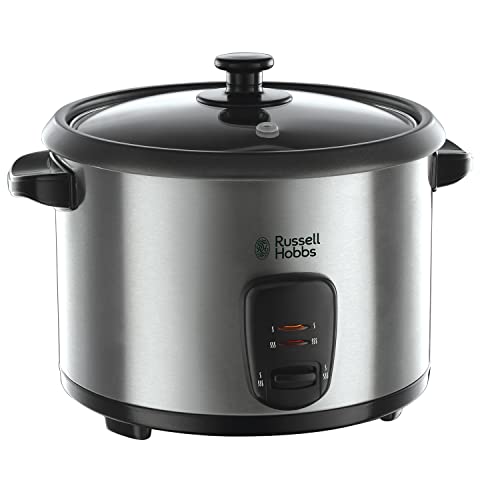
Russell Hobbs Electric Rice Cooker & Steamer 1.8L
Why we like it: If you want a simple, no-fuss rice cooker that can also steam the rest of the meal, this Russell Hobbs is the sensible choice — and a far safer bet than the obscure sub-£20 listings that come and go. It holds 1.8 litres, enough for ten cups of rice, and drops to keep-warm when the rice is done. An extra tray sits above the rice for steaming fish or vegetables at the same time. The non-stick bowl lifts out for cleaning, the glass lid lets you see what’s happening, and a spatula and measuring cup are included.
- Capacity: 1.8 litres (ten cups of rice)
- Fuzzy logic: No — simple cook + automatic keep-warm
- Keep-warm: Yes, automatic
- Extras: Steaming tray, removable non-stick bowl, glass lid, spatula and measuring cup
- Power: 700W; stainless steel base
Our honest take: Don’t expect specialist results — it’s a basic cooker, so brown rice and fussier grains aren’t its strength. At £28 it is also a little dearer than the Breville above, so if you only want rice, that is the cheaper big cooker; this one earns its place with the steaming tray. For everyday white, basmati or jasmine rice with steamed veg on top, it’s reliable, easy to clean, and far less hassle than watching a pan.
This link is an affiliate link — if you buy through it, we may earn a small commission at no extra cost to you.
Check price on Amazon →
Getting the Best From Your Rice Cooker
A rice cooker does the hard part for you, but a few small habits make the difference between good rice and genuinely excellent rice.
Rinse first. Give white rice a quick rinse in a sieve until the water runs nearly clear. This washes off surface starch and is the single biggest reason home rice turns out gluey. Basmati and jasmine especially benefit; you can skip it for short-grain sushi rice if you want it stickier.
Get the ratio right. As a starting point, most white long-grain rice cooks well at roughly 1 part rice to 1.25 parts water by volume; brown rice needs more, closer to 1 to 1.5, and a little longer. Many cookers come with a measuring cup and fill lines calibrated to their own scoop — use them, then adjust by a splash next time if your rice comes out firmer or softer than you like.
Let it rest. When the cooker switches to keep-warm, leave the lid on for five to ten minutes before opening. The residual steam finishes the grains and lets them firm up; fluff gently with a fork or the supplied paddle rather than a spoon, which compacts them.
Clean it properly. Let the inner pot cool, then wash it by hand if it has a ceramic or delicate non-stick coating — dishwashers shorten their life — and wipe the lid and steam vent, where smells and starchy residue collect. A pot left to soak for ten minutes lifts stuck-on rice without scrubbing.
Frequently Asked Questions
How much rice does a rice cooker make?
It depends on the cooker, but the key thing to understand is that rice roughly doubles in volume when cooked. A cooker with a 1-litre capacity typically handles around three to five standard rice cooker cups of uncooked rice — which produces enough cooked rice for four to six people as a side dish, or three to four as a main component of a meal. Always check the manufacturer’s minimum and maximum fill lines, as cooking below the minimum can affect results just as much as overfilling.
Can you cook other things in a rice cooker?
Yes, more than most people realise. Basic rice cookers can handle porridge, steamed vegetables (if they come with a steaming basket), and simple one-pot dishes like congee or dhal. More advanced models with multiple programmes can manage quinoa, couscous, and even cakes in some cases. The Instant Pot, listed above, is essentially designed around this versatility. If you want to go beyond rice regularly, it is worth choosing a model with dedicated settings for what you have in mind rather than assuming any cooker will handle everything equally well.
Is a rice cooker worth it if I only cook rice occasionally?
Probably not — if you make rice once a fortnight, a decent saucepan and a bit of practice will serve you well enough. Where a rice cooker pays for itself is in regularity and the removal of attention: if you cook rice several times a week, or if you batch cook it to use throughout the week, the convenience quickly adds up. The keep-warm function also means you can cook it in the background while doing other things and come back to it an hour later without any deterioration in quality. That kind of low-maintenance reliability is what makes it genuinely useful for a slower, more considered approach to cooking.
What size rice cooker do I need?
Work from how many people you usually cook for, remembering capacities are quoted in uncooked cups (a rice cooker cup is about 180ml). For one or two people, a 0.3–1 litre cooker is plenty. A couple who batch cook, or a small family, are well served by 1–1.5 litres. For four or more, or regular cooking-ahead, look at 1.8 litres and up. It is better to size up a little than to routinely cook at the very top of a small cooker’s range, where results get less reliable.
What’s the difference between a rice cooker and a pressure cooker?
A rice cooker gently steams and absorbs, which gives you the best texture and the most control over different rice varieties. A pressure cooker (or multi-cooker like the Instant Pot) cooks rice faster under pressure — a touch stickier and more uniform, but it also handles soups, stews, beans and far more besides. If rice is your main interest, a dedicated cooker wins on nuance; if you want one appliance that does a great deal, see our guide to the best pressure cookers UK.
Will a cheap microwave rice cooker do instead?
For occasional cooking, yes — a microwave rice cooker is a lidded plastic pot, costs under £15, and does a perfectly decent job of a portion or two of white rice with no worktop appliance to store. What you give up is the hands-off keep-warm and the consistency across larger batches and fussier grains. If you cook rice rarely it is a sensible, cheap starting point; if you cook it several times a week, an electric cooker quickly earns its place.
How much does a rice cooker cost to run?
Very little. Most rice cookers draw between 300 and 700 watts and only run at full power for the cooking phase — usually 20 to 40 minutes — before dropping to a low-wattage keep-warm. A typical batch of rice costs roughly a couple of pence in electricity at current UK rates; even leaving it on keep-warm for a few hours adds only pennies more. Running cost is rarely a reason to choose one model over another.
A Final Word
I have always thought the best kitchen tools are the ones that quietly make things easier without demanding your attention. A rice cooker fits that description well — set it going, walk away, and come back to something done. Whether you are cooking for one or feeding a household, there is a machine on this list that will slot into your routine without fuss. My pick remains the Yum Asia Sakura for the sheer consistency of its results, but every recommendation here has earned its place honestly. I hope one of them earns a place in your kitchen too.
— Gareth, Danbury & Lovejoy
Disclosure: This page contains affiliate links. If you purchase through one of our links, we may earn a small commission at no additional cost to you. We only recommend products we have researched thoroughly and believe to be worth your money. Our rankings are not sponsored or influenced by any brand.
For the deeper dive, see our wellbeing.
Related Guides
🍲 From the D&L Shop: Want a system for cooking smarter? Our Batch Cooking Planner gives you a weekly prep schedule, shopping lists organised by aisle, a freezer tracker, and practical tips — 5 pages, £3.99. Also free: the Weekly Budget Meal Planner. Browse the full shop →
You might also find our guide to Best Slow Cookers UK (2026): Our Honest Picks for Every Kitchen useful.
You might also find our guide to Best Pressure Cookers UK 2026: Instant Pot, Ninja More Reviewed useful.
Sources
Capacity, rated wattage, bowl coating and programme details are taken from manufacturer specifications and cross-checked against verified UK buyer reviews. On safe cooking, cooling and reheating of rice, see Food Standards Agency guidance on cooking food safely.
Last reviewed: 4 September 2026
🛡 Our standards: How we research · Editorial policy · Affiliate disclosure · Corrections · Last reviewed: 4 September 2026

About Gareth
Gareth Isherwood is the editor of Danbury & Lovejoy. He has baked bread at home for 25+ years and has 15 years of growing experience across gardens, containers and other growing spaces, including an East Sussex allotment for the past three years. Read his full story →
Was this useful?