You don’t need many kitchen knives. What you need is a few good ones. A sharp, well-balanced knife makes prep faster and safer — a dull, unwieldy one makes everything harder. The difference between cutting an onion with a sharp chef’s knife and fighting through one with a blunt supermarket knife is genuinely large. This is part of our wider kitchen tools and equipment guide, which covers everything from pans to gadgets.
✉ Join the Dispatch — a calm weekly note, every Thursday. Free.
By Gareth Isherwood — founder of Danbury & Lovejoy. Last reviewed June 2026. How we choose →
Our honest take: most home cooks need one good chef’s knife and a paring knife — not a block of ten. If you already own a sharp knife you get on with, a sharpening steel will do more for your cooking than a new set. These are the few we’d actually keep in a home kitchen.
How we chose these knives
We took the honest position that three good knives beat a padded boxed set, then compared steel quality and edge retention, blade length and shape for UK kitchens, handle comfort and balance, and value per knife actually used. These are researched picks, not first-hand reviews, and we don’t accept payment for placement. Read our full methodology →
We’ve looked at what’s available at every price point and what makes a knife worth buying. Here’s what we’d actually recommend.
Best Kitchen Knife for Each Need
- Best overall chef’s knife: Sabatier Professional 20cm — full-tang Sheffield steel at a fair price
- Best Japanese-style: Global G-2 — lightweight, razor-sharp, iconic
- Best British-made: Robert Welch Signature — beautiful balance, made in Chipping Campden
- Best budget set: Richardson Sheffield Cucina 3-piece — excellent value starter set
- Best bread knife: Victorinox 26cm Serrated — the baker’s standard
- Best paring knife: Victorinox 10cm Paring — precise, comfortable, inexpensive
Our Top Picks in Detail
Best Overall
Sabatier Professional 20cm Chef’s Knife
Correction (25 August 2026, resolved 11 September 2026): this pick used to link the Victorinox Swiss Classic 5-piece set, not the single 20cm chef’s knife described here. Victorinox still do not list the Fibrox chef’s knife on Amazon UK, so the slot now holds a full-tang Sabatier at a lower price. Our chef’s knives guide made the same change on 8 September.
The Sabatier Professional answers the question most people are actually asking, which is what to buy when you do not want to spend much and do not want to buy again. It is made in Sheffield by Taylors Eye Witness, who hold the Sabatier name, and the blade is full tang — one piece of high-chrome, taper-ground steel running the length of the knife into a twin-rivet handle. That construction is the thing worth paying for; it is what separates a knife you keep from one that works loose at the bolster. It costs a fraction of what Japanese knives charge.
It is one of the best pieces of kitchen equipment you can buy for the money. It takes an edge easily on a pull-through or a whetstone, and the money you have not spent covers a decent board and a honing steel — both of which will do more for your cutting than a knife costing ten times as much.
View the Sabatier Professional on Amazon →
Best Japanese-Style Knife
Global G-2
Global knives are made in Japan from a single piece of high-carbon stainless steel — the handle and blade are one piece, which makes them extremely easy to clean and keeps them hygienic. The G-2 is their 20cm chef’s knife and is a genuine classic: it’s lighter than German-style knives, which takes some adjustment but makes it less tiring over a long prep session, and the edge is exceptionally sharp out of the box.
Global knives require proper care — they need to be stored in a block or on a magnetic strip (not loose in a drawer) and sharpened on a whetstone rather than a steel. If you’re willing to do that, the edge they hold is remarkable.
Best British-Made
Robert Welch Signature
Robert Welch make cutlery and knives in Chipping Campden, Gloucestershire, and their Signature range is genuinely excellent. The knives have full-tang blades, weighted handles, and a balance that feels immediately right. They’re not cheap, but they’re made with real craft and carry a guarantee. If you want a knife made in the UK by people who care, this is it.
View Robert Welch Signature knives on Amazon →

Robert Welch Signature Kitchen Knife 14cm - Multi Award Winning British Design - Crafted from The Finest German 1.4116 Stainless Steel - Suitable for Slicing Fruit and Vegetables.
Best Budget Set
Richardson Sheffield Cucina 3-Piece Set
Richardson Sheffield have been making knives in Sheffield since 1839, and the Cucina starter set covers the three knives a kitchen actually reaches for — a cook’s knife, an all-purpose knife and a paring knife — at a price that’s hard to argue with. They’re not as refined as Global or Robert Welch, but they’re solid, sharpened reasonably, and will serve most home cooks well for years. If you enjoy in-depth cooking, our piece on cast iron cooking is worth a read too.

Richardson Sheffield Cucina Kitchen Knife Set, Chef Knife Set, 3 Pieces | Martensitic Stainless Steel Kitchen Knives, Paring Knife 9.6cm, Chef Knife 20cm, Utility Knife 12cm, Non-Slip Handles
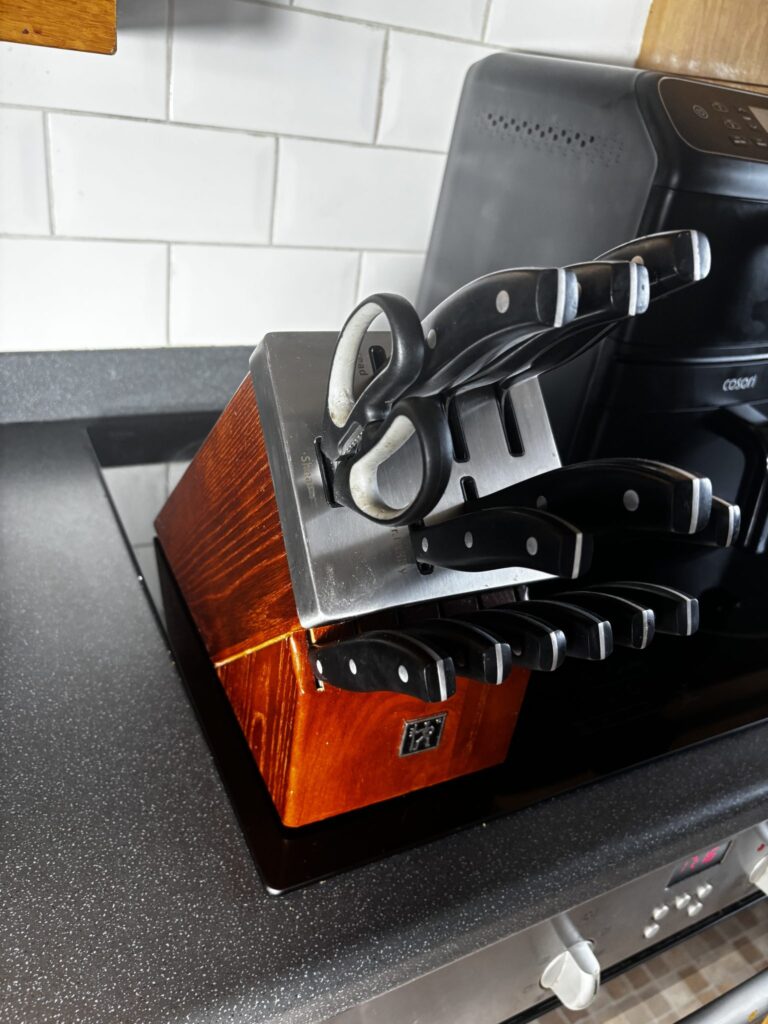
A note on blocks rather than blades. The one above is a J.A. Henckels International, which is not one of our picks on this page, and it is here because it answers the question in this section better than a specification does: a full block holds eight or nine pieces and a household of two will reliably use three of them. The detail worth copying whatever you buy is the steel top — it carries a sharpening slot, so the honing happens where the knives live instead of in a drawer, which is the single thing that decides whether it happens at all.
How Many Knives Do You Actually Need?
Most home cooks need three: a chef’s knife (20–25cm) for most prep work, a bread knife (serrated, 25–30cm) for bread and anything with a hard crust, and a paring knife (8–10cm) for small detailed work like peeling and coring. Everything else is optional. A good sharpener or whetstone is as important as the knives themselves — a sharp cheap knife beats a blunt expensive one every time.
Ready to Choose Your Knife?
Start with the Sabatier Professional 20cm — full tang, Sheffield-made and good value. It will outlast a drawer of cheaper knives.
Once you’ve found your knife, it’s worth thinking about the rest of your kitchen kit. We’ve put together an honest guide to the best cookware for UK kitchens, and you’ll find all of our reviewed recommendations in the Buying Guides. If you are sorting out your kitchen kit, our guide to the best cookware covers pans and more.

Sabatier Professional Kitchen Chef Knife - 8in/20cm Full Tang Blade Forged from High Chrome Taper Ground Stainless Steel, Twin Rivet Comfort Handle. Sharper for Longer, by Taylors Eye Witness
Related Guides
Kitchen Knives at a Glance
subject to change
Product prices and availability are accurate as of the date/time indicated and are subject to change. Any price and availability information displayed on Amazon.co.uk at the time of purchase will apply to the purchase of this product.Jump to Our Picks
Best Overall: Sabatier Professional →
 Global G-2 Cook's Knife 20cm Blade, Made in Japan, 8 Inch Chefs Knife, Versatile Japanese Knife for Cooking, Premium Stainless-Steel All-Purpose Kitchen KnifeView on Amazon →
Editor’s Pick
Sabatier Professional 20cm Chef’s Knife
The knife most professional chefs start with. Razor-sharp out of the box, holds its edge well, and costs a fraction of premium brands. It handles everything from dicing onions to breaking down a chicken — and it’s the best value in the kitchen.
Which one?
One do-it-all chef’s knife that suits almost any cook — light, grippy even with wet hands and easy to keep sharp: Sabatier Professional 20cm.
A lightweight, razor-sharp Japanese-style blade for precision work and finer cuts: Global G-2.
A British-made knife with the heft and balance for everyday use, built to last a lifetime: Robert Welch Signature.
A complete starter set on a budget — the everyday knives a new kitchen needs in one box: Richardson Sheffield Cucina 3-Piece Set.
How We Choose
Every knife on this list has been selected based on real cooking criteria — edge retention, balance, handle comfort, and value for money. Selections draw on in-depth cooking knowledge, verified customer reviews, and trusted UK kitchen equipment sources. We compare how each blade is built and what long-term owners report about edge retention and handling, rather than testing every knife ourselves. We assess edge retention, balance in hand, comfort during longer prep sessions, and how easy each knife is to sharpen at home. We also consider whether it’s dishwasher-safe (though we’d always recommend hand-washing).
Global Cooks Knife 20cm, Japanese Cromova 18 Stainless Steel | G-2: Award winning chef's knife, all-purpose kitchen utensil perfect for fruits, vegetables, meat and more, hand wash only.
Sabatier Professional Kitchen Chef Knife - 8in/20cm Full Tang Blade Forged from High Chrome Taper Ground Stainless Steel, Twin Rivet Comfort Handle. Sharper for Longer, by Taylors Eye Witness
Knife sets, blocks and buying individually
The honest position on sets: most people are better served by three good knives bought separately than by a boxed set of ten. A typical set pads its count with steak knives, a cleaver you’ll never lift, and a pair of kitchen scissors, while the chef’s knife — the one doing 90% of the work — is made to the price the set had to hit. Buy a chef’s knife, a paring knife and a bread knife individually and you’ll spend similar money on three tools you actually reach for.
A set does make sense in two situations: kitting out a first kitchen from nothing, where the convenience is worth a compromise, and as a gift, where a presentation box is part of the point. If you do buy one, judge it entirely on the chef’s knife and treat everything else as a bonus.
Storage: blocks, strips and guards
There are three sensible options. A wooden block protects edges and keeps knives to hand, but the enclosed slots trap crumbs and moisture and dictate how many knives you own — and self-sharpening blocks, which drag the blade over a ceramic rod every time you draw it, remove metal you didn’t ask to lose. A magnetic strip keeps blades dry, visible and unrestricted by slot count, but wants a wall you’re happy to drill and a bit of care putting knives back spine-first. In-drawer guards or a knife roll suit small kitchens where nothing can live on the worktop.
Whichever you choose, the point is the same: an edge that touches other metal in a drawer is an edge you’ll be sharpening again shortly.
Buying well under £50
A budget knife can be genuinely good, and the reason is boring: the steel used in a £30 knife and a £120 knife is often from the same family, and most of the price difference sits in handle materials, finishing and brand. What you give up at the budget end is edge retention — you’ll sharpen more often — and balance, which matters more the longer you cook for.
What to look for under £50: a full or partial tang running into the handle, stamped rather than forged is fine at this price, a comfortable grip you can hold with a pinch on the blade, and a plain high-carbon stainless steel rather than a coated novelty finish. What to skip: anything sold in a set of five for the price of one decent knife, ceramic blades (they hold an edge well until the day they chip and can’t be repaired), and coloured non-stick coatings, which wear off into your food and make sharpening awkward.
One good £40 chef’s knife plus a £10 sharpening steel will outcook a £50 block set comfortably.
Paring knives: the second knife worth owning
If the chef’s knife is the workhorse, the paring knife is the one that stops you using the workhorse badly. It handles everything done in the hand rather than on the board — hulling strawberries, peeling apples, deveining prawns, trimming fat, coring tomatoes, splitting vanilla pods — plus the small board jobs where a 20cm blade is unwieldy, like slicing a single shallot or segmenting citrus.
Look for a blade between 8 and 10cm; shorter feels fiddly, longer loses the control that is the whole point. A straight edge is more versatile than a curved “bird’s beak”, which is specialised for peeling round produce. Weight matters less than on a chef’s knife because you’re not chopping — comfort in a pinch grip matters more. And because paring knives are cheap relative to everything else in the block, this is the one place where buying two is sensible: one for produce, one that lives with the cheeseboard.
Knives as a gift
A good knife is a lasting present for someone who cooks, and one well-chosen knife beats a block of ten. For a first proper knife, the Sabatier Professional 20cm is full tang and good value. For a keen cook, the Global G-2 is the iconic Japanese-style blade, light and very sharp, though it wants a whetstone and a block or magnetic strip rather than a drawer. For a British-made present, Robert Welch’s Signature range is made in Chipping Campden. A set makes most sense for a first kitchen, where the Richardson Sheffield Cucina starter set covers the three knives that actually get used.
Adding a sharpening steel will do more for most cooks than a dearer knife. And if you send a knife straight to the recipient, the courier has to hand it to an adult and may ask for ID, so it cannot be left on the doorstep.
Common Questions
What is the best kitchen knife for beginners in the UK?
The Sabatier Professional 20cm is a good place to start. It’s full tang, takes an edge easily, and is cheap enough that the difference buys a board and a honing steel — which will improve your cutting more than a dearer knife would.
How often should I sharpen my kitchen knives?
A quick hone with a steel before each use keeps the edge aligned. A proper sharpen with a whetstone or pull-through sharpener every few months is usually enough for home cooks — you’ll notice when it starts to feel dull. If sharpening at home doesn’t appeal, a farmers’ market or hardware shop can often sharpen knives for you, or you can post them to a specialist service.
Are expensive kitchen knives worth it?
Not always. A well-made mid-range knife that you sharpen regularly will outperform an expensive knife that’s neglected. That said, higher-end knives often have better steel, better balance, and hold their edge longer.
What knives does a home cook actually need?
Most home cooks can manage with three: a chef’s knife (20cm), a small paring knife, and a serrated bread knife. A santoku is a nice alternative to a chef’s knife if you prefer a shorter, flatter blade.
Is a kitchen knife a good gift?
Yes, for someone who cooks: one good knife is a better present than a big block. The Sabatier Professional 20cm suits a first proper knife, the Global G-2 suits a keen cook willing to use a whetstone, and the Robert Welch Signature range is the British-made choice. Sent direct, a knife has to be handed to an adult on delivery, so it cannot be left on the doorstep.
You might also find our guide to Budget-Friendly Winter Stews: 3 Slow-Cooker Recipes for Comfort (UK) useful.
Considered but didn’t include
Zwilling Four Star — solid German steel, but consistently priced £20-£30 above the Wüsthof Classic equivalent without offering a meaningful difference in edge retention or balance.
— Gareth
Sources
Steel type, hardness (HRC), blade length and handle materials are taken from manufacturer specifications and cross-checked against verified UK buyer reviews. Guidance on safe handling and storage of kitchen knives follows RoSPA kitchen-safety guidance.
🛡 Our standards: How we research · Editorial policy · Affiliate disclosure · Corrections

About Gareth
Gareth Isherwood is the editor of Danbury & Lovejoy. He has baked bread at home for 25+ years and has 15 years of growing experience across gardens, containers and other growing spaces, including an East Sussex allotment for the past three years. Read his full story →
Was this useful?