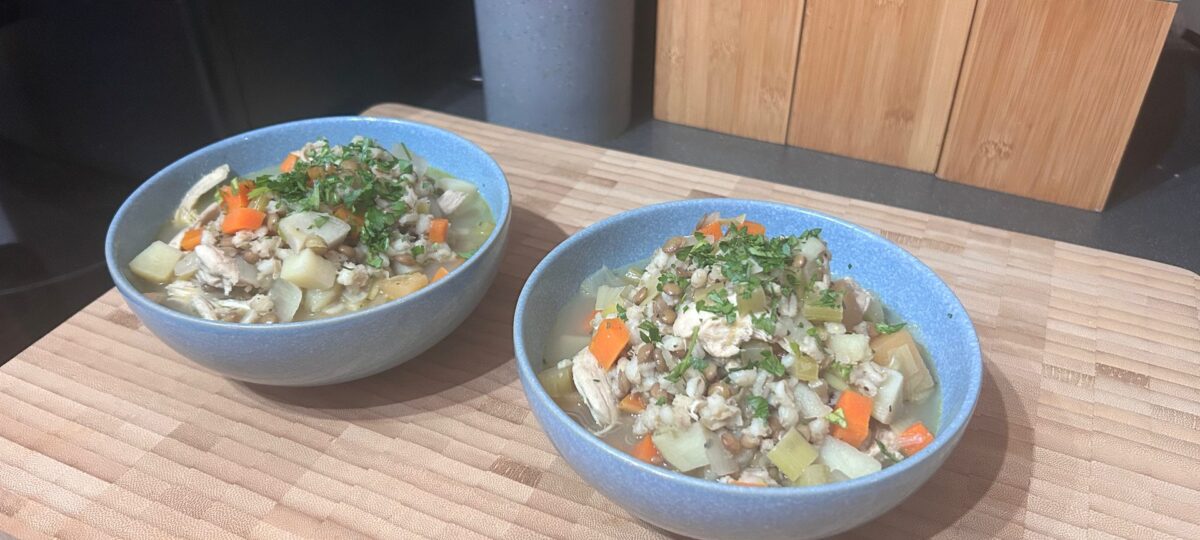
This is a broth in the old British sense: a proper bowlful of chicken, vegetables, pearl barley and lentils in a clear, savoury stock, closer to a Scotch broth than to a thin stock. The barley gives it body and a soft chew, the green lentils hold their shape and add some bulk, and the vegetables do most of the work. It’s cheap, it’s filling, and like most soups it tastes even better the next day.
It’s made with chicken breasts, which can turn dry and stringy if they boil for an hour. So they go in whole and poach gently in the broth for about 20 minutes. Then you lift them out, shred them, and stir them back in at the end. Everything happens in one large pan in about an hour and twenty minutes, and most of that is a gentle simmer that needs no attention.
When I made this for the photos, I used onion, leek, celery, carrot and potato, all from Sainsbury’s, and chicken stock cubes. It took about an hour and twenty minutes and made six good-sized bowls. It was properly filling, and I wouldn’t change anything.
You need a large, heavy pan or casserole that holds at least 4 litres. A good stock makes a real difference here: our homemade chicken broth is ideal if you have some in the freezer, and stock cubes are fine if you don’t.
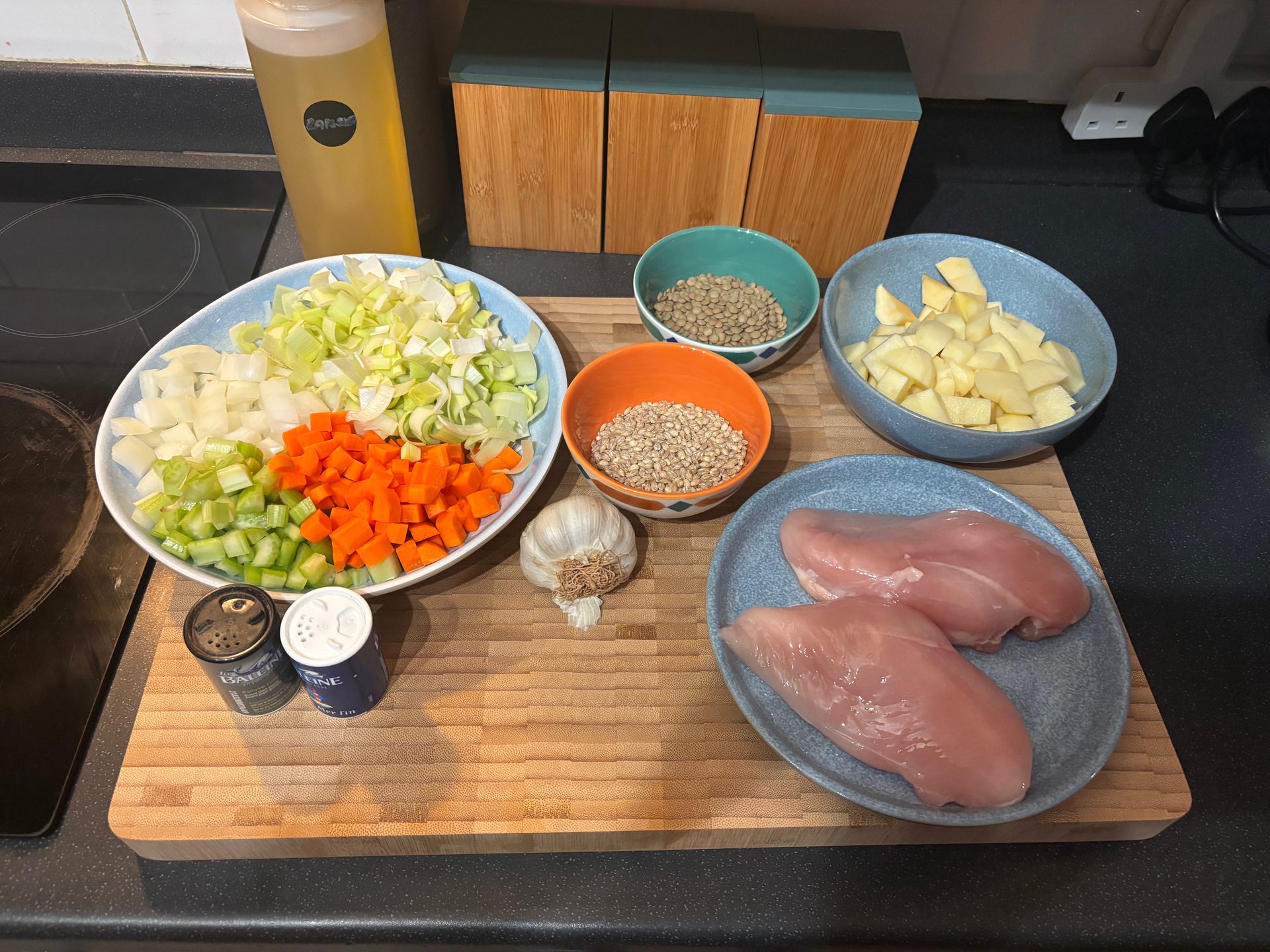
Chicken, Barley and Lentil Broth
A hearty, clear broth of chicken, root vegetables, pearl barley and green lentils. The chicken breasts poach whole and are shredded at the end, so they stay tender.
Ingredients
- Skinless chicken breasts (about 350g) 2
- Olive or rapeseed oil, or a knob of butter 1 tbsp
- Onion, finely chopped 1 large
- Carrots, peeled and diced 2
- Celery sticks, diced 2
- Leek, halved, washed and sliced 1
- Swede, parsnip or potato, peeled and diced 250g
- Garlic cloves, crushed 2
- Pearl barley, rinsed 100g
- Dried green lentils, rinsed 75g
- Chicken stock, homemade or from 2 cubes 1.75 litres
- Bay leaves 2
- Thyme sprigs, or dried thyme 3 sprigs or ½ tsp
- Kale or Savoy cabbage, shredded (optional) 2 handfuls
- Fresh parsley, chopped a small handful
- Salt and black pepper to taste
Method
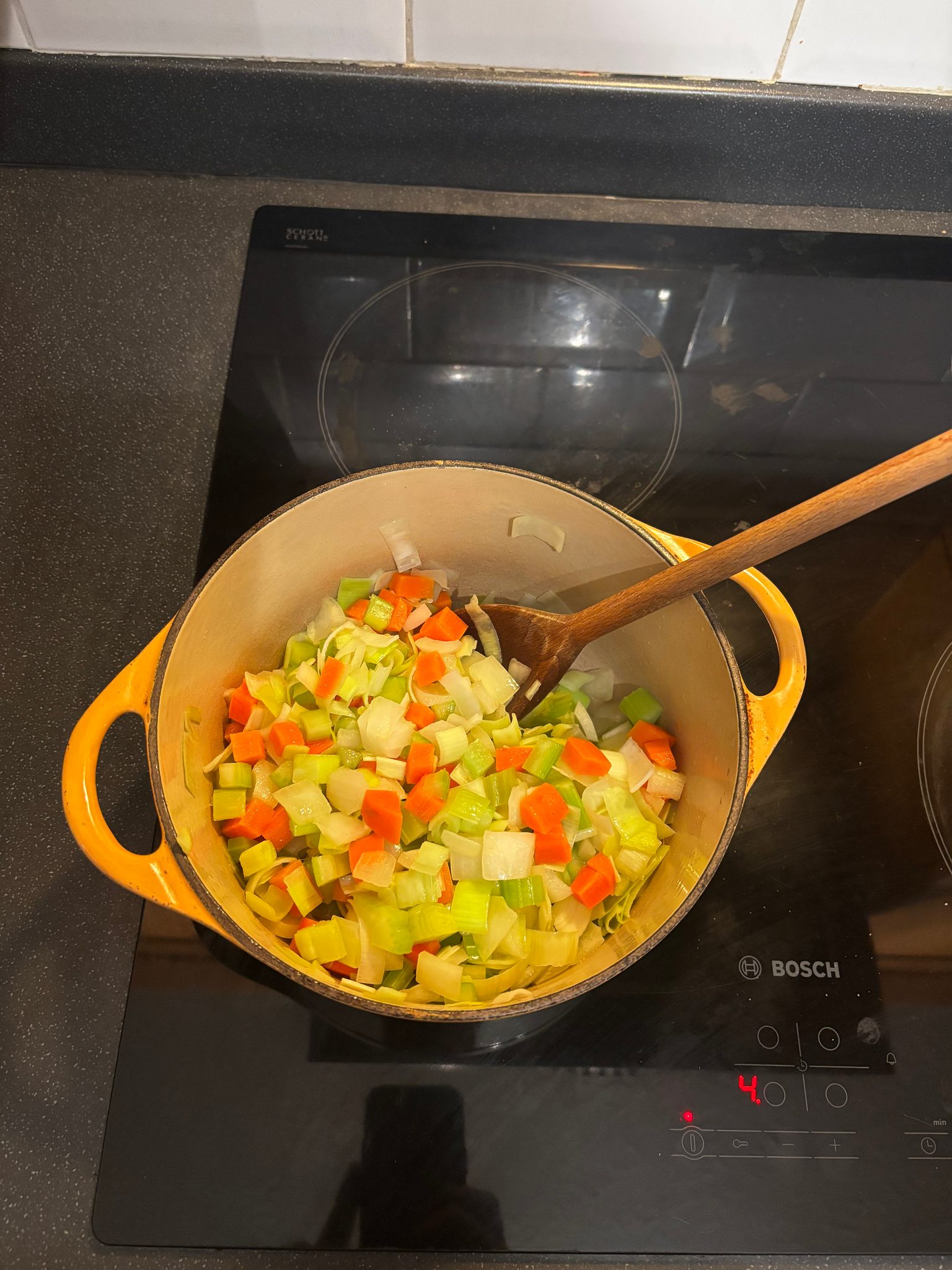
- Heat the oil in a large, heavy pan over a medium-low heat. Add the onion, carrots, celery and leek with a pinch of salt and cook gently for 10 minutes, stirring now and then, until softened but not browned.
- Add the swede (or parsnip or potato) and the garlic and cook for 2 minutes more.
- Stir in the rinsed barley, then pour in the stock and add the bay leaves and thyme. Bring to the boil, then turn down to a gentle simmer, put a lid on slightly ajar, and cook for 15 minutes.
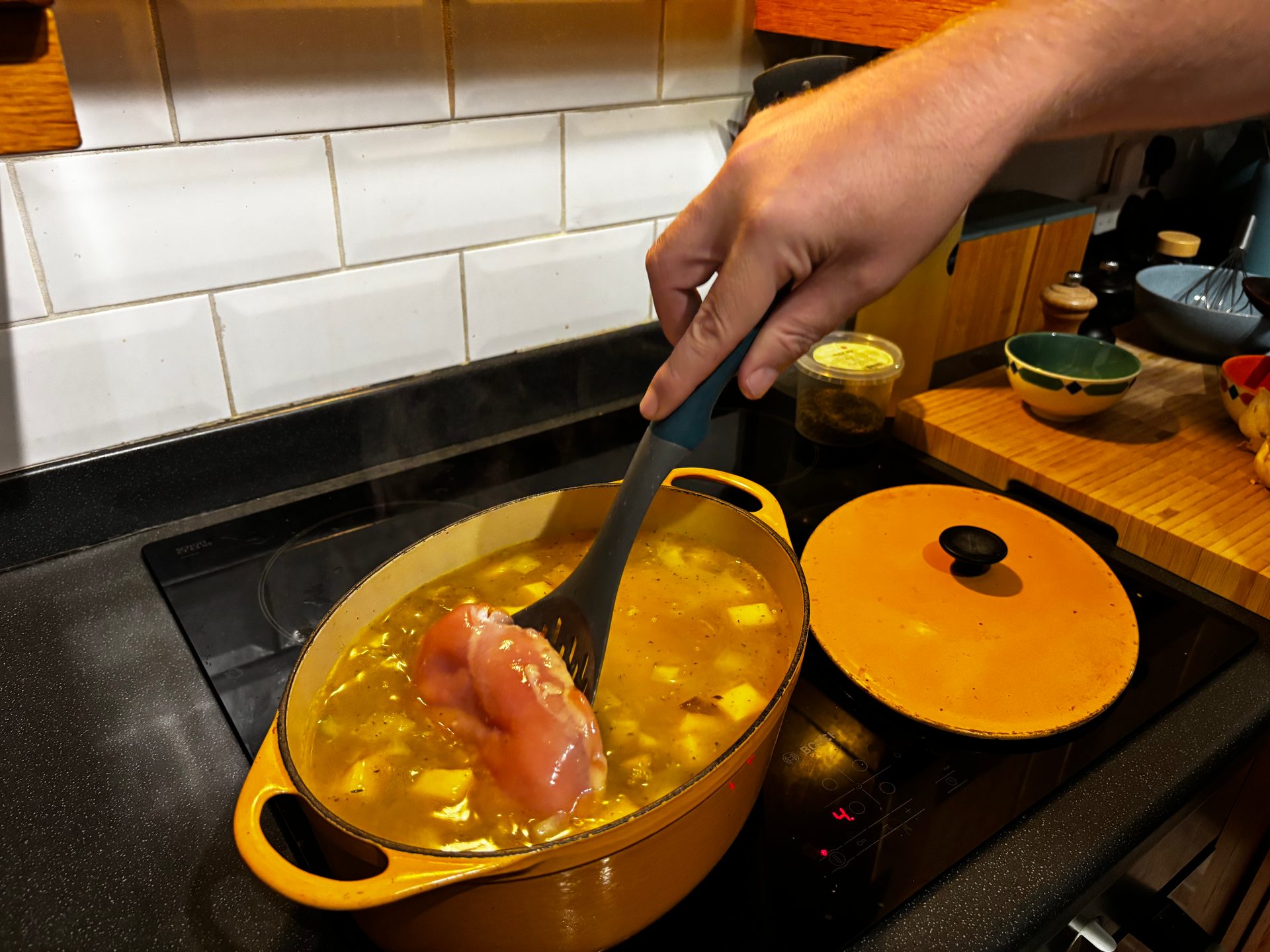
- Stir in the rinsed lentils, then lower the whole chicken breasts into the broth so they are covered. Keep it at a bare simmer, with just a few bubbles breaking the surface, for 20 minutes, until the chicken is cooked through. A thermometer in the thickest part should read 75°C, and there should be no pink inside.
- Lift the chicken out onto a board and leave the broth simmering gently for another 10–15 minutes, until the barley is tender but still has a little chew and the lentils are soft.
- Meanwhile, shred the chicken with two forks.
- If you’re using kale or cabbage, add it for the last 5 minutes. Return the chicken to the pan, remove the bay leaves and thyme stalks, and heat it through. If the broth looks too thick, add a splash of boiling water.
- Taste, season well with salt and pepper, and stir in the parsley. Serve in warm bowls with crusty bread.
Why poach the chicken breasts whole
Chicken breast has very little fat or connective tissue, so it goes from tender to dry quickly. If you dice it and let it boil with the barley for the best part of an hour, you get chewy cubes. If you poach it whole at a gentle simmer and take it out as soon as it’s cooked, it stays juicy and shreds into soft strands. It also flavours the broth while it cooks. If you’d rather use chicken thighs, they can stay in for the whole cook, and they give a richer broth.
Barley and lentils: what each one does
Pearl barley has had its outer husk polished off, so it cooks in about 40 minutes without soaking. It releases starch as it simmers, and that’s what gives the broth body. Rinse it first, or the broth turns cloudy and gluey. Green lentils keep their shape far better than red lentils, which fall apart into a purée (that’s what you want in our carrot and red lentil soup, but not here). They need no soaking and cook in 25–30 minutes, which is why they go in after the barley. Between them, they make a bowl filling enough to be a whole meal.
Tips for getting it right
- Soften the vegetables slowly. Ten unhurried minutes over a low heat builds a sweet, savoury base. Rushing them on a high heat browns the onion and muddies the flavour.
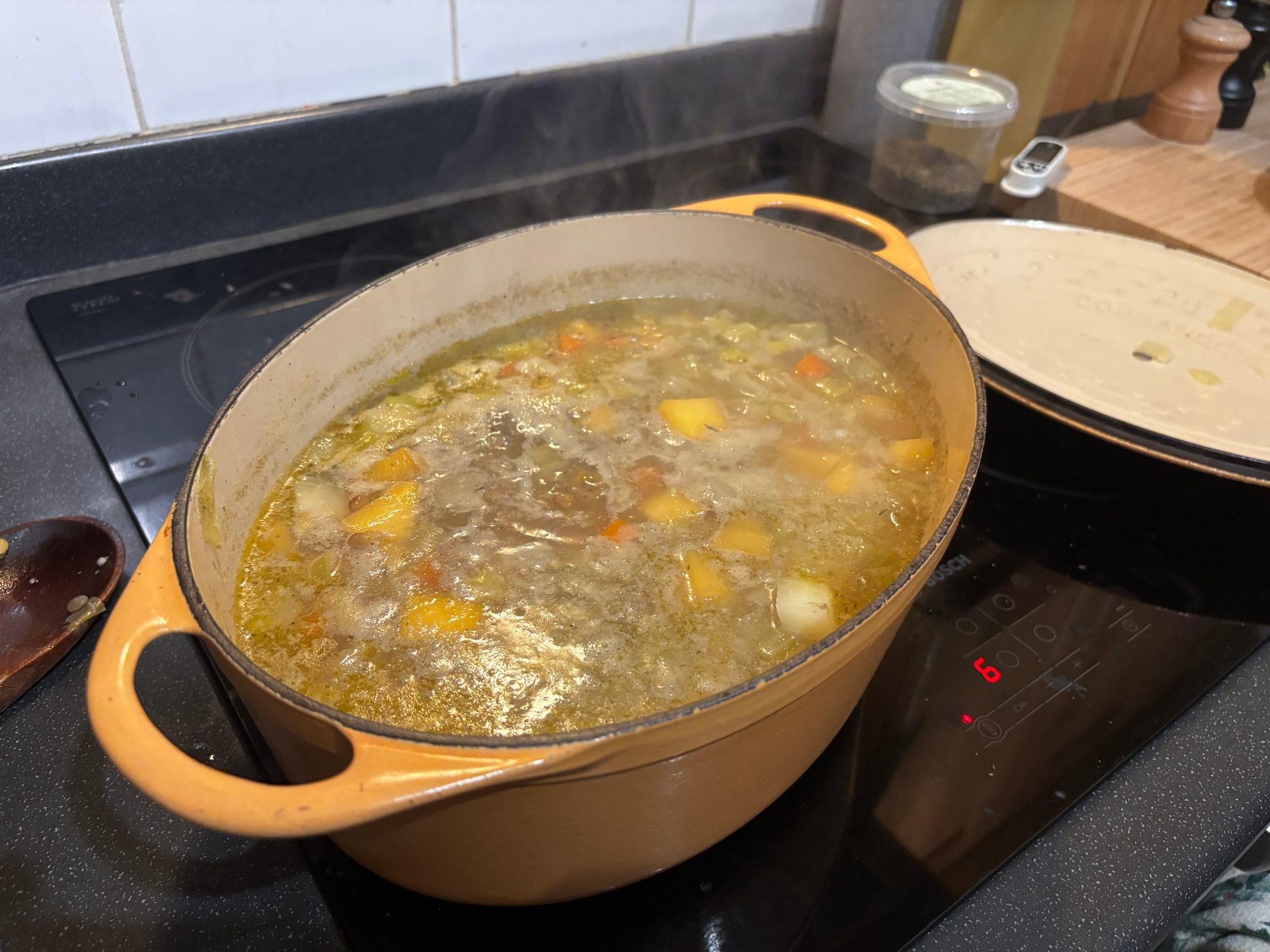
- Keep it at a simmer, not a boil. A hard boil toughens the chicken and breaks the barley up into a cloudy broth.
- Season at the end. Stock cubes are salty, and the broth reduces as it cooks, so taste it before you add more salt.
- Cut the vegetables to roughly the same size, about 1cm, so they cook evenly and fit on a spoon.
- Expect it to thicken. Barley and lentils keep absorbing liquid as the broth sits. Loosen leftovers with a little boiling water or stock when you reheat them.
Using what veg you have
The vegetables are flexible, and this is a good way to use up the end of the week’s veg. Roughly 750g of vegetables in total is about right. Swede, parsnip, turnip, potato and celeriac all work in place of each other, and a second leek can stand in for the onion. Greens such as kale, Savoy cabbage, spring greens or spinach go in for the last few minutes only. Peas or sweetcorn from the freezer can go in with the chicken when it returns to the pan. Avoid anything that turns to mush in an hour, such as courgette, unless you add it near the end.
Keeping and freezing
- Cool it quickly: divide it into shallow containers, and once it’s cool, put it in the fridge within 2 hours.
- Fridge: up to 3 days in a covered container.
- Freeze: in portions for up to 3 months. Defrost it in the fridge overnight.
- Reheat: in a pan with a splash of water until it’s steaming hot all the way through. Reheat only once.
It’s very good with a few slices of warm bread for mopping up the bowl. Our soda bread needs no yeast or kneading, so it can bake while the broth simmers.
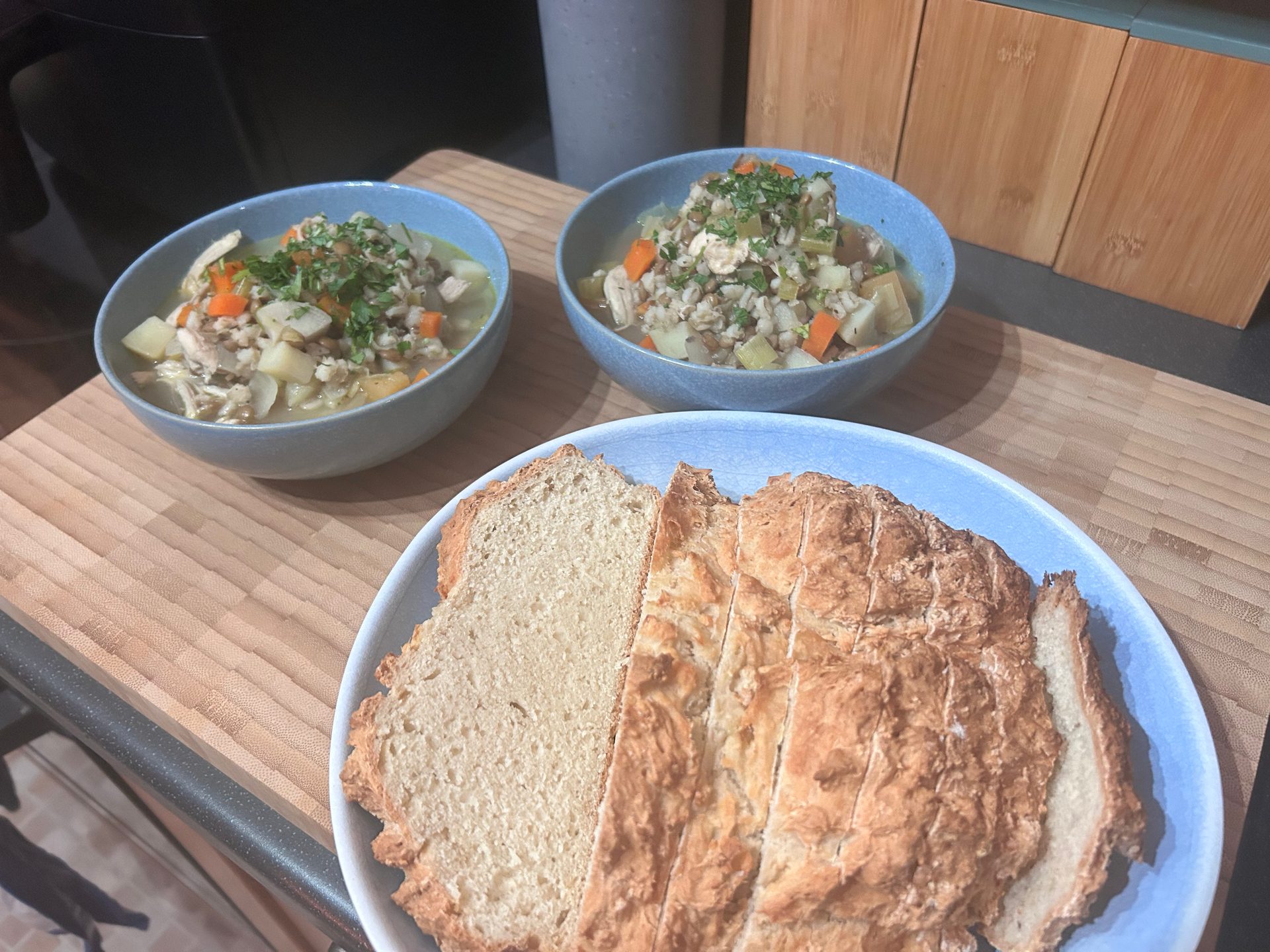
For more cheap, filling suppers, see our cheapest high-protein meals, and for the same kind of cooking done in a slow cooker, there’s our week of slow cooker meals.
FAQs
Do you need to soak pearl barley before making soup?
No. Pearl barley has had its outer husk removed, so it cooks in about 40 minutes straight from the bag. Rinse it in a sieve first to wash off the loose starch, which keeps the broth clearer.
Can I use red lentils instead of green?
You can, but they behave differently. Red lentils collapse into a purée and thicken the broth, so it becomes more of a thick soup. Green or brown lentils hold their shape, which is what this recipe is after.
How do I stop chicken breast going dry in soup?
Poach the breasts whole at a gentle simmer for about 20 minutes, until they reach 75°C in the thickest part, then lift them out and shred them. Stir the chicken back in at the end so it only heats through.
Can I use chicken thighs instead of breasts?
Yes. Boneless thighs can stay in the broth for the whole cook without drying out, and they give a richer flavour. Shred or chop them before serving.
Why has my broth gone thick overnight?
The barley and lentils keep absorbing liquid as the broth sits. Add a splash of boiling water or stock when you reheat it, until it’s as loose as you like.
Can you freeze chicken and barley soup?
Yes, for up to 3 months. Freeze it in portions, defrost it in the fridge overnight, and reheat it until it is steaming hot all the way through. The barley softens a little after freezing but is still good.
Can I make this in a slow cooker?
Yes. Soften the vegetables in a pan first, then put everything except the greens and parsley into the slow cooker with the chicken breasts whole, and cook on LOW for 6 hours. Shred the chicken, stir it back in with the greens, and cook for 15 minutes more.
Was this useful?