Best Dehumidifiers for Laundry UK 2026: Stop Damp, Dry Clothes Faster
Drying laundry indoors is a year-round reality for most UK households — and it comes at a cost. Every load hung on a clothes horse releases roughly two litres of moisture into the air, raising humidity levels that lead to condensation on windows, damp smells, and — left unchecked — mould growth on walls and ceilings. A dehumidifier removes that excess moisture at source, speeding up drying time while protecting your home.
✉ Join the Dispatch — a calm weekly note, every Thursday. Free.
This pillar guide covers everything you need: our research-based picks for the best dehumidifiers for laundry in the UK, a complete buyer’s guide, guidance on ideal home humidity levels, and practical fixes for window condensation. Whether you’re drying in a small flat or a large family home, there’s a right dehumidifier for your needs.
Quick Comparison: Best Dehumidifiers for Laundry UK 2026
| Product | Type | Capacity/day | Coverage | Price Range | Amazon Link |
|---|---|---|---|---|---|
| MeacoDry Arete One 20L | Compressor + HEPA | 20 litres | Up to 5 beds | £256.99 | Buy on Amazon |
| EcoAir DDWH10 Desiccant | Desiccant + heater | 6 litres | Rooms up to 50m² + garages | £393.36 | Buy on Amazon |
| Pro Breeze 12L | Compressor | 12 litres | Up to 3 beds | £134.99 | Buy on Amazon |
| EcoAir DD1 Classic MK6 | Desiccant | 7.5 litres | Up to 2 beds | £219.00 | Buy on Amazon |
subject to change
Product prices and availability are accurate as of the date/time indicated and are subject to change. Any price and availability information displayed on Amazon.co.uk at the time of purchase will apply to the purchase of this product.Best Overall Dehumidifier for Laundry UK
MeacoDry Arete One 20L
The MeacoDry Arete One 20L pairs a large compressor dehumidifier with an H13 HEPA air filter, which suits a home that dries laundry indoors most days. Its laundry mode runs for six hours and then switches itself off, and its smart humidity mode holds the room at your target rather than running flat out. Meaco quote 40 dB and a running cost of about 5p an hour.
Pros:
- Dedicated laundry mode speeds up drying time significantly
- Quiet for its size at 40 dB, with a night mode
- Smart humidity mode holds your target and saves energy
Cons:
- Higher upfront cost than budget alternatives
- Large unit may not suit very small flats
| Type | Compressor |
|---|---|
| Capacity/day | 20 litres |
| Coverage | Up to 5-bedroom homes |
| Noise | 40 dB |
| Energy rating | About 5p an hour (Meaco) |
| Laundry mode | Yes |

MeacoDry Arete® One 20L Dual Dehumidifier & HEPA Air Purifier for Homes - 5x Year Warranty - Controls Humidity & Removes Excess Moisture
Best for Cold Rooms & Garages
EcoAir DDWH10 Desiccant
The EcoAir DDWH10 is a desiccant dehumidifier, so it keeps working in the cool, unheated rooms where compressor models lose their edge, which is exactly where a lot of UK laundry actually dries. It removes up to 6 litres a day (at 20°C and 60% humidity), suits rooms up to 50m² and has a laundry mode. It also doubles as a heater: a built-in PTC heater runs at up to 1,500W, so in a cold garage or utility room it can take the chill off while the washing dries. It mounts on a wall or stands on the floor, is IP24 splash-rated, and comes with a remote and a 1–7 hour timer.
Pros:
- Desiccant operation — suited to cold rooms and garages where compressor models lose efficiency
- Laundry mode, plus a built-in heater for cold spaces
- Wall-mountable and IP24 splash-rated, with a remote and a timer
Cons:
- Dearer than most compressor models
- Power-hungry when working hard: 250–420W dehumidifying, 1,200W in laundry mode, up to 1,500W heating
| Type | Desiccant (with heater) |
|---|---|
| Capacity/day | 6 litres (20°C, 60% RH) |
| Coverage | Rooms up to 50m², including garages and unheated rooms |
| Noise | 37–53 dB |
| Energy rating | 250–420W dehumidifying; 1,200W laundry mode |
| Laundry mode | Yes |

EcoAir DDWH10 Desiccant Dehumidifier 6L or Heater | Wall Mount/Free Standing | Remote Control | Home Garage Basement Boat Bathroom
Best Budget Dehumidifier for Smaller Homes
Pro Breeze 12L
The Pro Breeze 12L is a budget option sized for smaller flats, maisonettes, and terraced houses. Based on our research, it handles everyday laundry drying competently and includes a useful continuous drainage option, making it a practical pick if you don’t need the muscle of a full 20-litre unit.
Pros:
- Excellent value — one of the most affordable effective dehumidifiers available in the UK
- Continuous drainage hose option for hands-free operation
- Compact and easy to position near a clothes horse
Cons:
- Smaller capacity means it may struggle in larger or very damp homes
- No laundry mode — requires manual settings
| Type | Compressor |
|---|---|
| Capacity/day | 12 litres |
| Coverage | Up to 3-bedroom homes |
| Noise | 45 dB |
| Energy rating | C |
| Laundry mode | No |

Pro Breeze® 12L/Day Dehumidifier with Automatic Humidity Sensor & Display, Sleep Mode, 24-hour Timer, Laundry Drying, Large Tank - WHICH? BEST BUY DEHUMIDIFIER AWARD
Best for Cold Rooms & Unheated Spaces
EcoAir DD1 Classic MK6 Desiccant
Unlike compressor dehumidifiers, the EcoAir DD1 Classic MK6 uses a desiccant rotor to extract moisture — a method that works effectively even in temperatures below 10°C, making it the better choice for garages, conservatories, and poorly heated rooms in winter. Based on our research, desiccant models like this draw warmer, drier air out of the unit, which also gently warms the room — a secondary benefit when drying laundry in cold spaces.
Pros:
- Works effectively below 15°C — ideal for garages, conservatories, and cold back rooms
- Lighter and quieter than many compressor models
- Ioniser function helps reduce airborne bacteria and odours
Cons:
- Higher running costs than compressor models at equivalent temperatures above 15°C
- Lower daily extraction rate than compressor competitors
| Type | Desiccant |
|---|---|
| Capacity/day | 7.5 litres |
| Coverage | Up to 2-bedroom homes / single rooms |
| Noise | 34 dB |
| Energy rating | C |
| Laundry mode | No (but effective in cold rooms) |

EcoAir DD1 Classic MK6 Blue Desiccant Dehumidifier | Electronic Control | 7.5L/Day | Quiet 34dBA | Ioniser | Silver Filter | Laundry | Timer | 6Kg | Economy Mode | Home Garage Basement Boat
Which One Should You Buy?
If you only read this far, here is the quick steer for the four situations most UK households are in:
- Most homes, drying laundry in a heated room: the MeacoDry Arete One 20L — high extraction, a proper laundry mode and an H13 air filter, quiet enough for a living room.
- Drying in a cold garage, conservatory or unheated room: a desiccant — the EcoAir DDWH10 keeps working in cold rooms where compressors fade, and its built-in heater can warm the space as well.
- Smaller flat or a tight budget: the Pro Breeze 12L — the best value here, and plenty for one or two bedrooms.
- One cold room, lightest and quietest: the EcoAir DD1 Classic MK6 — a compact desiccant for a single unheated room, where a big compressor would be overkill.
How We Chose Our Picks
These are research-led picks, not tested at home: we compared manufacturer specifications with verified UK buyer reviews and published energy figures. We assess each product against key criteria relevant to UK homes: extraction capacity in litres per day, performance at typical UK room temperatures (which are often lower than manufacturer test conditions), noise output, energy rating, laundry-specific features, and overall value for money. We do not include products based on manufacturer claims alone — every pick must demonstrate consistent performance based on real UK buyer feedback.
Buyer’s Guide: Choosing the Right Dehumidifier for Laundry in the UK
Compressor vs Desiccant Dehumidifier: Which Is Better for UK Homes?
Compressor dehumidifiers work by drawing air over cold coils to condense moisture — they’re highly efficient and extract large volumes of water per day, but their performance drops significantly in cold temperatures (below 15°C). Desiccant dehumidifiers use a moisture-absorbing rotor that works equally well across all temperatures, making them the better choice for cold garages, conservatories, or homes without central heating in winter.
For most UK living rooms and bedrooms where laundry is dried, a compressor model is the more cost-effective choice. For cold or unheated spaces, choose a desiccant.
What Size Dehumidifier Do I Need?
As a general guide for UK homes:
- 1–2 bedroom flat or small terraced house: 10–12 litres/day
- 3–4 bedroom semi-detached or detached: 16–20 litres/day
- Large detached home or home with damp problems: 20–25 litres/day
Note that manufacturer capacity figures are measured at 30°C and 80% RH — real-world UK performance, particularly in winter, will be lower. Size up if in doubt.
How Long Does It Take a Dehumidifier to Dry Laundry?
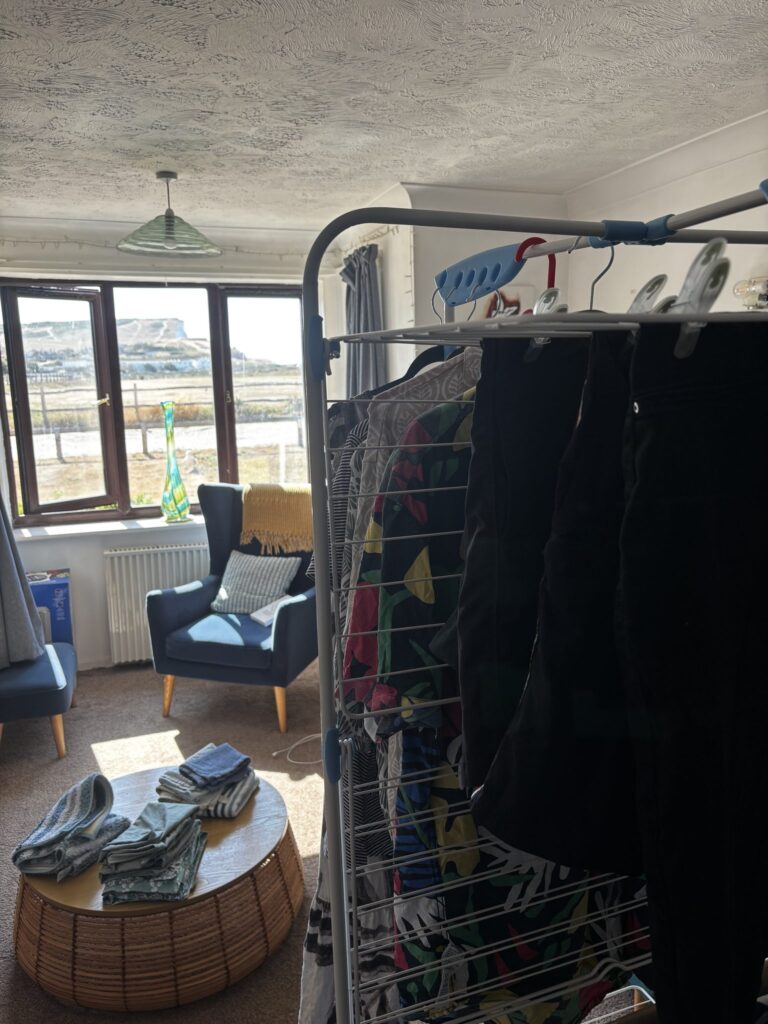
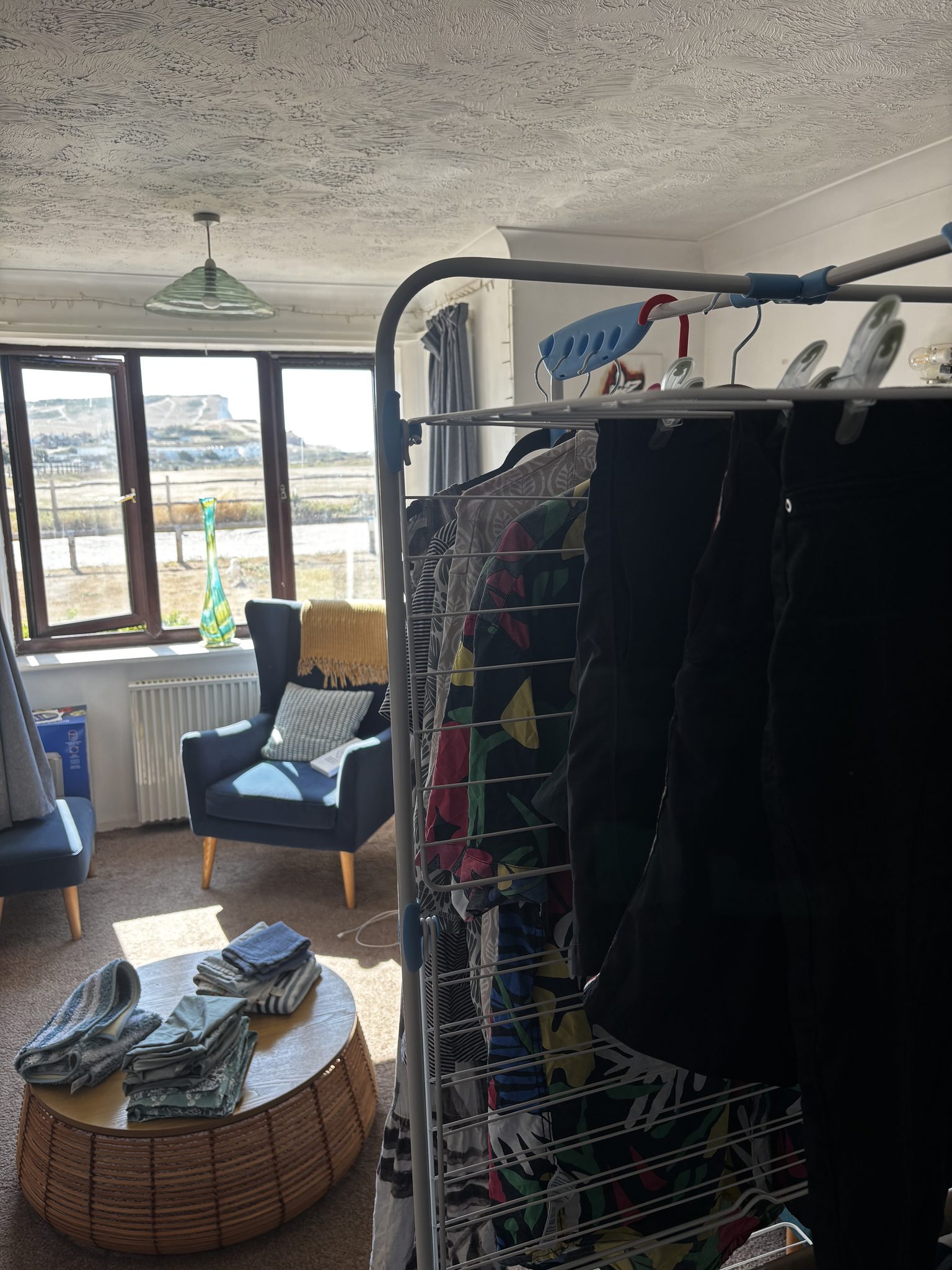
In a well-sealed room with the dehumidifier running on its laundry setting, a typical load of washing will be dry in 2–4 hours. Without a dehumidifier, the same load hung indoors can take 24 hours or more, pushing moisture into walls and soft furnishings throughout. Closing the room and positioning the dehumidifier close to the clothes horse dramatically improves results. In my own spare room, with the door shut and the dehumidifier running on its normal setting, a load dries in three to four hours instead of seven or eight on the airer alone.
Should I Run a Dehumidifier With a Heated Clothes Airer?
Yes — combining a heated clothes airer with a dehumidifier is one of the most effective indoor drying strategies available to UK households. The airer raises the temperature around the clothes, accelerating evaporation; the dehumidifier removes that evaporated moisture before it can settle on windows or walls. The combination typically dries a load in under 2 hours.
For a full buying guide with model comparisons, see our heated clothes airer guide.
How Much Does a Dehumidifier Cost to Run in the UK?
Running costs depend on wattage and usage time. As a rough guide:
- A 200W compressor dehumidifier running for 4 hours = 0.8 kWh ≈ 21p at current UK energy rates (~26.32p/kWh)
- A 400W desiccant dehumidifier running for 4 hours = 1.6 kWh ≈ 42p
Over a month of daily use, expect to pay £7–£15 for a compressor model, or £14–£20 for a desiccant. Efficient compressor models like the MeacoDry Arete One are the most economical for laundry in warmer rooms; desiccant models like the EcoAir DDWH10 pull ahead in cool, unheated spaces.
What Humidity Level Should My Home Be? UK Guide
The ideal indoor relative humidity (RH) for a UK home is between 40% and 60%. Staying within this band keeps occupants comfortable, protects the fabric of your home, and discourages mould growth.
Below 40% RH — Too Dry
If humidity drops below 40%, the air becomes uncomfortably dry: you may notice dry skin, irritated sinuses, static electricity building up on fabrics and electronics, and wooden furniture or flooring beginning to shrink or crack. In practice, this is rarely a problem in UK homes — our damp climate means excess humidity is far more common than insufficient humidity.
Above 60% RH — Condensation and Mould Risk
When indoor humidity rises above 60%, warm moist air begins to condense on cold surfaces — most visibly on window glass, but also behind wardrobes, under window sills, and inside external walls. Persistent high humidity above 70% creates conditions in which mould can grow within 24–48 hours on porous surfaces like plasterboard, grout, and soft furnishings.
How to Measure Humidity in Your Home
The simplest way to measure humidity is with a hygrometer — an inexpensive device that displays current temperature and relative humidity. One option is the ThermoPro TP49 Digital Hygrometer, a compact, accurate unit that shows current temperature and relative humidity at a glance.
Seasonal Humidity Variations in UK Homes
UK humidity levels fluctuate significantly through the year. In summer, outdoor humidity is high but warm air holds more moisture, so condensation is less likely unless the house is poorly ventilated. In autumn and winter, cold external surfaces — walls, windows — cause warm indoor air to drop its moisture as condensation. Indoor activities that add moisture (cooking, bathing, drying laundry) compound the problem significantly in the colder months.
Signs Your Home Has Too Much Humidity
- Condensation on windows each morning
- Musty or damp smell, particularly in bedrooms or bathrooms
- Mould spots on walls, ceilings, or around window frames
- Peeling wallpaper or bubbling paint
- Damp patches on external walls
- Clothes taking unusually long to dry indoors
If you recognise several of these signs, a dehumidifier set to maintain 50–55% RH will typically resolve the issue within a few weeks of consistent use.
How to Stop Condensation on Windows UK
Window condensation is one of the most common damp-related complaints in UK homes — and one of the most straightforward to address once you understand what causes it.
Why Condensation Forms on Windows
Condensation occurs when warm, moisture-laden air contacts a cold surface. In UK homes, window glass — particularly single glazing or older double glazing with degraded seals — is often the coldest surface in a room. When the room’s air humidity is high (from cooking, showering, or drying laundry), that moisture drops out of the air and appears as droplets on the glass. This typically peaks in the morning, after a night of breathing and minimal ventilation.
Short-Term Fixes: Ventilate and Wipe Daily
In the short term, the most important step is to ventilate. Open windows for 10–15 minutes each morning to flush moist air out. Wipe condensation off window frames and sills immediately — leaving it to pool on timber frames accelerates rot, and pooling on walls leads to black mould. Trickle vents (the small slots at the top of many double-glazed windows) should be left open, not shut.
Long-Term Fix: Dehumidifier and Draught-Proofing
The most effective long-term solution is to reduce the moisture in your home’s air before it reaches the windows. A dehumidifier running on its auto or continuous setting — particularly in the rooms where condensation is worst — removes moisture at source. Pair this with draught-proofing around doors and letter boxes to prevent cold external air creating additional cold spots.
Window Film as a Secondary Fix
Secondary glazing film — applied to the interior of single-glazed windows — raises the interior glass temperature, reducing the likelihood of condensation forming. It’s a cost-effective stopgap for older properties. One low-cost option on Amazon UK is the SOL Window Insulation Kit.
When Condensation Means Something Worse
Not all window condensation is a humidity problem. If condensation appears between the panes of a double-glazed unit — inside the sealed unit itself, not on the room-facing glass — this indicates a failed seal. A failed double-glazing unit loses its insulating argon or krypton gas fill, becoming dramatically less thermally efficient. This cannot be fixed by a dehumidifier: the sealed unit needs to be replaced by a glazier. Contact your installer if your windows are still under warranty (typically 10 years for sealed units).
Frequently Asked Questions
What is the best dehumidifier for drying clothes in the UK?
Based on our research, the MeacoDry Arete One 20L is the best dehumidifier for drying laundry in most UK homes: a dedicated laundry mode, a high 20-litre daily extraction rate and an H13 air filter. For smaller homes, the Pro Breeze 12L offers excellent value.
How long should I run a dehumidifier after drying laundry?
Run the dehumidifier throughout the drying session — typically 2–4 hours in a closed room — and for an additional 30–60 minutes afterwards to bring room humidity back to the 45–55% target range. Some models with an auto or laundry mode will manage this automatically.
Does a dehumidifier help with condensation on windows?
Yes. Window condensation forms when moist room air contacts cold glass. By maintaining indoor humidity below 55–60% RH, a dehumidifier significantly reduces the moisture available to condense. Most UK buyers who use a dehumidifier consistently report a marked reduction in morning window condensation within 1–2 weeks.
What humidity level should my home be in the UK?
The NHS and most UK housing guidance recommends maintaining indoor relative humidity between 40% and 60%. At 50% RH you are comfortably within the safe zone: low enough to prevent condensation and mould, and high enough to avoid the discomfort of overly dry air. Use a hygrometer to monitor your home’s levels.
Is a compressor or desiccant dehumidifier better for drying laundry in the UK?
For laundry drying in a heated living space, a compressor model is usually better — it extracts more litres per day at lower running cost. However, if you dry laundry in a cold garage, conservatory, or unheated room (below 15°C), a desiccant dehumidifier like the EcoAir DD1 Classic MK6 is the better choice, as compressors lose effectiveness in the cold.
Can I use a dehumidifier in a bedroom overnight?
Yes, provided you choose a quiet model. The MeacoDry Arete One 20L is rated at 40 dB and has a night mode, which suits a bedroom. Set it to auto mode to let it maintain your target humidity without running continuously, and position it away from the bed to minimise airflow disturbance.
🏠 From the D&L Shop: Making your home warmer this winter? Our Winter Home Survival Guide covers heating, draught-proofing, condensation, energy bills, and keeping comfortable through the cold months — 11 pages, £8.99. Also free: the Sunday Reset Checklist (a calm weekly home reset, instant download). Browse the full shop →
For a side-by-side comparison of the Meaco models that handle indoor laundry best — including the Arete Two 12L versus 20L decision — see our Meaco dehumidifier guide.
🛡 Our standards: How we research · Editorial policy · Affiliate disclosure · Corrections

About Gareth
Gareth Isherwood is the editor of Danbury & Lovejoy. He has baked bread at home for 25+ years and has 15 years of growing experience across gardens, containers and other growing spaces, including an East Sussex allotment for the past three years. Read his full story →
Was this useful?