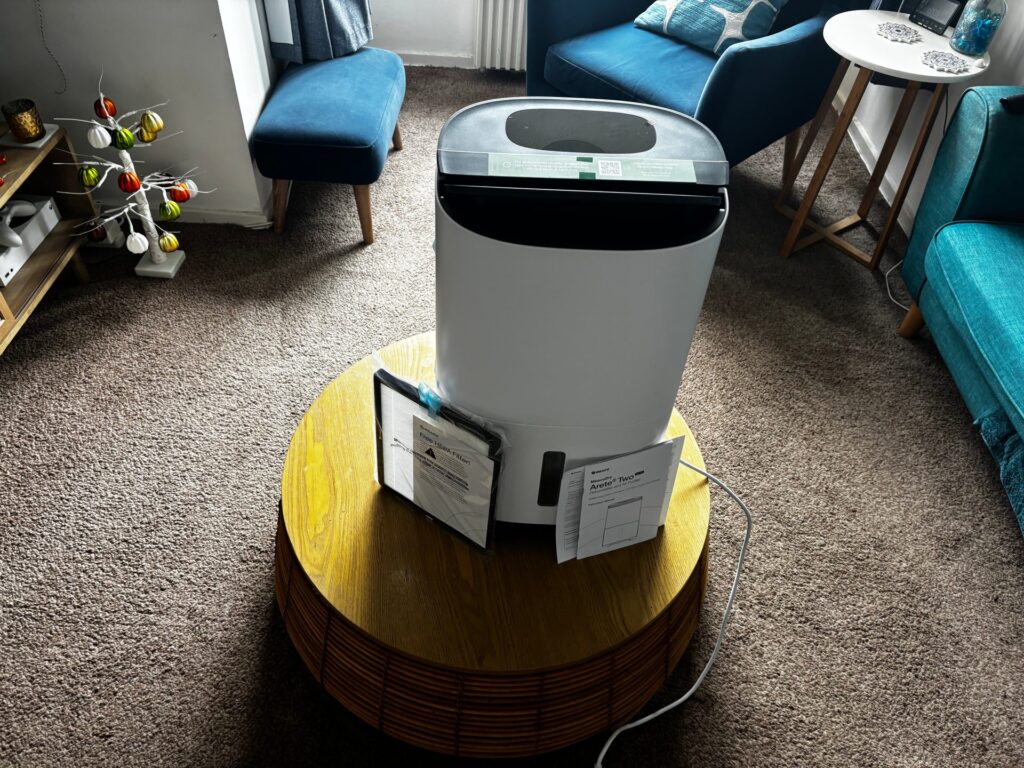
I came to dehumidifiers the way most people do: slowly and slightly reluctantly. When I finally bought a dehumidifier and put it in the spare room with the door shut while drying laundry, the change was significant enough that I have never been without one since. The drying time dropped from seven or eight hours to three or four. The bedroom window condensation I’d assumed was just part of living here reduced a lot, though it never disappeared entirely. I wish I’d done it sooner. My own dehumidifier is a Duux Bora, not a Meaco. Meaco sent us the Arete Two 20L (pick 2) in October and our review of it isn’t finished, so nothing here is a hands-on verdict yet. This guide will help you choose the right Meaco model for your space — they’re the brand we’ve researched most closely and the one we’d trust first for UK conditions.
In this guide, I’ll help you choose the right Meaco model for your space, with quick picks, a simple sizing checklist, and practical setup tips — plus a note on Meaco’s very quiet fans for later in the year.
Jump to a section
What a dehumidifier actually fixes (and what it doesn’t)
A dehumidifier helps when moisture is hanging around in the air: condensation on windows, musty smells, slow-drying laundry, and the kind of damp that feeds surface mould. It’s especially useful in winter when you’re keeping windows shut and drying clothes indoors.
The distinction between “moisture in the air” and “moisture in the walls” matters. A dehumidifier will handle the former beautifully; it won’t fix a failed render, a leaking roof, or rising damp. In most homes it’s the same story: most of the damp is moisture in the air from cooking, bathing, breathing and drying laundry indoors, not a structural problem. Without a dehumidifier running (mine is a Duux), the windows run wet on winter mornings and mould starts to appear; aiming for about 50–55% relative humidity is what keeps it in check.
It won’t fix an underlying building issue (like a leak, failed render, or rising damp) — but it can make day-to-day living far more comfortable while you address the root cause.
Meaco model guide (UK)
1) MeacoDry Arete® Two 12L: the “most homes” choice
If you want one appliance that covers the two most common winter problems — damp air and indoor air quality — the Arete Two 12L is built for that. It pulls up to 12 litres of moisture per day in standard conditions, runs at sound levels low enough for a bedroom on Night Mode, and the built-in H13 HEPA filter takes care of dust and pollen alongside humidity.
What stands out in the specification and in owner reports: the humidistat is sensitive enough that the unit cycles off when it’s hit target, rather than running flat-out and overshooting. The Smart Mode picks a target relative humidity for you based on outdoor temperature, one of those features that sounds gimmicky until owners stop noticing it because it simply works. App control via the Meaco app is useful if you want to schedule it to run only during cheap-rate hours on an Economy 7 tariff.
Best for: typical UK living rooms and bedrooms, condensation control, indoor laundry in a closed room, households with allergies who want air purification in the same unit.
Worth noting: the water tank holds 3 litres, which is roughly half a day of heavy laundry duty before it needs emptying. If you’ll be running it for long stretches, set up continuous drainage with the included hose to a sink or floor drain — it transforms the unit from “needs babysitting” to genuinely set-and-forget.
- AmazonCurrently unavailableCheck availability
- MeacoBuy from Meaco
2) MeacoDry Arete® Two 20L: for bigger homes and serious laundry
The 20L is the same Arete Two design — H13 HEPA filtration, a humidistat that switches the unit off once it reaches your target, and control from the Meaco app or by voice through Alexa or Google — with the extra capacity for homes where the 12L would be running constantly. As a rough guide, if you have more than two bedrooms, dry laundry indoors most days, or have a noticeably damp room (a poorly ventilated utility, a conservatory, a basement office), the 20L is the right starting point rather than the 12L.
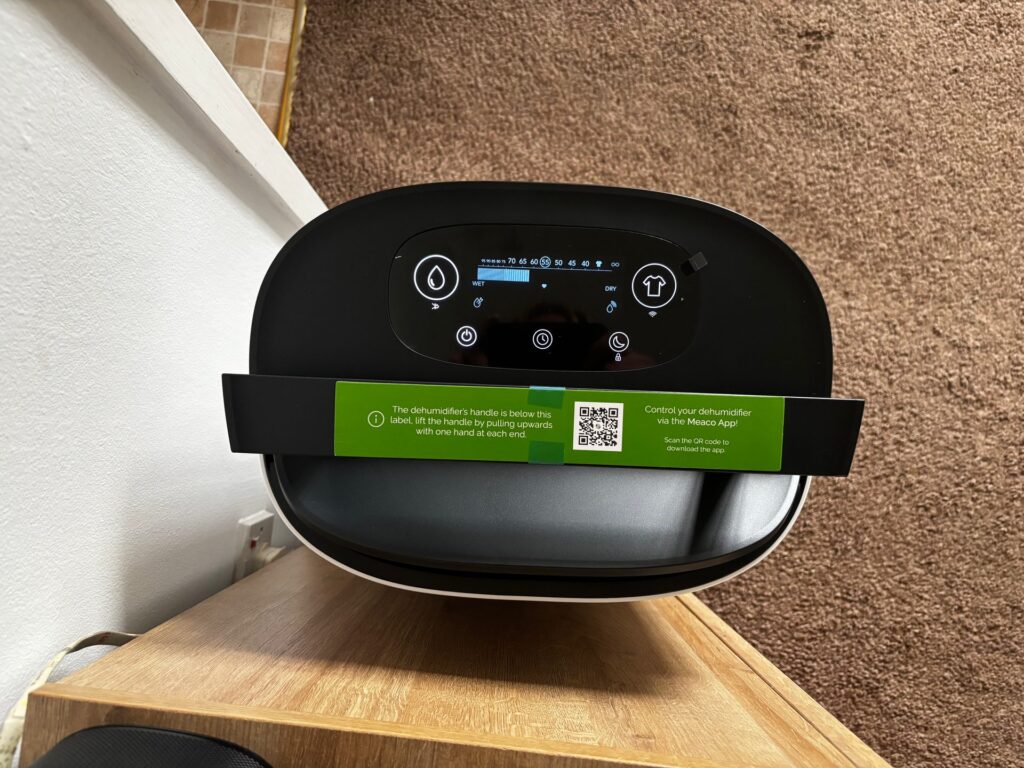
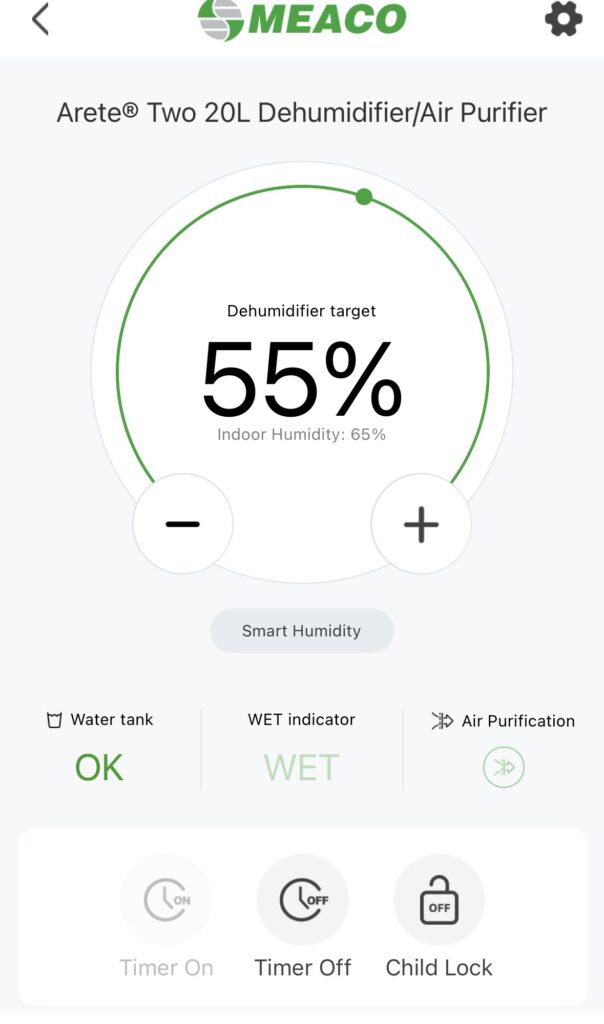
Its Laundry Mode is built for exactly that job: stand it beside the airer, open the louvre, and it runs for six hours before switching itself off. Meaco quote 38 dB, the same as the 12L, and a running cost of about 5p an hour.
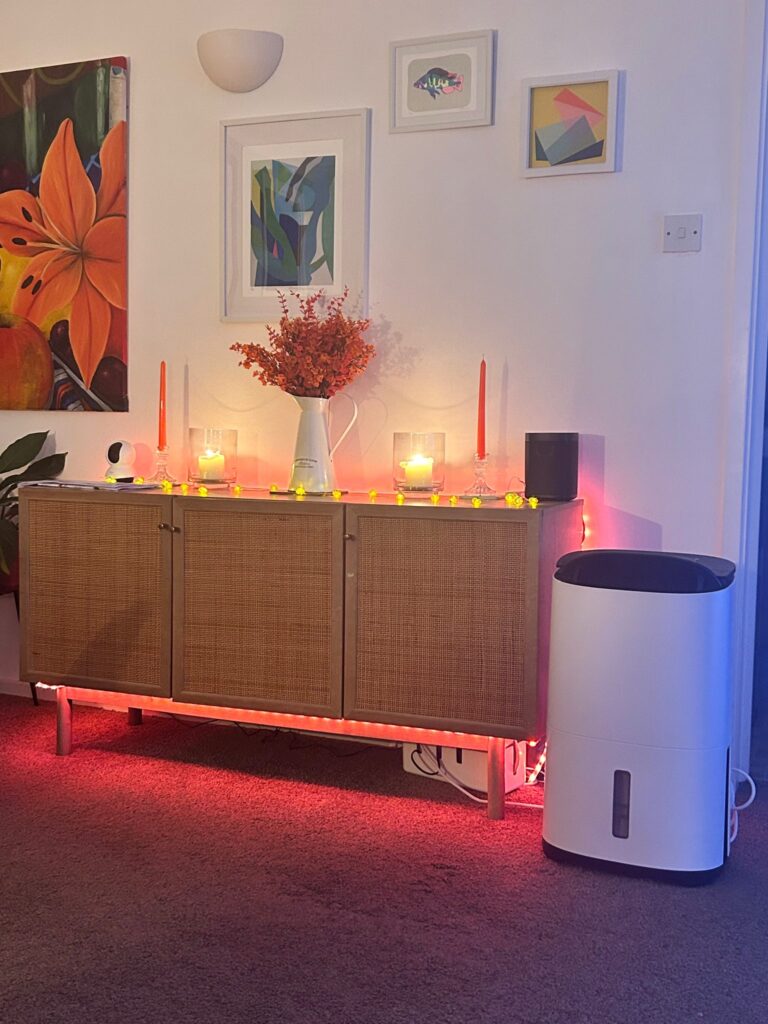
Best for: homes with three or more bedrooms, households that dry several loads indoors each week, and larger rooms with persistent damp (conservatories, big kitchens, open-plan living spaces).
- Amazon£298.95Check price
- MeacoBuy from Meaco
3) MeacoDry ABC 10L (and 12L): simple, compact damp control
The MeacoDry ABC range is Meaco’s “no extras” line — compressor dehumidification, a humidistat, a laundry mode, and that’s about it. No HEPA filter, no app, no smart mode. For a lot of UK homes that’s exactly what’s needed: pick a target humidity, set it down, leave it running.
It’s the one I’d point you to if the Arete Two’s price puts you off, or if you only need a dehumidifier for one specific job — a damp utility, a single bedroom with condensation, a conservatory in autumn. The 10L variant is enough for a bedroom or small flat; the 12L is the right move if you want a bit of headroom or you’ll be using it across two rooms.
Best for: single-room damp problems, smaller flats, anyone who wants a straightforward unit without smart features, second-home or holiday-let owners who want to leave one running on a humidistat during empty periods.
Worth noting: Meaco rate the ABC 10L at 35 dB, and it carries a Quiet Mark, so noise isn’t the reason to pay more for the Arete Two; the HEPA filter, the app and Smart Mode are.
- Amazon£129.99Check price
- MeacoBuy from Meaco
How to choose the right size (a simple UK checklist)
The rule of thumb manufacturers print on the box assumes a moderately damp room at a reasonable temperature. UK homes — particularly older ones — are often colder and damper than the spec sheet expects, so I’d size up rather than under-size if you’re between two options.
| Home size | Typical use | Recommended capacity | Meaco match |
|---|---|---|---|
| Studio / 1-bed flat | Light condensation, occasional laundry | 10L/day | ABC 10L |
| 2-bed flat / small house | Daily condensation, regular laundry indoors | 12L/day | Arete Two 12L |
| 3-bed semi / terrace | Multi-room damp, indoor drying most days | 12-20L/day | Arete Two 12L (or 20L if cold) |
| 4+ bed detached | Whole-house humidity control, heavy laundry | 20-25L/day | Arete Two 20L |
| Conservatory / utility / garage | Cold-temperature damp, seasonal use | 12-20L/day, check low-temp rating | Arete Two 12L or 20L (with low-temp performance) |
Beyond the capacity number, four things matter for picking the right unit:
- Temperature: if the space is regularly cold (unheated utility, chilly conservatory, garage), check the model’s lower-temp performance notes — compressor dehumidifiers like the Arete Two and ABC work down to around 5°C but their extraction drops as the air cools. Below 10°C, a desiccant model can be more effective, but they cost more to run.
- Laundry indoors: if you dry clothes inside most days, prioritise a proper Laundry Mode and size up rather than down. The 12L with laundry mode in a closed bedroom will outperform a 20L unit running open-plan in a kitchen.
- Drainage: if you hate emptying tanks, look for easy continuous-drain options and place the unit near a suitable drain point — a kitchen sink, utility floor drain, or even a hose run to a bathroom.
- Noise: bedrooms need quiet operation and a good Night Mode. Meaco rate the Arete Two at 38 dB and the ABC 10L at 35 dB, so both are quiet enough for a bedroom; the Arete Two’s Night Mode also dims its display.
Setup tips that make a big difference
- Close doors and windows when you’re actively drying laundry or pulling down humidity — otherwise you’re drying the whole neighbourhood.
- Use the humidistat (targeting around 50–55% RH) so the unit cycles only as needed, rather than running constantly.
- Place it sensibly: a little space around the unit helps airflow; don’t wedge it tight into a corner.
- Keep filters clean: if your model includes dust/HEPA filtration, keep up with cleaning/replacement for performance.
The closed door made the biggest difference for me. In my spare room, with the door shut and the dehumidifier running, a load dries in three or four hours instead of seven or eight. With the door open, a dehumidifier is drying the whole home slowly rather than the clothes quickly — the usual reason people say dehumidifiers “don’t seem to do much”.
Five real-world uses, from laundry to night running
The model and capacity matter less than how you use the thing. Here’s where a dehumidifier earns its keep, starting with the job that makes the biggest difference.
1) Drying laundry faster (the killer use case)
This is the use that turned me from “dehumidifier-curious” to “I would not be without one”. A dehumidifier in a closed room with a clothes airer beats the same airer in an open room by a factor of two or three on drying time, and beats radiator-drying by even more without the condensation penalty.
What I do: load the airer, shut the spare-room door, switch the dehumidifier on and leave it for three to four hours. The clothes come out dry without the room steaming up. For the longer version including airer pairings and which heated airers work best alongside, see our dehumidifier for laundry UK guide.
2) Killing window condensation in winter
Older UK houses, particularly those with single-glazed or first-generation double-glazed windows, get heavy condensation overnight on the inside of bedroom and bathroom windows. Wipe it off in the morning, run a dehumidifier in the room for an hour or two during the evening, repeat. Within a fortnight you’ll see the condensation drop dramatically because you’ve taken the moisture out of the air rather than trying to ventilate it out into the cold.
If your condensation is persistent or you’ve started to see black mould around window seals, our dehumidifier for window condensation guide walks through the targeting strategy and timing in more detail.
3) Drying out a damp utility or cold room
Utility rooms, downstairs loos, and garages used as workshops are the rooms where damp accumulates because they’re rarely heated and often poorly ventilated. The Arete Two handles these spaces well in autumn and mild winter conditions, but in deep cold (below 5°C) any compressor unit will struggle. If you’re hearing your dehumidifier kick into a defrost cycle every few minutes in a cold space, that’s the symptom — our why your dehumidifier keeps freezing piece covers what to do.
4) Spring damp and the “house feels stale” feeling
The damp problem people don’t talk about as much is the one that arrives in March and April, when warmer outdoor air carries moisture into a house whose walls and floors are still cold from winter. You don’t get window condensation in spring the way you do in January, but the house can feel stale, slightly clammy, and slow to warm up. A dehumidifier run for a few hours a day during a damp spring spell pulls that moisture out before it settles into soft furnishings. The full version is in our spring dehumidifier guide.
5) Bedrooms, baby rooms, and night running
Running a dehumidifier in a bedroom overnight only works if it’s quiet enough not to wake you up. The Arete Two on Night Mode is genuinely whisper-quiet at around 38 dB — quieter than a typical fridge. For a baby’s room or a light sleeper’s bedroom, either is quiet enough on Meaco’s figures; the Arete Two’s Night Mode, which dims its lights, is the tie-breaker. Run it on a humidistat target of 50-55% so it cycles off rather than running constantly.
One detail to know: Meaco dehumidifiers do warm the room slightly (perhaps 1-2°C over a few hours) because compressor dehumidification is exothermic. In a bedroom in winter that’s a small bonus; in summer it’s a reason to run the unit during the day, not overnight.
Not just winter: a quick note on Meaco fans (for summer)
When warmer weather returns, Meaco’s quiet air circulators are worth a look.
For Meaco’s fan range specifically — same low-noise engineering as the dehumidifiers but for summer cooling — see our best Meaco fan UK guide and our best portable air conditioners guide.
FAQ: Meaco dehumidifiers (UK)
Is it expensive to run a Meaco dehumidifier?
Running costs depend on your tariff, temperature, and how hard the unit has to work. The Arete Two 12L draws around 165W when actively dehumidifying — roughly 5p per hour at typical UK 2026 electricity rates — but the humidistat means it cycles off when humidity hits target rather than running flat-out. In practice, a few evenings per week in a targeted room costs less than a single load of tumble-dryer drying.
What humidity should I aim for?
Many home guides recommend around 50-55% relative humidity as a comfortable target, but your best setting depends on your home and condensation patterns. A cheap hygrometer will tell you where you’re starting from — worth the £10 investment before you set targets. If you’re seeing condensation on windows, 50% is your aim; if your air feels too dry (static, dry skin), nudge it up to 55-60%.
Will a dehumidifier dry clothes faster?
Usually, yes — especially in a closed room with the unit set to Laundry Mode. I went from 7-8 hours drying time on an airer to 3-4 hours once I added a dehumidifier to the same space and shut the door. The closed-room detail matters: a dehumidifier in an open room is drying the whole house slowly rather than the clothes quickly.
Do I need a HEPA filter?
If you have allergies, pets, or you simply want cleaner air alongside humidity control, a combined dehumidifier/air purifier with HEPA filtration can be a tidy all-in-one solution. The Arete Two includes an H13 HEPA filter as standard; the ABC range does not. If you already own a standalone air purifier, the ABC’s lower price is the better-value pick.
Where should I place it?
Near the problem area (drying room, musty corner, condensation-prone window) with around 30cm of clearance for airflow. Close internal doors when you’re targeting one room. Avoid putting it directly against a wall — give the back vents space — and don’t place it in a way that blocks the humidistat sensor from sampling representative room air.
Will running a dehumidifier heat the room?
Yes, slightly — compressor dehumidification gives off heat as a by-product, typically warming a closed room by 1-2°C over a few hours of running. It’s a small but useful bonus in winter, and a reason to run the unit during the day rather than overnight in summer.
Can I use a dehumidifier in a bathroom?
No — domestic dehumidifiers aren’t rated for direct bathroom use because of splash risk and condensation on internal electronics. Run it in an adjacent room with the bathroom door open after a shower, or wait until the room has dried out before bringing the unit in. For persistent bathroom damp, a proper extractor fan is the right fix.
How loud is a Meaco dehumidifier really?
Meaco rate the Arete Two at 38 dB and the ABC 10L at 35 dB (it carries a Quiet Mark), so both are quiet enough for a bedroom on their lowest setting. Expect more noise on full Laundry Mode.
Are the HEPA filters expensive to replace?
Meaco’s H13 HEPA filters cost around £20-30 each and Meaco recommend replacing them every 12 months in typical use, longer if you only run the unit seasonally. Clean the pre-filter (the washable mesh layer in front of the HEPA) every month or two and the HEPA itself will last closer to the maximum end of that range.
The bottom line on Meaco dehumidifiers
For most UK homes dealing with condensation, slow-drying laundry, or musty winter air, the Arete Two 12L is the one to start with — it handles both humidity control and air quality in a single unit. For anything larger or with heavier laundry loads, move to the 20L. The ABC range is the sensible, no-frills choice for smaller spaces. All three perform well in UK conditions. The setup detail that matters most: closed room, humidistat set to 50–55%, filters kept clean.
Some links in this guide are affiliate links. If you buy through them we may earn a small commission, at no extra cost to you.
Related on Danbury & Lovejoy
- Best Heated Clothes Airers in the UK (2026)
- Drying Clothes Indoors UK: How to Do It Without Causing Damp
The Danbury Dispatch — Free Weekly
One calm note every Thursday — seasonal guides, practical ideas, and quietly useful recommendations.
Quick Picks

MeacoDry Arete® Two 12L Smart Dehumidifier & HEPA H13 Air Purifier | Low Energy, Low Noise, Wi-Fi Meaco App, Smart Humidity Mode, Removes Moisture in Homes & Flats, 5x Year Warranty

MeacoDry Arete® Two 20L Dehumidifier & HEPA H13 Air Purifier | Quiet & Energy Efficient, Wi-Fi Meaco App, Smart Humidity Mode, Laundry Mode, Prevents Damp & Mould, 5x Year Warranty
🏠 From the D&L Shop: Making your home warmer this winter? Our Winter Home Survival Guide covers heating, draught-proofing, condensation, energy bills, and keeping comfortable through the cold months — 11 pages, £8.99. Also free: the Sunday Reset Checklist (a calm weekly home reset, instant download). Browse the full shop →
Last reviewed: September 2026
Further reading: our guides to the best dehumidifier and air purifier combos and best air purifiers.
Sources
Extraction rates, tank capacities and rated wattages are taken from Meaco’s published specifications and cross-checked against verified UK buyer reviews. The health case for controlling indoor damp is set out in the UK Government’s guidance on the health risks of damp and mould. Running-cost figures apply the current unit rate from Ofgem’s energy price cap to declared wattages.
🛡 Our standards: How we research · Editorial policy · Affiliate disclosure · Corrections · Last reviewed: September 2026

About Gareth
Gareth Isherwood is the editor of Danbury & Lovejoy. He has baked bread at home for 25+ years and has 15 years of growing experience across gardens, containers and other growing spaces, including an East Sussex allotment for the past three years. Read his full story →
Was this useful?