Home storage solutions in UK homes need to work with the space you actually have — here’s what genuinely works room by room, without spending a fortune.
Storage is the part of home organisation that people tend to approach in the wrong order. The instinct — when a room feels chaotic — is to go to a homeware shop, buy a collection of baskets and boxes, and hope for the best. But storage bought before editing almost always makes things worse. You end up with a lot of attractive containers full of things you didn’t actually need to keep.
The right order is: edit first, then store. Once you know exactly what needs a home, you can choose storage that fits the specific thing rather than buying generically and hoping it works.
Storage Principles That Actually Work
Store Things Where You Use Them
The most elegant storage solution fails if the storage is in the wrong place. Charging cables belong where you charge things. Extra bin bags belong in or immediately under the bin. Scissors belong in the room where you most often need scissors. When storage is positioned at the point of use, putting things away becomes the path of least resistance — which is the only way a system sustains itself.
Make It Easy to Put Things Back
The best storage solutions are the ones that take zero effort to use. Hooks are easier than hangers. Open shelves are easier than cupboards. Baskets without lids are easier than boxes with lids. If a storage system requires more than one action to use — open a lid, lift a flap, move something else out of the way — it will slowly stop being used. Design for the reality of how you actually behave, not how you’d like to behave.
Use Vertical Space
In most British homes, the floor space is limited but the walls go all the way to the ceiling. Shelving, wall-mounted hooks, pegboards, over-door organisers, and high cupboards all make use of vertical space that would otherwise be wasted. A wall of shelving in a spare room or study can hold an extraordinary amount while keeping the floor clear — which is what makes a room feel spacious.
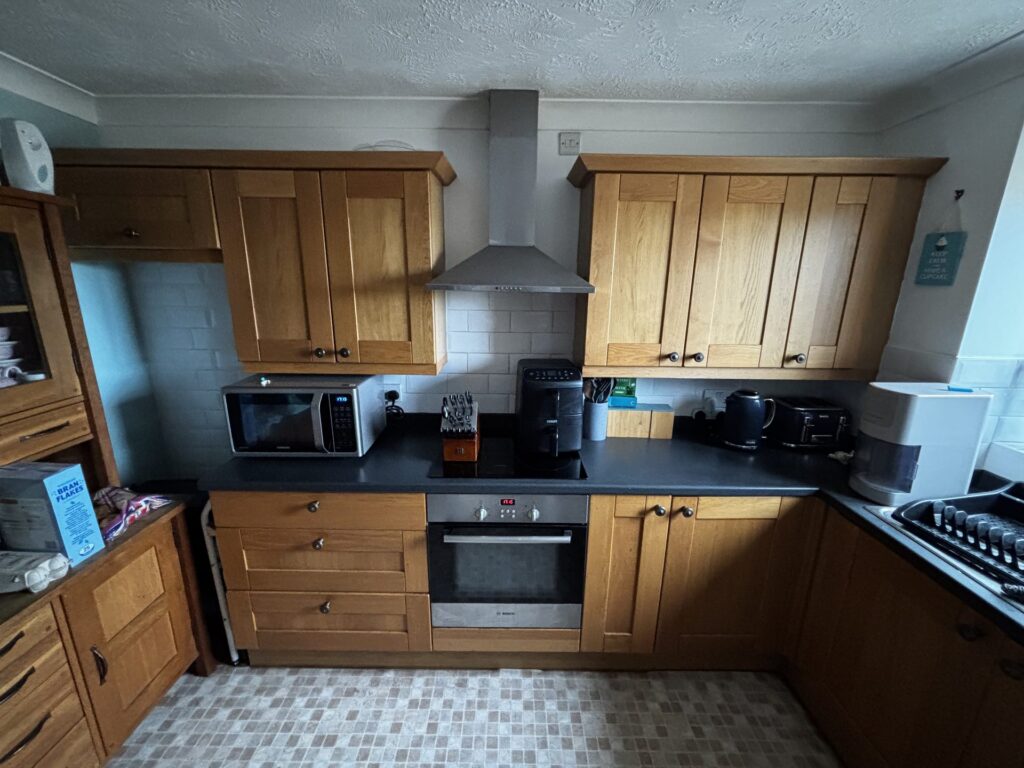
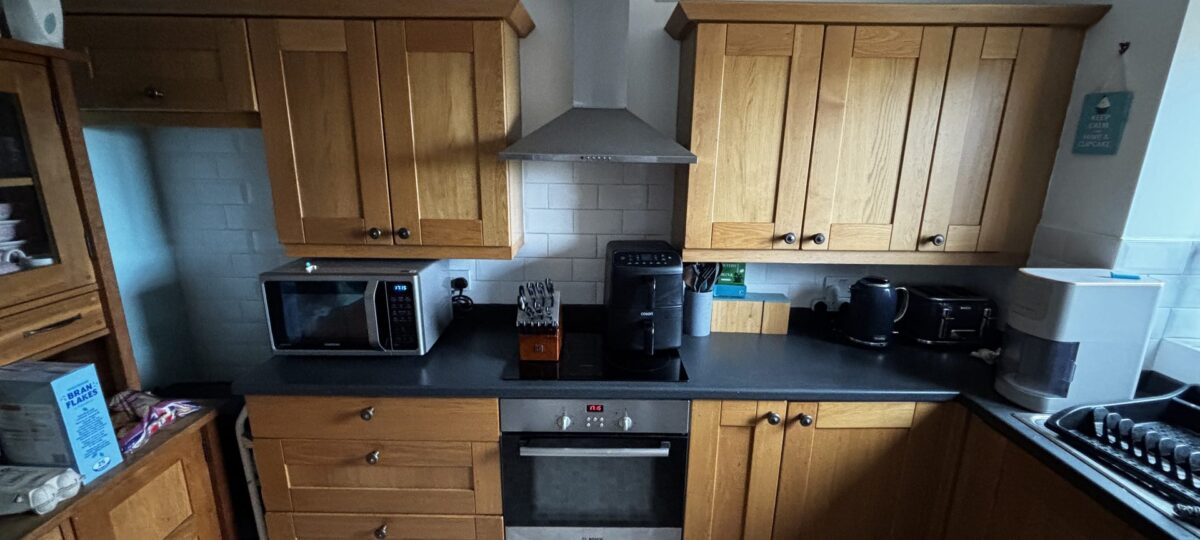
Storage advice usually assumes more wall than most homes have. The kitchen above runs round two sides of a small room, which means every base unit is doing double duty and the corner is the awkward part — the cupboard behind the oven wall is deep, dark and the single hardest space in the room to use well. That is the trade-off worth understanding before buying any storage product: in a room this shape you are not short of volume, you are short of reachable volume, and the fix is almost always a pull-out rather than another box.
Room-by-Room Storage Solutions
Hallway
Wall-mounted hooks at adult and child height. A bench with storage underneath for shoes or seasonal items. A console table with a drawer for daily essentials. A boot tray for wet shoes and wellies. A letter rack or small shelf for post. See our full hallway organisation guide for more.
Two habits keep a hallway working. Give each person one hook and keep only this season’s coats on it: out-of-season coats go into storage at the spring and autumn changeover, so the hooks never turn into a pile. And keep a small tray by the door for the things that leave the house with you — keys, cards, charging cables — so they always land in the same place.
Kitchen
Pull-out drawer inserts for deep lower cupboards. Shelf risers inside cupboards to double usable shelf space. A pot lid rack. Uniform containers for dry goods (only once you’ve decided what you’re keeping). Magnetic knife strips to free up drawer space. Wall-mounted spice racks. Our kitchen declutter guide covers the editing step first.
Keep the worktop for what you use every day, such as the kettle; anything used weekly earns a cupboard, not counter space. A drawer organiser in the ‘everything’ drawer gives each item a defined home, and things with a home go back to it. A quick clear-out of the food cupboard at the turn of each season — anything past its date out, the oldest tins to the front, labels facing forward — stops it filling up with forgotten stock.
Bathroom
Over-toilet shelving units make excellent use of otherwise wasted space. Adhesive shower caddies or suction cup organisers keep products off the bath edge. Under-sink pull-out drawers or tiered organisers maximise what’s often the largest storage area in a small bathroom. A magnetic strip inside a cabinet door can hold metal nail files and tweezers.
A mirror cabinet hides storage behind the one mirror you need anyway, and a couple of removable adhesive hooks on the tiles hold a towel or robe without drilling. Keep the shower shelf to a few products per person, and go through the medicine cabinet every month or so: check the dates, clear out what’s no longer used and note what needs replacing. Done little and often, it never becomes an afternoon’s job. Two sets of towels per person — one in use, one in the wash — is a sensible baseline for a small bathroom.
Bedroom
Under-bed storage is useful for items used seasonally — spare bedding, off-season clothes — but only if the bed frame allows it and if items are stored in proper containers rather than shoved under loose. Drawer dividers make a substantial difference to how easy it is to find things and how tidily items stay put. Hooks on the back of the wardrobe door or bedroom door for tomorrow’s outfit, bags, or dressing gowns.
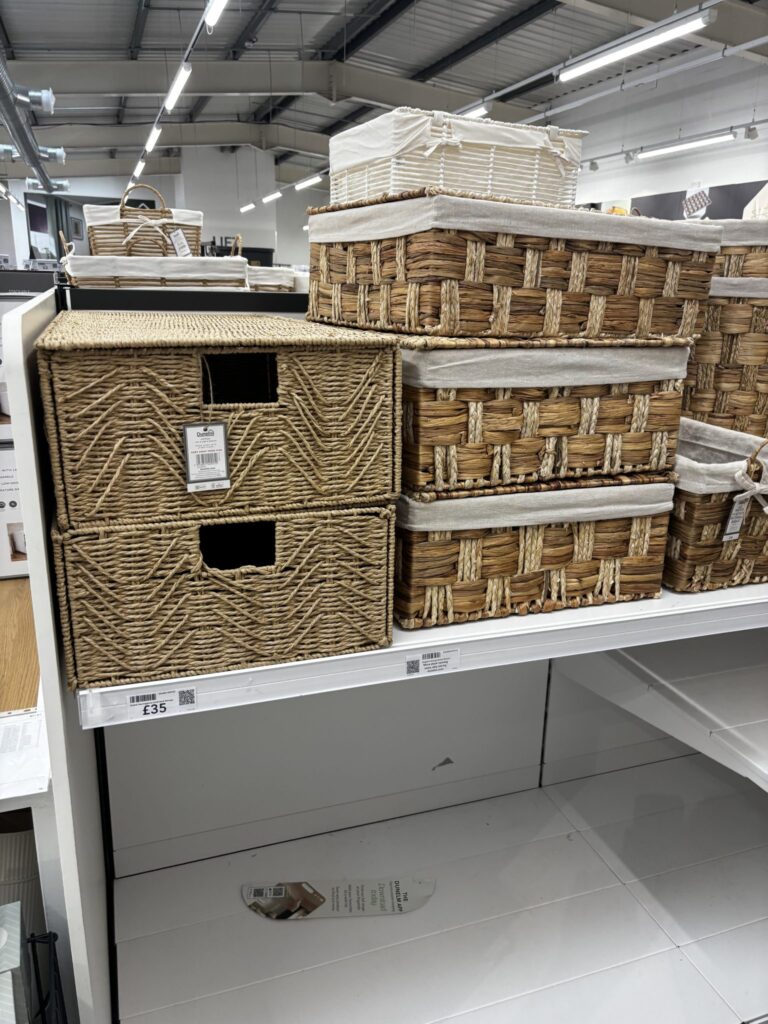
A useful test: can you get ready in the morning without hunting for anything? If not, start with drawer dividers for the small things — socks, underwear, accessories — and a ten-minute tidy at the end of the week, which stops the gradual drift better than an occasional big clear-out.
Living Room
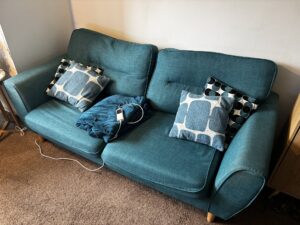
Storage ottomans work as seating, a footrest and hidden storage in one, which suits the remote controls, throws and chargers that otherwise live on every surface. Shelving fixed higher up the wall keeps the floor clear, and a single basket or box for remotes gives them one place to go back to.
Spare Room and Study
Open shelving with consistent storage boxes or baskets, clearly labelled. A dedicated filing system for paperwork — a simple concertina file organised by category (utilities, insurance, medical, tax, home) handles most households’ paperwork needs without requiring a full filing cabinet. Cable management boxes for desk cables.
A spare room usually goes wrong because its job was never decided. Guest room, office, laundry room, storage: it can do two of those well, but not all four. Pick a main use and a second one, and let the furniture and storage follow. Seasonal things — spare bedding, off-season clothes, decorations — belong there in uniform, labelled boxes on a shelf rather than loose bags on every surface. If it doubles as a guest room, it only needs a little to feel like a bedroom: some hanging space with a spare hanger or two, one empty drawer, and a lamp within reach of the bed.
Loft, Garage or Under-Stairs
If you have a loft, a garage or an under-stairs cupboard, run it on a seasonal rotation: only the current season’s things need to be easy to reach, so summer things come to the front in spring and winter things go to the back. Clear boxes with a contents label on the outside answer “where is it?” without unpacking everything, and one box per category stops “misc” boxes multiplying until the space is unusable.
Small Homes and Flats
In a small home or flat, storage is structural: the difference between a calm room and a chaotic one is usually how well things are put away, not how big the room is. Five principles do most of the work:
- Go up before you go out — shelving to ceiling height, over-door hooks and wall-mounted shelves add capacity without using any floor.
- Give everything a home — anything without a set place ends up as clutter.
- Choose furniture that doubles up — a bed with drawers, an ottoman, a hallway bench with storage underneath.
- Start under the bed — often the biggest hidden storage space in a small home. Lidded boxes or wheeled drawers for things you reach for; compression bags for bulky synthetic bedding and off-season clothes.
- Decant and label — uniform containers with a label on the front turn a chaotic cupboard into one you can read at a glance.
Our guide to organising a small flat goes through a flat room by room.
The Seasonal Edit, Twice a Year
A once-a-year declutter tends to be overwhelming, and a home organised in January has usually drifted by June. A lighter edit at the spring and autumn changeover works better: you’re already swapping summer things for winter ones, so it costs little extra to ask what earned its place over the last six months and what didn’t.
- Keep a donation bag open in the room while you work, so things leave rather than going on a “maybe” pile.
- Get the bag out of the house the same day.
- Edit before you organise: storage bought for things you haven’t decided to keep just produces tidier clutter.
Storage Worth Buying
Once you’ve edited and know what you need, these storage solutions genuinely earn their keep in most homes:
- Vacuum storage bags — for bulky synthetic bedding and off-season coats. Compress dramatically. Not for down or feather duvets and pillows — long spells compressed crush the loft and it never fully recovers. Store those in a breathable cotton bag instead.
- Uniform lidded boxes — for anything going into long-term storage. Labelled on the outside. Stackable.
- Drawer dividers — adjustable ones work in almost any drawer. Transform underwear drawers, kitchen drawers, desk drawers.
- Over-door organisers — hooks, pockets, or racks that make use of the back of doors. Particularly good in bathrooms, bedrooms, and pantries.
- Pull-out shelf inserts — for deep cupboards where things get lost at the back. Significantly improve kitchen and bathroom storage.
- Pegboard — versatile, adaptable, and excellent in kitchens, home offices, and utility areas.
To keep things from building up again, see the seasonal edit above. For the bigger picture, browse the Home & Warmth hub.
Last reviewed: April 2026
📖 From the D&L Shop: Looking for a calmer way to organise your week? Our Calm Week Planner is designed for people who want structure without pressure — printable, fillable, and tablet-optimised versions included. £3.99. Browse the full shop →
🛡 Our standards: How we research · Editorial policy · Affiliate disclosure · Corrections · Last reviewed: April 2026

About Gareth
Gareth Isherwood is the editor of Danbury & Lovejoy. He has baked bread at home for 25+ years and has 15 years of growing experience across gardens, containers and other growing spaces, including an East Sussex allotment for the past three years. Read his full story →
Was this useful?