
✉ Join the Dispatch — a calm weekly note, every Thursday. Free.
“Earn their keep” is the only useful test for a kitchen gadget. Single-purpose machines — panini presses, electric carving knives, the soda maker that lasts three weekends — teach the same lesson again and again: the only kit worth shelf space is the kit that gets used at least once a week. By that measure, most of the “essential” lists you see online fail their own brief.
The five below have one thing in common: they don’t just save time, they enable food you wouldn’t otherwise cook. A slow cooker means stews and shoulders of meat on weeknights when you’d otherwise reach for the freezer. An air fryer puts a proper roast potato on the table in twenty-five minutes. A stick blender turns yesterday’s roast vegetables into soup in ninety seconds. A rice cooker takes one variable out of weeknight cooking that would otherwise demand babysitting. A digital thermometer is the difference between consistently-cooked meat and an annual game of roast-dinner roulette.
What I’ve consciously not included: stand mixers (essential if you bake bread or cakes weekly, otherwise overkill), food processors (too much washing-up for what they do; a good knife is faster for most prep), electric kettles (you already have one), pressure cookers (overlap too much with the slow cooker and air fryer combo for most people), and anything labelled “multi-cooker” that promises to do twelve things and does most of them mediocrely.
On price: the five below can all be bought for under £80 each at the budget end and last five-to-ten years with regular use. Resist the urge to spend £300 on a flagship version of any single one before you’ve worn out the basic version — you’ll learn what features you actually use, which is rarely the same as what the marketing promises.
On storage: UK kitchens are typically smaller than the American counterparts most appliance reviews are written for. If you live in a flat or a smaller terraced house, prioritise gear that either folds away or has a useful counter-top footprint when not in use. A slow cooker doubles as a serving dish at the table; an air fryer can stay out as a second oven; a rice cooker that doubles as a steamer is two appliances in one. A thermometer slips into a drawer. The stick blender hangs on a hook.
Choosing kitchen gadgets worth buying means cutting through the noise and focusing on tools that genuinely earn their keep. This guide covers our favourites — from the best slow cooker to everyday essentials — with honest picks for UK home cooks. We also link to BBC Food for recipe inspiration to put them to work.
Not every kitchen gadget deserves a permanent place on the worktop. Some promise convenience but end up forgotten in a cupboard. Others quietly earn their keep: they save time, reduce energy use, and make everyday cooking feel calmer. These are the five that consistently justify their space.
Quick Comparison: The Five Gadgets Worth Owning
| Gadget | Best for | Why it’s worth it | Typical price |
|---|---|---|---|
| Slow cooker | Batch cooking, winter meals | Low-effort dinners, cheaper cuts, hands-off cooking | £40–£130 |
| Air fryer | Fast everyday cooking | Quick, crisp results, often less energy than the oven | £90–£180 |
| Stick blender | Soups, sauces, smoothies | Small, versatile, minimal washing up | £30–£100 |
| Rice cooker | Hands-off grains | Perfect rice every time, frees up hob space | £30–£80 |
| Digital thermometer | Roasts and baking | Better results, less waste, no guesswork | £12–£90 |
1) Slow Cooker
If there’s one appliance that quietly earns its place in the kitchen, it’s a slow cooker. A slow cooker like this becomes the backbone of the weekly cooking rhythm: a few minutes of prep on a Sunday morning, set it on Low, get on with the day, come home to something ready. It turns cheaper cuts — shoulder, shin, thighs — into tender, genuinely satisfying meals, and makes batch cooking feel effortless.
The sweet spot for most households is a model with a digital timer and a removable ceramic pot. For a fuller walkthrough, see our guide: How to Use a Slow Cooker (UK).
Slow cooker picks
Crock-Pot Lift & Serve Digital Slow Cooker — the model I’d recommend for most households. Digital timer, removable ceramic pot, keep-warm setting.
Tower slow cookers — good UK alternative; reliable and well-priced.
2) Air Fryer
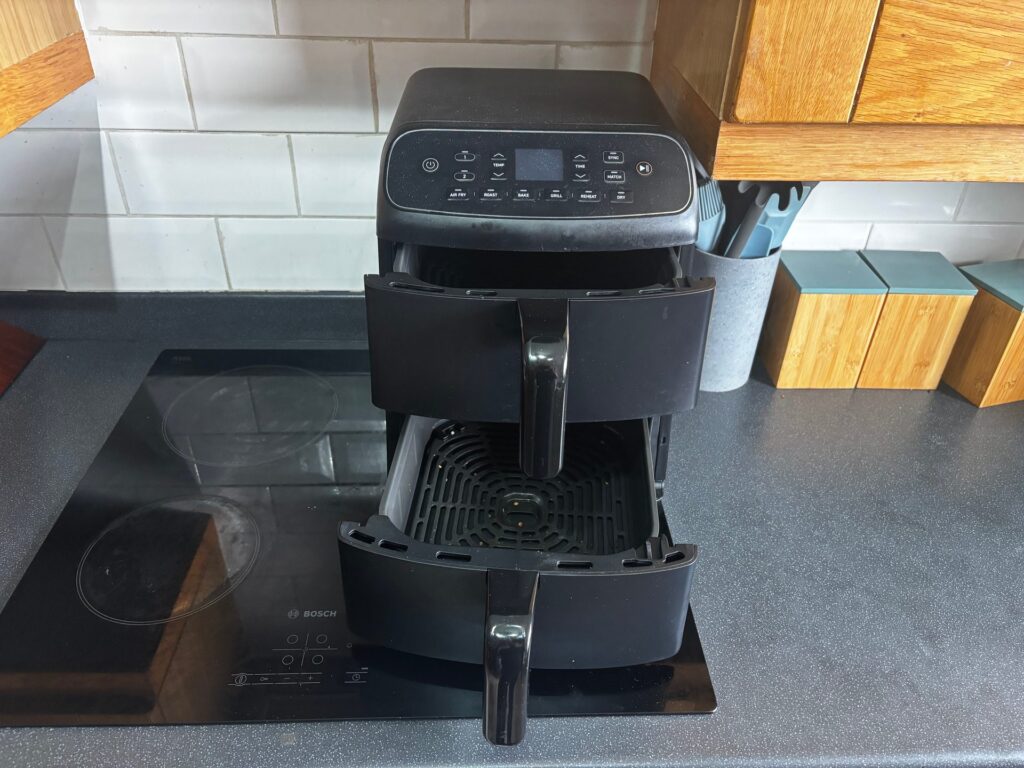
The air fryer is the weeknight workhorse: fast, crisp results with little oil, and often less energy than heating the whole oven for a small meal. It’s also excellent for reheating leftovers properly — chips that crisp again, pizza that doesn’t go sad, roast veg that comes back to life. It’s easy to reach for almost every day, for quick weeknight meals when the slow cooker isn’t running.
For cooking for two to four people, a dual-basket model is particularly useful — two things at different temperatures, everything on the table together.
Air fryer pick
Ninja Air Fryer Pro AF140UK — compact, dependable single drawer for smaller households.
3) Stick Blender (Hand Blender)
A stick blender is one of the most quietly useful tools in the kitchen. It blends soups directly in the pot — no decanting, no burning yourself on a jug blender, no extra washing up. A good one earns its keep through autumn and winter, turning allotment vegetables into soups — a leek and potato, a butternut squash, a batch of tomato — all done in under a minute, straight in the pan.
The main thing to look for is power and comfort in the hand. A model that struggles with thicker soups defeats the purpose.
Stick blender pick
Braun MultiQuick 7 Hand Blender — the one I’d recommend. Powerful, comfortable, and the splatter guard actually works.
4) Rice Cooker
If you cook rice even once or twice a week, a rice cooker removes all guesswork. Measure, press, done — while you finish the rest of the meal without hovering over a pot. It frees up a hob ring at the exact moment you need it most. Many models also come with a simple steaming tray, useful for vegetables or fish.
Rice cooker pick
Russell Hobbs 19750 Rice Cooker & Steamer — dependable, good value, comes with steaming tray.
5) Digital Cooking Thermometer
A digital thermometer is one of the cheapest ways to meaningfully improve your cooking. It removes uncertainty from roasts — you stop cutting into a joint to check, stop guessing, stop overcooking and then wondering why it’s dry. It earns its keep on every roast, on thick cuts of pork, and when baking bread and wanting to know if the interior is actually done.
Thermometer pick
ThermoPro TP16 Digital Probe Thermometer — great-value probe thermometer. Simple, accurate, long probe that keeps your hand away from the heat.
A calm, practical kitchen
The best kitchen gadgets aren’t about novelty — they’re about usefulness. These five earn their place by being reliable, easy to reach for, and genuinely helpful in everyday cooking. None of them require special skills or elaborate recipes. They just make the ordinary cooking week work more smoothly.
🛡 Our standards: How we research · Editorial policy · Affiliate disclosure · Corrections · Last reviewed: July 2026

About Gareth
Gareth Isherwood is the editor of Danbury & Lovejoy. He has baked bread at home for 25+ years and has 15 years of growing experience across gardens, containers and other growing spaces, including an East Sussex allotment for the past three years. Read his full story →
Was this useful?