Every air fryer chart online has the same quiet problem. It gives you a number to one minute and a temperature to five degrees, as though every machine in the country were the same machine — and then your chips come out pale at the time the chart promised, or the sausages are dark before the middle is done.
The numbers are not really wrong. They are just being asked to do something they cannot do. A 1,500-watt drawer model and a 2,000-watt tower with a fan half again as fast will not cook the same food in the same time, and no chart can hold both.
So here is a chart, and here is the honest version of what it is: a starting point. It gets you to roughly the right setting on the first go. What tells you the food is actually done is the second half of this piece — five temperatures that do not vary by machine, by brand, or by year.
The one conversion that does most of the work
Most of what you will ever cook in an air fryer started life as an oven recipe. There is a single adjustment that handles the great majority of them:
Drop the oven temperature by 20°C, and start checking at about 80% of the oven time.
A tray of roast potatoes at 200°C for 40 minutes becomes 180°C, first check at around 30.
The reason is worth understanding, because it tells you when the rule will not hold. An air fryer is a small fan oven with the food sitting close to the element and the air moving fast through a perforated basket. Heat reaches the surface faster and from more directions at once. You need less of it, and you need it for less time.
Where the rule breaks down is anything with a wet batter, anything you would normally cover, and anything large enough that the outside will be finished long before the middle is. A whole chicken is the classic case: the conversion gets the skin right and leaves the thigh underdone. That is what the probe is for.
The starting chart — UK staples
Times assume a preheated machine and a single, uncrowded layer. Both of those matter more than the numbers do; see the section after this one.
Potatoes
| Food | Start at | First check | Notes |
|---|---|---|---|
| Frozen chips | 200°C | 12 min | Shake at halfway. No oil needed. |
| Homemade chips, thin cut (~6 mm) | 190°C | 16 min | Rinse the starch off, dry properly, one teaspoon of oil. |
| Homemade chips, thick cut (~13 mm) | 190°C | 20 min | A thicker chip wants more time, not more heat. |
| Sweet potato fries, fresh | 190°C | 18 min | They soften before they colour — judge by feel, not by browning. |
| Roast potatoes, parboiled | 190°C | 22 min | Rough up the edges first; it matters more here than in an oven. |
| Jacket potato | 190°C | 35 min | Prick it. Turn once. A large one may want an hour. |
| Frozen wedges / hash browns | 190°C | 12 min |
Meat and poultry — always finish on temperature, never on time
| Food | Start at | First check | Notes |
|---|---|---|---|
| Sausages | 190°C | 10 min | Turn once. Thick butcher’s sausages want longer. |
| Bacon | 190°C | 7 min | Streaky crisps faster than back. |
| Chicken thighs, bone-in | 180°C | 20 min | Skin side up for the last third. |
| Chicken breast | 180°C | 16 min | The easiest thing in the machine to overcook. |
| Chicken wings | 190°C | 18 min | Turn at halfway. |
| Burgers | 180°C | 10 min | See the temperature section — minced meat is not negotiable. |
| Pork chops | 180°C | 12 min | Rest them. |
| Frozen breaded chicken (nuggets, goujons) | 190°C | 9 min | Turn once. Check the middle, not the coating. |
Fish
| Food | Start at | First check | Notes |
|---|---|---|---|
| Salmon fillet | 180°C | 8 min | Skin down, no turning. |
| White fish fillet | 180°C | 8 min | Delicate — check early. |
| Fish fingers, frozen | 190°C | 8 min | Turn once. |
| Breaded scampi, frozen | 190°C | 8 min |
Vegetables and everything else
| Food | Start at | First check | Notes |
|---|---|---|---|
| Frozen peas, sweetcorn, mixed veg | 180°C | 8 min | Shake once. |
| Broccoli or cauliflower florets | 180°C | 8 min | A little oil stops the tips burning. |
| Mushrooms | 180°C | 8 min | They release water; do not crowd them. |
| Halloumi | 190°C | 8 min | Turn once. |
| Yorkshire puddings, frozen | 190°C | 4 min | Watch them — they go from pale to dark quickly. |
| Reheating leftovers | 160°C | 6 min | Lower and slower than you would think. |
The five numbers that do not vary
Everything above is negotiable. This is not.
UK government guidance is that the middle of the food should reach 70°C for two minutes, or one of these equivalents:
| Temperature at the centre | Held for |
|---|---|
| 60°C | 45 minutes |
| 65°C | 10 minutes |
| 70°C | 2 minutes |
| 75°C | 30 seconds |
| 80°C | 6 seconds |
Those five lines are the same in an air fryer, an oven, a pan or a slow cooker. They are about the food, not the appliance — which is exactly why they are the part of this article you can rely on when the times above turn out to be wrong for your machine.
The foods that must be cooked all the way through, every time: poultry (chicken, turkey, duck, game birds), pork, minced meat of any kind, burgers, sausages and kebabs, rolled joints, and offal. A rolled joint is on that list for a reason people forget — rolling moves the outside surface, and whatever was on it, into the middle.
Without a probe, the checks are the familiar ones: the food is steaming right through, juices from poultry and pork run clear with no pink meat left when you cut into the thickest part, and fish has turned opaque and flakes apart with a fork.
A digital probe is the single thing that makes an air fryer easy, and it is the cheapest useful thing you can put in a kitchen drawer. It replaces every guess in the chart above with a fact. Clean it after each use — a probe that has been in raw chicken and then goes into something cooked has undone the point of using it.
Why your machine will not match the chart
Five things move the numbers, and they move them a long way.
Wattage. The spread across ordinary domestic air fryers is wide enough that a lower-powered machine can want a third longer than a high-powered one for the same food. This is the single biggest reason charts disagree with each other.
Crowding. An air fryer cooks by moving hot air around food. Fill the basket and you have built a small casserole dish: the food steams in its own moisture instead of crisping, and the middle of the pile lags badly. Two smaller batches genuinely are faster than one large one, which is the least intuitive thing about the machine.
Preheating. Most manufacturers say a few minutes; plenty of people skip it. Skipping it is fine as long as you are consistent, because everything shifts by roughly the same amount. Doing it sometimes is what makes results feel random.
Basket shape. A deep drawer and a wide flat basket of the same stated litres do not hold the same amount of single-layer food, and single-layer capacity is what actually determines cooking time.
From frozen. Most frozen food is designed to go in frozen and the packet time is usually close. Defrosting first rarely improves it and often makes it soggy.
If you have two drawers
Dual-basket machines add one wrinkle worth knowing before you trust any chart: whether the two compartments have a heating system each, or share one between them.
Drawers with their own element and fan are effectively two independent little ovens and behave like the chart says, however they are arranged. Where a single heating system serves both compartments — most often, though not always, on machines that stack one above the other — the compartment nearer the element and the fan gets the hottest, driest air and tends to finish sooner. On those, the same food in both compartments will not necessarily be done at the same moment — so check the further one, not the nearer one, and expect to swap them partway through a longer cook.
How to tell which kind you have
Three checks, simplest first.
Can you set two genuinely different temperatures at once? Not two timers — two temperatures, running together, with a real gap between them. A machine that will hold one compartment low and the other high at the same moment has to have two heating systems. If the controls only let you pick one temperature for both, or setting the second quietly changes the first, you have one.
Look for where the air comes from. With the drawers out and the machine cold and unplugged, you can often see whether each compartment has its own fan and element or a single assembly serving both.
Run one matched cook. Put the same food in both compartments — same weight, cut the same way, spread the same — and set both the same. Compare the two batches side by side at the end, in the same light. If they match, you have two independent ovens. If they don’t, the size of the difference is the number that matters for your machine, and no specification sheet prints it.
Loading a machine with one heating system
Load by weight and surface area, not by portions. An air fryer cooks the outside of things, so what counts is how much surface the air has to work on and how much mass it has to heat. Two chicken thighs and a drawer of chips are not a matched pair, even if they look like one dinner.
Put what you want crisp nearer the heat. The nearer compartment gets the hottest, driest air, which is what browning wants. The further one suits food that only needs cooking through.
Keep the further compartment to a single layer, strictly. Piling food up there is the most reliable way to get the pale, slightly steamed result people blame on the machine.
Watch the moisture. If the nearer compartment is full of something wet, the air reaching the further one has already given up heat and picked up water, so in principle the further drawer browns less. That follows from the shared airflow rather than from anything measured, so treat it as something to check on your own machine rather than a rule.
Swap the drawers only on long cooks. On anything running half an hour or more, swapping at halfway evens out most of the difference. On a ten-minute cook it doesn’t: opening the machine loses more heat than the swap recovers.
What the sync button does
Most two-drawer machines have a button that makes both compartments finish at the same moment, usually by starting the shorter cook later. It does exactly that, and it is useful. But it equalises the clock, not the cooking. On a machine with one heating system, two compartments set to the same temperature are not at the same temperature, and lining up the finishing times does not change that. It stops one dish going cold while the other finishes; it does not make them equally done.
Whichever kind you have, a probe in the thickest part of the food in the further compartment settles the question.
Disclosure: The Cosori Double Stack used here was sent to us free of charge by VeSync, the company behind Cosori, when we reviewed it. VeSync has no say over what we write. We earn a commission if you buy through our links. How we handle supplied products →
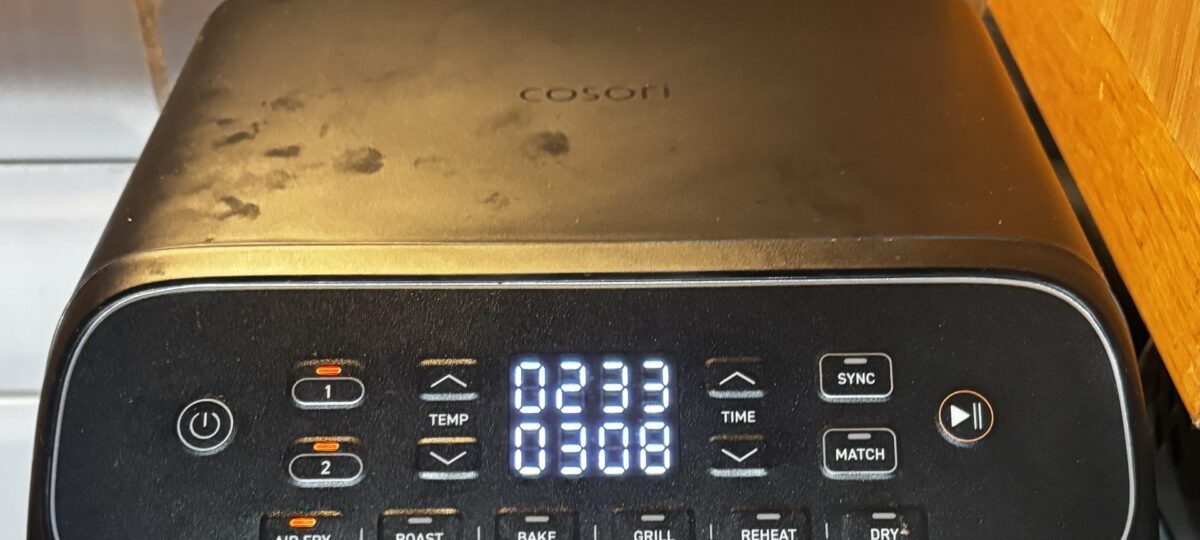
I made beef jerky in the Cosori Double Stack VeSync sent us: about four hours in the marinade, 10 minutes on Air Fry at 135°C, then the Dry setting at 70°C, six hours in all.
Working from an oven recipe, start to finish
Say a recipe gives you sausages and roasted peppers at 200°C for 35 minutes.
- Convert: 200 − 20 = 180°C. 80% of 35 is 28 minutes, so that is when you start paying attention — not when you take it out.
- Split the tray. The peppers want a single layer and the sausages want turning; in a basket that means doing them one after the other, or accepting that one of the two will be merely fine.
- Turn at halfway, which the oven version did not ask you to do.
- Finish on temperature, not the clock. Sausages are minced meat, so 70°C in the middle for two minutes, or one of the equivalents above. The recipe’s 35 minutes is now irrelevant; the number in the sausage is the answer.
That is the whole method. The chart gets you started, the probe tells you when to stop, and after a fortnight with one machine you will stop needing the chart at all — which is the honest measure of whether a guide like this has done its job.
Related
- Air Fryer Cooking: What Actually Works, What Saves Money and How to Use It Well — the energy maths and what an air fryer will not do
- Best Air Fryers UK — if you are choosing rather than cooking
- Find Your Air Fryer — two minutes, no email required
- Air Fryer vs Oven: What Each Dish Actually Costs to Cook — the same eight dishes priced both ways
- Can You Dry Apple Rings in an Air Fryer? — what the Dry setting will and will not do, and the limit that decides it
Sources
- Cooking your food — UK government / Food Standards Agency guidance — the time and temperature combinations, and the list of foods that must be cooked all the way through.
Was this useful?