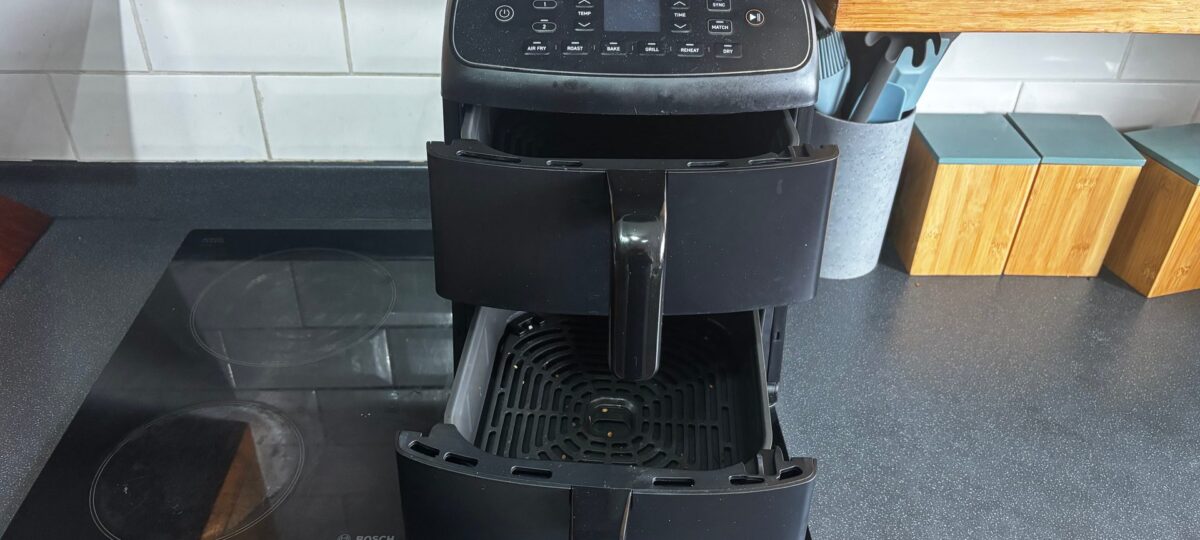
Air fryer cooking has changed the way a lot of households approach weeknight meals — faster than an oven, cheaper to run, and surprisingly versatile once you know what it does well. This guide covers what’s worth cooking in it, what to skip, and how to make the most of it all year. If you’re still deciding whether to buy one, our best slow cooker guide covers another energy-efficient option. For energy running costs, Which?’s air fryer running costs breakdown is the most reliable source.
Part of our Countertop Cookers Hub — the complete guide to pressure cookers, slow cookers, air fryers, soup makers, rice cookers and bread makers for UK kitchens.
The air fryer has become one of those kitchen objects that people either swear by or have tucked away in a cupboard after two uses. The difference, usually, comes down to whether they understood what it is actually good at — and what it is not. Once you know that, it stops being a gadget and becomes something genuinely useful for everyday cooking. If you are still choosing one, our guide to the best air fryers has our honest picks. Our kitchen tools guide covers the rest of the kit worth having.
We have been cooking with air fryers for a while now, and what follows is a practical account of what works, what does not, and how to actually save money using one — not just in theory, but in the way you cook week to week.
What an air fryer actually does
An air fryer is a compact forced-air oven. It circulates hot air rapidly around the food, which produces a crisp exterior much faster than a conventional oven — and without the need for much oil. The energy saving comes partly from the smaller cavity (less to heat up) and partly from the speed (it is usually done in half to two-thirds of the time). For many foods, the result is genuinely better: crispier vegetables, faster chicken thighs, chips that actually crisp rather than steam. Our piece on energy-efficient cooking compares running costs across different appliances.
Where it struggles: anything that needs moisture to cook — braised dishes, soups, stews — is not suited to it. Nor is anything larger than the basket will sensibly fit, which rules out a full chicken for most models. And bread, despite what some recipes suggest, is rarely as good as from a proper oven.
The energy maths
A typical air fryer draws around 1,400–1,700 watts but runs for fifteen to twenty minutes rather than forty-five to sixty. A conventional oven draws 2,000–2,500 watts for a much longer period. At current UK electricity rates of roughly 26.32p per kWh, the difference adds up meaningfully over a month of regular use.
For context: reheating leftover roast potatoes in an air fryer for fifteen minutes costs around 6–8p. Doing the same in the oven costs 20–25p. Over a week of lunches, that is a small but genuine saving. The bigger savings come when you replace full oven use — roasting a tray of vegetables at 200°C for forty minutes versus air frying the same batch in twenty minutes at the same temperature saves you around 15–20p per session. Modest per occasion, meaningful over time.
Those are averages, and an average hides the thing you actually want to know: what this dish cost. Air Fryer vs Oven: What Each Dish Actually Costs to Cook prices eight of them both ways — chips, sausages, salmon, chicken thighs, roast potatoes, a jacket potato, a reheat and a typical evening meal — at the same 26.32p, with the oven preheat counted in.
What we cook in ours, week to week
Chicken thighs: Twenty-two minutes at 190°C, skin side up, no oil needed. The skin crisps in a way that is difficult to replicate in an oven without significantly more time. We do these at least twice a week.
Chicken breast: the cut that dries out if you guess. Times by thickness and the 75°C check are in our air fryer chicken breast recipe.
Roasted vegetables: Courgette, red pepper, tenderstem broccoli, cherry tomatoes — all work well. Cut them to a similar size, season, a little oil, fifteen to twenty minutes at 180°C with a shake halfway. This has largely replaced oven roasting for weeknight vegetable sides.
Reheating: This is where the air fryer earns its counter space. Pizza, pastries, leftover roast potatoes, fried chicken — all come back to something close to their original texture. The microwave, by comparison, is good for speed but poor for anything that relies on crispness.
Frozen food: Fish fingers, oven chips, spring rolls, halloumi fries — faster and crispier than the oven, and almost always better than the packaging instructions suggest. This is a weekday staple in households with children and also, frankly, in households without them.
Choosing one that actually suits your kitchen
The market has expanded enormously. The key distinctions that actually matter for most households:
Basket vs dual basket: A single basket suits one to two people or one-dish cooking. A dual basket (two separate compartments) is genuinely useful for families — you can run chips and chicken wings simultaneously without one going cold while the other finishes. The dual models take up more counter space and cost more, but for households cooking more than one component at once, they pay for themselves in convenience quickly.
One more question worth asking before you buy a dual basket: how many heating systems are inside it. Some are genuinely two small ovens that happen to share a plug, and those two compartments really are independent. Others heat air in one place and move it through both, so the drawers are not thermally independent however many displays the front panel has. Air Fryer Times and Temperatures: A Starting Chart for UK Staples covers the three checks that tell you which kind you are looking at — the cheapest being whether it will hold two genuinely different temperatures at once — and why side by side versus stacked is not the distinction that decides it.
One stacked machine, a month in: VeSync, the company behind Cosori, sent us a Cosori Double Stack free of charge for review, and we have been cooking with it since late August. Our Cosori Double Stack review covers what stacking really saves on the worktop, what it costs you in height, and how the two drawers have behaved over about twenty cooks.
Capacity: A 4-litre basket is the minimum for two people eating a proper meal. For four people, 6 litres or the dual basket equivalent. The common mistake is buying too small and then finding it limiting. For more budget-friendly ideas, see our cheap meals guide.
Temperature range and controls: Most models go up to 200–220°C, which is sufficient. Manual dials are simple and reliable. Digital controls allow more precision but add cost. The additional presets most models advertise — “steak”, “pizza”, “cake” — are largely marketing; what matters is being able to set temperature and time accurately.
One preset that is not marketing: if a model has a setting called Dry or Dehydrate, it does something the cooking presets do not — it runs the fan with very little heat behind it, for hours, which is the job description of a food dehydrator rather than of a cooking programme. If you get gluts of fruit it is worth having, with one real limit, and the limit is capacity rather than capability. Can You Dry Apple Rings in an Air Fryer? covers why the method carries over from a dehydrator almost unchanged, why you should start checking earlier than a dehydrator guide tells you to, and why a drawer that holds about a dozen rings in a single layer makes this a good way to do a jar at a time and the wrong way to deal with a tree.
If you are choosing one for the first time, our air fryer guide for UK kitchens covers the models we recommend, with honest notes on what each is best suited to.
What it will not do
Worth being clear: an air fryer does not replace an oven. It replaces a portion of oven use. The oven is still needed for roasting a joint, baking bread, anything that benefits from a longer, gentler heat, or anything too large for the basket. The households who get the most from an air fryer are those who use it alongside the oven rather than assuming it can do everything the oven does.
Used well, though, it is one of those kitchen tools that changes the rhythm of weekday cooking in a way that is quietly but genuinely useful. And at current energy prices, the economics are increasingly in its favour.
More on Energy-Efficient Cooking & Home: Best Air Fryers UK 2026: Reviewed & Compared · Best Slow Cookers UK 2026 · Best Electric Heaters UK 2026
For more of our reviewed kitchen recommendations, have a look at the Buying Guides.
Related Guides
- How to Feed a Family on £50 a Week in the UK
- Best Slow Cookers UK 2026
- Budget Cooking: Filling Meals for UK Families
- Switching Off Standby: The Energy Habits That Actually Make a Difference
Last reviewed: April 2026
💰 From the D&L Shop: Ready to take control of your household budget? Our Household Budget Reset is a 5-page printable workbook covering income, outgoings, spending, and savings goals — £3.99. Also free: the Weekly Budget Meal Planner to cut your food bill. Browse the full shop →
Sources
Running cost figures (~12p per use, 0.7–1.0 kWh per cooking session) are calculated using the current Ofgem electricity price cap applied to typical air-fryer wattages (1400–1800W) over a 15–20 minute cooking session. Cooking temperatures and timings reflect manufacturer guidance and verified UK buyer reports on Amazon UK.
If you’re still choosing the appliance, our best Ninja air fryer UK guide covers the Foodi Dual Zone vs MAX vs AF140UK 4.7L decision by household size.
🛡 Our standards: How we research · Editorial policy · Affiliate disclosure · Corrections · Last reviewed: April 2026

About Gareth
Gareth Isherwood is the editor of Danbury & Lovejoy. He has baked bread at home for 25+ years and has 15 years of growing experience across gardens, containers and other growing spaces, including an East Sussex allotment for the past three years. Read his full story →
Was this useful?