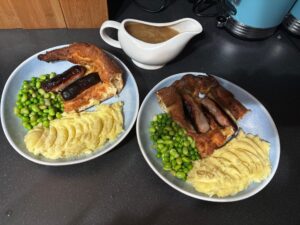
Most of the numbers you will find on this question are per hour: an air fryer costs so much an hour, an oven costs so much an hour. Nobody cooks for an hour. You cook a tray of chips, or six sausages, or a jacket potato, and what you want to know is what that cost — and whether it would have been cheaper in the oven.
So this is the per-dish version, worked at the current UK price cap for the dishes most of us actually make. The short answer: a typical evening meal costs about 13p of electricity in an air fryer and about 39p in a fan oven, roughly three times as much. The long answer is the table, because the gap is not the same for every dish, and for one or two things the oven still wins.
If you want the wider picture — what an air fryer will and will not do, and where the savings really come from — start with the air fryer cooking guide. If you want the timings behind these figures, they are in the air fryer times and temperatures chart.
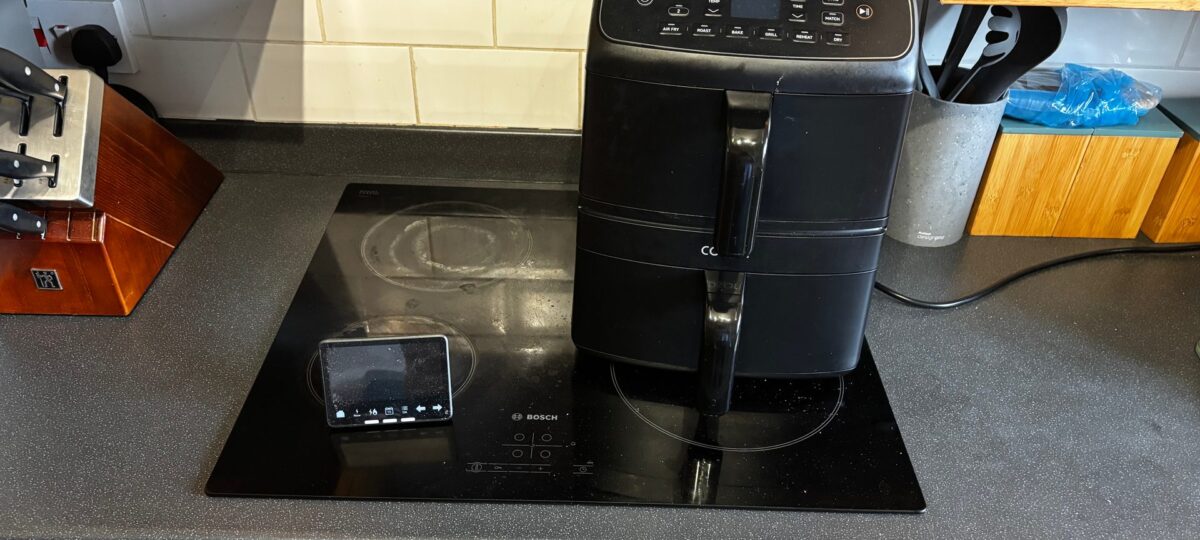
The air fryer in our photo is a Cosori Double Stack that VeSync, the company behind Cosori, sent us free to review. The costs on this page are worked from the price cap and typical wattages, not measured on it.
The headline figure: at the October–December 2026 price cap (26.32p/kWh), a 1,500-watt air fryer running for twenty minutes costs about 13p. The same meal in a 2.2 kW fan oven — ten minutes to preheat, thirty to cook — costs about 39p. Cooking once a day, that difference is worth roughly £93 a year.
What each dish costs to cook
Air-fryer times are the first-check times from our chart; oven times are the ordinary packet or recipe time at 200°C fan, plus ten minutes of preheating, which the air fryer does not need.
| Dish | Air fryer (1,500 W) | Fan oven (2.2 kW, incl. preheat) | Oven costs |
|---|---|---|---|
| Frozen chips, one bag | 12 min · 8p | 18 + 10 min · 27p | 3.4× |
| Sausages, six | 10 min · 7p | 25 + 10 min · 34p | 5.1× |
| Salmon fillets, two | 8 min · 5p | 15 + 10 min · 24p | 4.6× |
| Chicken thighs, four | 20 min · 13p | 40 + 10 min · 48p | 3.7× |
| Roast potatoes, parboiled | 22 min · 14p | 45 + 10 min · 53p | 3.7× |
| Jacket potato, one large | 35 min · 23p | 70 + 10 min · 77p | 3.4× |
| Reheating last night’s dinner | 6 min · 4p | 15 + 10 min · 24p | 6× |
| A typical evening meal, 20 minutes | 13p | 30 + 10 min · 39p | 2.9× |
Two things stand out. The first is the preheat: ten minutes of a 2.2 kW oven is nearly 10p before any food goes in, and for a quick dish that is a third of the whole cost. The second is that the gap is widest on the quick things — reheating, fish, sausages — and narrowest on the long ones, because a jacket potato takes a long time either way.
A dual-basket machine draws more, typically around 2,400 watts with both drawers going. The same twenty-minute meal comes to about 21p — still well under the oven, and you are cooking two things at once.
How we worked it out
Every figure is the appliance’s rated power multiplied by the cooking time, priced at the Ofgem price-cap electricity unit rate of 26.32p per kWh (1 October to 31 December 2026, direct debit; electricity currently carries no VAT). A 1,500-watt air fryer for twenty minutes is 0.5 kWh, which is 13p; a 2.2 kW oven for forty minutes including preheat is 1.47 kWh, which is 39p.
Be honest about what that method is: a ceiling for both appliances. Neither runs its element flat out for the whole time — once an oven reaches temperature its thermostat cycles, and an air fryer does the same in a smaller way. Because the oven spends longer at temperature, its real figure is further below the ceiling than the air fryer’s is, so the true gap is a little smaller than the table shows. It does not close. The reason is not cleverness in the air fryer; it is that you are heating a few litres of air next to the food instead of sixty or seventy litres of oven and the metal around it.
These are electric figures. If your oven is gas, the sums are different — gas is priced at roughly a third of electricity per kWh — and the answer is much closer. Your own unit rate may also differ from the cap; it is on your bill, and everything here scales in proportion.
When the oven still wins
An air fryer wins on almost every single dish. It does not always win on the meal.
- Cooking for a crowd. A drawer holds one uncrowded layer. A Sunday roast for six is one oven load and three or four air-fryer batches, and by the third batch you have spent the saving. The oven’s cost barely moves whether it holds one tray or three.
- Anything that needs the whole oven anyway. If the joint is in the oven for two hours, the roast potatoes are effectively free in there. Putting them in the air fryer saves you nothing and costs you a socket.
- Bread and anything with a wet batter. Not a running-cost point, a results one — a loaf wants the steady heat and the space; a batter wants to rise before it sets.
So the practical rule is simple. Cooking one or two portions of one thing: the air fryer, every time, and the saving is real. Cooking a full meal for a full table: the oven, and stop feeling guilty about it.
So what does it save you?
Take the meal figure at face value and the arithmetic is plain. Thirteen pence against thirty-nine is about 25p a day before rounding, and that is about £93 a year if you cook that meal daily — less if the oven was only ever on twice a week, more if you also reheat in it. That is the honest size of the prize: a useful saving, not a life-changing one, and one that a cheap machine delivers just as well as an expensive one, because the physics is the same.
“The per-hour numbers everybody quotes make the oven look worse than it is and the air fryer look better than it is. Per dish, the gap is still there — about three to one — but you can see where it comes from: a preheat you are paying for and a cavity you are heating for nothing.” — Gareth Isherwood, Danbury & Lovejoy
Once you know what a dish costs, the choosing is easier. What a machine can and cannot do, and how to get the most out of one, is in the air fryer cooking guide; the cost of running everything else in the house is in the UK home running costs index, which is kept at the current cap.
We keep these running-cost figures up to date as the price cap changes. Journalists and editors are welcome to cite them with a link to this page; for the underlying arithmetic or a regional breakdown, get in touch.
Related
- Air Fryer Times and Temperatures: A Starting Chart for UK Staples — the timings these figures are built on
- Air Fryer Cooking: What Actually Works, What Saves Money and How to Use It Well — the wider picture
- UK Home Running Costs Index — every appliance, at the current cap
- Best Air Fryers UK — if you are choosing rather than cooking
Sources
- Ofgem — the energy price cap and standing charges explained — the 1 October to 31 December 2026 electricity unit rate used throughout.
- Rated power is typical of the class: 1,500 W for a single-drawer air fryer, 2,400 W for a dual-basket, 2.2 kW for a built-in fan oven. Check the rating plate on your own appliance; everything here scales with it.
Was this useful?