✉ Join the Dispatch — a calm weekly note, every Thursday. Free.
Shed Size Guide UK: What Actually Fits in Each Size?
One of the most common shed-buying mistakes UK gardeners make is choosing a size that sounds big enough — only to discover it won’t fit a lawnmower, a set of garden tools, and anything else they had in mind. Whether you’re after a compact tidy-away for a small garden or a proper workshop space, getting the dimensions right from the start saves a lot of frustration. This guide breaks down every common UK shed size, what realistically fits inside, and what the planning rules say — so you can buy with confidence.
UK Shed Sizes at a Glance
Use the table below to find your best fit at a glance. Detailed breakdowns for each size follow below.
| Size | Imperial | Metric approx | What fits | Best for |
|---|---|---|---|---|
| 6×4 | 6ft x 4ft | 1.83m x 1.22m | Bikes or tools (not both) | Small gardens, minimal storage |
| 7×5 | 7ft x 5ft | 2.13m x 1.52m | Lawnmower + basic tools | Medium gardens, one-person use |
| 8×6 | 8ft x 6ft | 2.44m x 1.83m | Mower + tools + shelving | Most UK buyers — the bestseller |
| 10×8 | 10ft x 8ft | 3.05m x 2.44m | Workshop potential + storage | Hobbyists, serious gardeners |
| 12×8 | 12ft x 8ft | 3.66m x 2.44m | Full workshop or dual-use | Large gardens, dual storage/work |
| 16×10 | 16ft x 10ft | 4.88m x 3.05m | Multiple uses, full workshop | Very large gardens, business use |
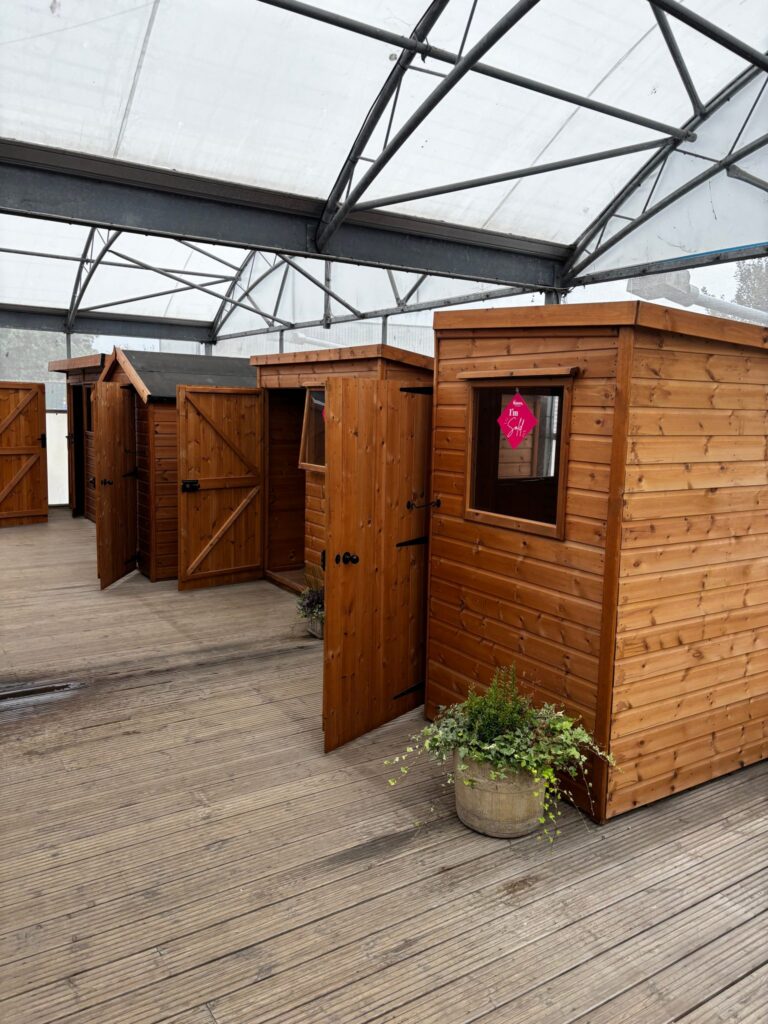
6×4 Shed: Compact but Limited
The 6×4 is the entry-level choice for UK buyers — typically used in smaller urban gardens where space is at a premium. Interior floor space is approximately 5.5ft x 3.5ft once wall thickness is accounted for, giving you roughly 19 square feet of usable floor space.
You can fit a standard lawnmower OR a set of garden tools comfortably, but rarely both. Bikes can be stored vertically with the right hooks, though this limits remaining space significantly.
Planning rules: Under permitted development, a 6×4 shed typically falls well within the 2.5m eaves height rule and the 50% garden coverage rule. No planning permission is usually required.
Best for: Small terraced or semi-detached gardens, apartment courtyard storage, bin and tool tidy-away.
7×5 Shed: The Step-Up Option
The 7×5 gives noticeably more room than a 6×4 — usable floor space increases to around 28 square feet. You can fit a mid-sized lawnmower plus a set of garden tools with some room left for shelving on one wall. One person can work comfortably in this size without feeling cramped.
Planning rules: Still comfortably under permitted development limits in most gardens.
Best for: Medium-sized gardens, buyers wanting flexibility between storage and workspace.
8×6 Shed: The UK Bestseller
The 8×6 is consistently the most popular shed size in the UK — and for good reason. With around 48 square feet of floor space, you get real versatility: a lawnmower fits alongside a full set of garden tools, you can add a wall of shelving, and there’s still room to stand and work comfortably.
This is the size where shed organisation products — shelving, hooks, pegboards — start making a meaningful difference to how much you can store and access easily.
Planning rules: Remains under permitted development rules for most gardens, provided the eaves height stays below 2.5m and the shed doesn’t cover more than 50% of the garden.
Best for: Most UK buyers. If you’re unsure which size to choose, go 8×6.
10×8 Shed: Workshop Territory
At 10×8, you’re entering proper workshop territory — around 80 square feet of floor space. This is enough for a dedicated workbench, full storage, a lawnmower, and space to move around freely. Many buyers use this size as a hobby room, potting shed, or DIY workshop.
Planning rules: Still within permitted development in most cases, but check your local authority’s rules if the shed is more than 4m high with a ridged roof, or if it sits within 2m of a boundary (where the 2.5m height limit applies strictly).
Best for: Hobbyists, keen gardeners, home workers needing an outdoor office or workshop hybrid.
| Do I Need Planning Permission for a Shed in the UK?Under permitted development rules, most garden sheds don’t require planning permission — provided all of the following apply:The shed is not forward of the principal elevation of your home (i.e., not in your front garden)The eaves height does not exceed 2.5 metresThe shed does not cover more than 50% of the total garden areaThe shed is not within the curtilage of a listed building or in a designated area (e.g. National Park, AONB)Always check with your local planning authority if you are unsure. Rules in Scotland, Wales, and Northern Ireland may differ from those in England. |
|---|
Maximise Your Shed Space: Recommended Products
Whatever size shed you choose, the right accessories make a huge difference. Based on our research, these are the ones worth adding:
Heavy-Duty Racking for Sheds and Garages
Five-tier heavy-duty racking, two bays — the quickest way to get everything off the shed floor. View on Amazon UK
Tool Storage Hooks and Pegboard Kit
Keeps long-handled tools off the floor and walls organised. Search for a pegboard kit — the term “shed pegboard hooks” works well. An easy, immediate space improvement.
Shed Roofing Felt
Shed felt is the part that fails first and the cheapest thing to put right — a 10m roll covers a re-felt with room to spare. View Shed Felt on Amazon UK
Also see: Timber vs Metal vs Plastic Sheds UK — which shed type suits your garden?
Frequently Asked Questions
What size shed do I need in the UK?
For most UK gardeners, an 8×6 shed is the sweet spot — big enough for a lawnmower, tools, and shelving, without being overwhelming. If you have a smaller garden, a 7×5 works well. For hobbyists or workshop users, go 10×8 or larger.
Does a shed need a base in the UK?
Yes — a solid, level base is essential for any shed. It prevents timber from rotting at ground level, improves stability, and helps with drainage. Concrete slabs, paving slabs, or plastic shed base grids (such as EcoBase) are all popular options.
What is the most popular shed size in the UK?
The 8×6 shed is the UK’s bestselling size. It offers the best balance of floor space, cost, and fit for standard UK garden sizes.
Can I put a shed in my garden without planning permission UK?
In most cases, yes. Under permitted development rules, garden sheds don’t require planning permission as long as they meet certain conditions — including being no more than 2.5m at the eaves, not in a front garden, and not covering more than 50% of the garden. There is one more limit that catches people out: if any part of the shed sits within 2m of a boundary, the whole structure must be under 2.5m tall — not just the eaves. Away from a boundary the overall limit is 4m for a dual-pitched roof and 3m for any other roof.
What is the best shed base material in the UK?
Concrete is the most durable option for permanent sheds. For easier DIY installation, plastic interlocking shed base grids (such as EcoBase) are easier to lay and allow drainage beneath the shed floor.
🌱 From the D&L Shop: Planning your growing year? Our Your First Year on the Allotment guide covers every month from clearing the plot to your first proper harvest — written from 15+ years of UK growing experience. £9.99, instant PDF download. Also useful: the Allotment Plot Planner (£4.99) for mapping beds and planning crop rotation. Browse the full shop →
You might also find our guide to How to choose the right shed: size, material & base (UK guide) useful.
You might also find our guide to How to choose the right shed: size, material & base (UK guide) useful.
The list of what actually goes in is shorter than you’d think — see our garden tool round-up for the handful that earn their wall space.
🛡 Our standards: How we research · Editorial policy · Affiliate disclosure · Corrections

About Gareth
Gareth Isherwood is the editor of Danbury & Lovejoy. He has baked bread at home for 25+ years and has 15 years of growing experience across gardens, containers and other growing spaces, including an East Sussex allotment for the past three years. Read his full story →
Was this useful?