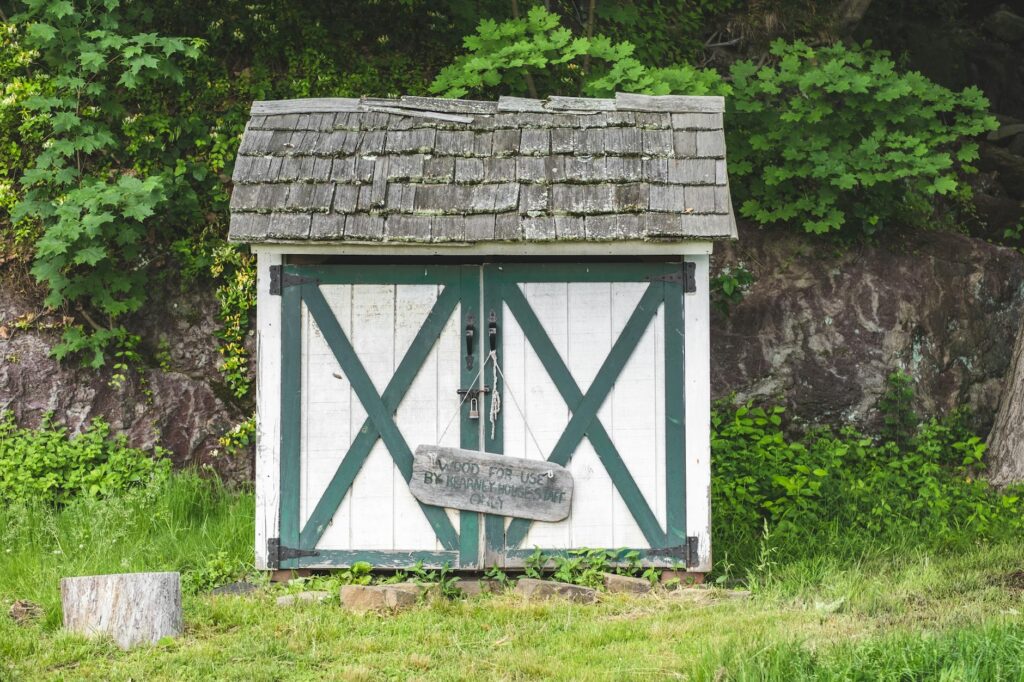
A shed front can go from a muddy afterthought to one of the nicest corners of the garden or plot without much money or effort — just a few deliberate choices about pots, path, paint and light that make the whole area feel intentional. These ideas work in real British gardens, not show-garden budgets.
✉ Join the Dispatch — a calm weekly note, every Thursday. Free.
Think of your shed as a tiny front door at the end of the garden: a spot that says “this way to quiet jobs, tools and pottering.” Below are ten realistic ideas to style your shed front using plants, lighting and storage.
1. Give Your Shed Door a Simple “Front Path”
A defined route to the shed door makes it feel intentional rather than incidental. A short run of reclaimed brick pavers across a patch of grass that turns to mud every November transforms the approach, and old bricks often turn up free in skip clearances or on allotment sites. In slippers or trainers in bad weather, a proper path is worth more than any amount of planting.
- Lay stepping stones across the lawn — even two or three is enough.
- Use a strip of gravel or bark chippings for persistently muddy spots.
- Edge the path with low herbs or ground cover if you want it to feel more planted.
Garden edging and path ideas at Buy Sheds Direct →
2. Add a Couple of Well-Chosen Pots
Pots are the fastest way to soften a bare shed frontage, and you don’t need many. Two tall terracotta pots framing the door, one either side and planted with rosemary, give you an entrance and a herb you’ll actually use; drop violas around the edges in spring. It needn’t cost much, and the effect is disproportionate to the effort.
- Use tall pots to frame the door — one on each side creates a genuine entrance.
- Plant with something evergreen (bay, rosemary, box) so it looks good year-round.
- Drop in seasonal colour around the edge: violas, tulip bulbs, geraniums.
3. Choose a Door Colour That Suits the Garden
A coat of paint is the single highest-impact change you can make to a shed frontage. A deep sage green melts into a garden or plot backdrop in the best possible way, while the wrong colour, such as a bright blue, makes the shed fight with everything around it. Stick to one main colour for the door and trim, and keep accessories in a simple palette.
- Soft greens and greys blend into hedges and lawns.
- Deep blues or charcoal look smart with pale gravel and light timber.
- Warm creams work beautifully with terracotta and brick.
4. Upgrade Hinges, Latch and Door Furniture
Basic shed hardware often looks apologetic — thin, zinc-plated, and slightly misaligned from the start. Replacing the original T-hinges with heavier galvanised ones, and the flimsy latch with a proper hasp and a decent padlock, changes how the door feels and looks out of all proportion to the cost. Heavy-duty black cast hinges in particular age beautifully on a painted timber door.
- Swap thin T-hinges for chunkier black or galvanised versions.
- Add a traditional handle or pull to the door.
- Use a decent hasp and padlock — it improves both security and appearance.
Heavy-duty shed hinges and latches on Amazon →
5. Add Hooks and a Simple “Working Rail”
Front-of-shed clutter accumulates faster than you’d expect: hosepipes, hand tools, trugs, bags of compost that didn’t quite fit back inside. A simple peg rail under the eaves — six large galvanised hooks on a pressure-treated batten — will hold a trowel, hand fork, small broom and a trug. It keeps the doorstep clear and puts the most-used tools within reach without opening the shed.
- Use an outdoor peg rail or coat rack under the eaves for everyday tools.
- Hang a trug, broom, hand fork and trowel where you can grab them without unlocking.
- Keep heavier tools and electrics safely inside the shed itself.
Wall hooks and tool storage rails on Amazon →
6. Use Lighting to Make Evenings Nicer (and Safer)
Without a path light, the shed becomes hard to use after dusk in winter — which in much of the UK means by 4pm in December. A small solar wall light above the door isn’t dramatic, but it means you can find the padlock in the dark without using your phone as a torch. A set of warm-white festoon lights along the eaves for the summer months makes the whole area feel genuinely pleasant on an evening.
- Fit a small solar wall light above or beside the door — no wiring required.
- Run warm-white outdoor string lights along the eaves in summer.
- Place a solar lantern or stake light near the path for safe footing.
Look for a solar wall light with a PIR sensor (motion-activated) — far more useful than a constant-on light in winter. Solar wall lights on Amazon → Outdoor string lights on Amazon →
7. Hide Bins, Logs and “Ugly but Necessary” Things
The compost bin, the water butt, the log pile, the bag of spent compost you keep meaning to deal with — all of these tend to end up near the shed. The trick is not to fight the clutter but to organise it into something that looks deliberate. A proper log store with a roof is both useful and structurally tidy. A water butt planted around with tall grasses in a pot softens it considerably. The test is simple: does this area look cared for, or abandoned?
- Use a log store or bin store that matches or complements your shed.
- Plant a climber or tall grass in a pot to soften the view of necessary but ugly kit.
- Keep the immediate area swept — it makes even imperfect organisation look intentional.
Log stores at Buy Sheds Direct →
8. Add a Tiny Seating Spot (If You Have Room)
A single old wooden garden chair in the corner by the shed door — a Freecycle find is fine — transforms the area into somewhere you actually stop rather than just pass through, and somewhere to sit with a coffee on a dry morning before getting started. It makes the shed feel like a destination rather than just storage.
- A slim wooden bench tucked against the wall takes up surprisingly little space.
- A single bistro chair and a small table works well in tight spots.
- Use cushions you bring out from the house rather than leaving in the weather.
9. Use Seasonal Decor Sparingly
A little seasonal touch at the shed door goes a long way — but the key word is sparingly. A small wreath in winter and a terracotta pot of tulips in spring is enough. The moment there are too many competing elements the area loses the calm, quiet feel that makes a shed frontage appealing in the first place.
- Spring: a pot of bulbs or a simple wreath on the door.
- Summer: a short length of bunting for parties, then pack it away.
- Autumn: a single pumpkin and a lantern.
- Winter: a small outdoor wreath and warm solar lights.
Choose pieces that pack away easily so you’re not tripping over storage boxes inside the shed year-round.
10. Keep the Area Tidy with Clever Storage
The most stylish shed frontage in the world struggles if the doorstep is buried in pots, tools and half-empty bags. A shallow shelf just inside the door — at eye level, visible as soon as you open up — gives the daily things a home: a folding knife, ties, a small watering can, the seed packets you’re working through. Everything that would otherwise pile up on the step has a designated home just inside the door.
The back of a shed door is usually wasted space, and a single hook there earns its keep. Mine is a timber 6×4, with a tote bag for the next visit hanging on the back of the door.
- Use a trug or crate by the door for off-cuts and small tools.
- Hang a narrow shelf just inside the shed door for daily-use items.
- Keep a stiff brush or broom by the door for a quick sweep-up.
Flexible garden trugs on Amazon →
Stop the Mud Before It Reaches the House
A tidy shed front only goes so far if the mud still follows you indoors. The door from the garden into the house needs a system of its own for the clutter a garden creates: wet boots, a trug with tools still in it, a damp jacket, the trowel you meant to clean. Give each of those a fixed place before it arrives, rather than tidying up after it has spread.
- A two-step dirt trap. A heavy-duty waterproof mat outside, big enough for two steps, to scrape boots on, and a boot tray just inside to catch drips and clumps. Boots land in one place and dry there instead of wandering across the kitchen, and dried mud, which crumbles into grit that gets everywhere, stops at the threshold.
- Hooks where hands reach. Coats, keys, gloves and hats on hooks at adult height by the door, with a slim shelf above for the small things that otherwise land on the nearest surface: a torch, hand cream, a pen, the seed packet in use.
- A crate for garden kit. A labelled crate or box for gloves, secateurs, kneeler and sun hat, and another for shared odds and ends, stops the scatter of small things put down “for a moment”.
- Bulky things go outside. Compost bags, long-handled tools, spare pots and bikes belong in the shed or a slim outdoor store (see our slimline bike storage guide), not in the doorway.
No porch or utility room? Keep it minimal: mat outside, boot tray just inside, hooks on the nearest wall. Even a narrow landing strip stops mud travelling through the house, as long as each thing has a fixed spot. Once a week, empty the boot tray, shake the mat and put stray items back in their crates.
Quick shed frontage checklist
- Brush down the door and sweep the area in front.
- Decide on a colour palette: paint, pots, and accessories in one scheme.
- Add or define a short path to the door.
- Place two pots to frame the entrance.
- Add one light, one hook rail, and one “nice to have” — bench, wreath or sign.
Small changes, lasting effect
None of this is expensive or time-consuming: a peg rail, a painted door, two terracotta pots and a solar light can all be done in a single afternoon. Start with the path and the paint; everything else follows naturally.
Further Reading
Thinking about your shed setup? You might find these useful: How to Choose the Right Shed: Size, Material & Base and Timber vs Metal vs Plastic Sheds UK: Which is Best for Your Garden?.
📋 From the D&L Shop: Planning your growing year? Our Your First Year on the Allotment guide covers every month from clearing the plot to your first proper harvest — written from 15+ years of UK growing experience. £9.99, instant PDF download. Also useful: the Allotment Plot Planner (£4.99) for mapping beds and planning crop rotation. Browse the full shop →
🛡 Our standards: How we research · Editorial policy · Affiliate disclosure · Corrections · Last reviewed: July 2026

About Gareth
Gareth Isherwood is the editor of Danbury & Lovejoy. He has baked bread at home for 25+ years and has 15 years of growing experience across gardens, containers and other growing spaces, including an East Sussex allotment for the past three years. Read his full story →
Was this useful?