✉ Join the Dispatch — a calm weekly note, every Thursday. Free.
A baking tray is the piece of kit that quietly does the most work in a home kitchen and gets the least thought when you buy it — you grab whatever’s stacked by the tills, and then spend the next few years wrestling a warped, buckling sheet that tips your roast potatoes into one corner and won’t sit flat on the shelf. It needn’t be that way. This guide covers the best baking trays you can buy in the UK in 2026, from a budget non-stick sheet to a commercial-grade Nordic Ware pan that will outlast your oven, and — just as usefully — where the money stops buying you a better tray and starts buying you a bigger box.
I’ve been baking at home for twenty-five years, and if there’s one thing that separates a tray you keep for two decades from one that warps in its first month, it’s gauge — the thickness of the metal. A heavy 1mm carbon-steel sheet or a thick aluminium pan sits dead flat and stays that way; a thin pressed-steel tray tents and pops the moment it hits a hot oven, and no coating on earth fixes that. Get the gauge right and everything else is detail. If you’re kitting out a baking cupboard from scratch, this pairs naturally with our best loaf tins and best cake tins guides.
The best baking trays UK 2026, at a glance
| Baking tray | Best for | Type | Rough price |
|---|---|---|---|
| MasterClass Non-Stick (39x27cm) | Best overall | Rimmed, non-stick | Check price |
| Tala Performance Baking Sheet | Best non-stick release | Flat sheet, coated | £9.00 |
| 3-Piece Non-Stick Tray Set | Best budget set | Rimmed, non-stick | £10.49 |
| Nordic Ware Naturals Half Sheet | Best heavy-gauge aluminium | Rimmed, uncoated | £24.43 |
| Wiltshire Easybake Roasting Tray | Best deep/roasting tray | Deep-sided | £14.91 |
| MasterClass Smart Space 7-Piece Set | Best set for value | Nesting bakeware set | £51.19 |
subject to change
Product prices and availability are accurate as of the date/time indicated and are subject to change. Any price and availability information displayed on Amazon.co.uk at the time of purchase will apply to the purchase of this product.The one to buy for most kitchens is the MasterClass Non-Stick. It does the job a baking tray is for — sits flat, browns evenly and releases cleanly — in a heavy gauge that won’t warp, without asking you to spend commercial-bakeware money. Everything above it here is buying permanence, depth or a whole set, not fundamentally better baking.
The picks
Best overall
MasterClass Non-Stick Baking Tray (39x27cm)

MasterClass Non-Stick Baking Tray (39x27cm)
This is the tray I’d put in most kitchens, and it’s genuinely hard to do better for the money. The body is heavy 1mm carbon steel — roughly double the thickness of a supermarket own-brand tray — so it sits dead flat and resists the buckling that ruins cheaper sheets in a hot oven. The surface is big enough for a full batch of biscuits or a tray of roasties, the rim keeps fat and batter contained, and the non-stick finish releases cleanly with barely any oil. It’s the sensible default: thick enough to last, coated enough to be convenient, and large enough to earn its shelf space. Buy this unless you have a clear need one of the others solves.
Best non-stick release
Tala Performance Baking Sheet

Tala Performance Baking Sheet
If your baking is mostly biscuits, pastry and anything delicate that likes to stick, the Tala is the sheet to reach for. It’s pro-gauge steel — properly rigid, no flimsy flex — finished with Tala’s Eclipse non-stick coating, which bakeware reviews rate among the cleanest releases at this price: shortbread and choux lift straight off with nothing left behind. The low rim means good airflow round the edges for even browning, which is exactly what you want for a tray of biscuits. It’s remarkable value for the build. The coating is still a consumable — treat it kindly and skip metal implements — but as a dedicated biscuit-and-pastry sheet it’s hard to beat.
Best budget set
3-Piece Non-Stick Baking Tray Set

3-Piece Non-Stick Baking Tray Set
For a first kitchen, a rental or simply stocking up cheaply, this three-tray set covers most everyday jobs for under a tenner. You get three graduated rimmed trays — small, medium and large — so you can bake a couple of things at once, or pick the size that suits the batch rather than heating a big sheet for four biscuits. The non-stick finish does the everyday work and the rims contain juices and fat. They’re a lighter gauge than the MasterClass, so keep them off the very top shelf of a fierce oven to avoid tenting, but for the price it’s honestly hard to argue with three usable trays for the cost of one decent one.
Best heavy-gauge aluminium
Nordic Ware Naturals Half Sheet Pan

Nordic Ware Naturals Half Sheet Pan
This is the one pan here I’d call permanent. It’s thick, uncoated natural aluminium — the commercial-kitchen standard — with a steel rod encapsulated in the rolled rim, which is what stops it warping even under a screaming-hot oven. There’s no coating to wear out, so it’s essentially a buy-it-for-life pan: aluminium conducts heat superbly and browns pastry and roast vegetables more evenly than any coated steel tray. The trade-off is you bake on parchment or a silicone mat because bare aluminium isn’t non-stick, and it can dull or spot over time (harmless). It’s dearer up front, but spread over a lifetime of flat, even, warp-free baking it’s the frugal choice for a serious home baker.
Best deep/roasting tray
Wiltshire Easybake Large Roasting Tray

Wiltshire Easybake Large Roasting Tray
A flat sheet is no use for a Sunday roast or a saucy traybake — you need real depth to hold fat, rendered juices and batter without it sliding over the edge and smoking on the oven floor. The Wiltshire Easybake gives you exactly that: high, sturdy sides that contain a proper volume of liquid, so it handles roast potatoes swimming in goose fat, a tray of sausages, or a deep flapjack or brownie bake. It’s the tray that stops your oven getting filthy. It’s the deep workhorse every kitchen needs alongside its flat sheets — different job, and one a shallow tray simply can’t do.
Best set for value
MasterClass Smart Space 7-Piece Bakeware Set

MasterClass Smart Space 7-Piece Bakeware Set
If you’re fitting out a kitchen from nothing, buying a considered set is cheaper and tidier than picking pieces off one at a time. The Smart Space seven-piece covers the lot — baking trays, a roasting tin and cake tins — and its party trick is that the pieces nest together to save cupboard space, which matters more than you’d think when bakeware is famously awkward to store. The gauge is solid MasterClass quality throughout, not the flimsy pressed steel that undoes most bargain sets. For seven proper pieces it’s the best value here if you need breadth rather than one perfect tray — a whole baking cupboard sorted in a single box.
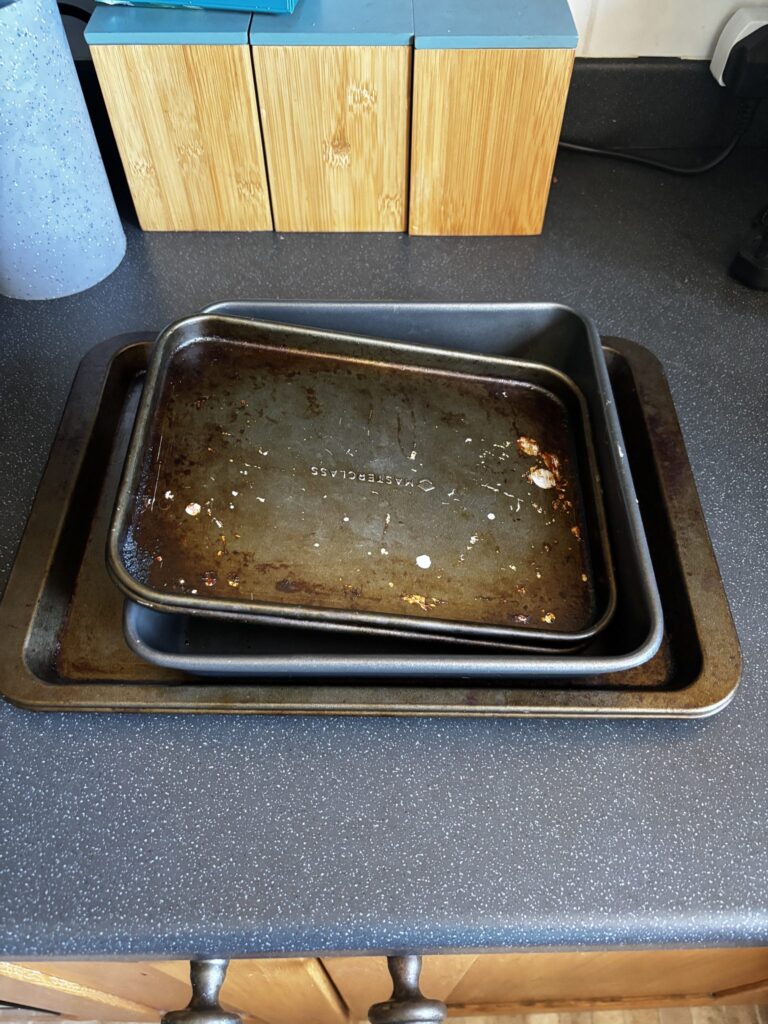
This is what baking trays look like after years of ordinary use, which is worth seeing before you spend. The dark mottled bloom across all three is polymerised oil — thin films of fat baked on and darkened at temperature — rather than dirt or a failed coating, and it is not a fault. It is also not reversible by scrubbing, so a tray you want to keep looking new is a tray you will be disappointed by. The middle tray carries the MasterClass name embossed in its base; nothing in the frame gives its size or model, so read these as an illustration of how the category ages rather than as a verdict on any pick above.
How to choose a baking tray
Ignore the packaging and buy on the things that actually decide whether a tray lasts and bakes well. In rough order of importance:
- Gauge matters most. This is the single thing that separates a twenty-year tray from one that warps in month one. Heavy 1mm carbon steel or thick aluminium sits flat and stays flat; thin ~0.4mm pressed steel tents and pops the moment it hits a hot oven. If you feel a tray flex in your hands in the shop, it’ll buckle in the oven.
- Flat sheet vs rimmed sheet-pan. A flat sheet (rim on one or two sides only) is best for biscuits and anything that wants airflow and easy sliding-off. A rimmed sheet-pan (all four sides) is the more versatile everyday tray — it contains fat, batter and juices, so it’s the one to own if you only buy one.
- Non-stick vs uncoated aluminium. Non-stick is convenient but it’s a consumable — the coating degrades over time and above roughly 230°C, so it won’t last forever. Uncoated aluminium is permanent and browns beautifully evenly, but you bake on parchment because it isn’t non-stick. Coated for convenience, bare aluminium for longevity.
- Leave room to breathe. Whatever you buy, leave a ~2–3cm airflow gap around the tray in the oven — a sheet jammed edge-to-edge against the walls browns unevenly and traps steam, so measure your oven before buying the biggest tray on the shelf.
Put simply, the ideal home kit is three trays doing three jobs: one rimmed workhorse for everyday baking and roasting, one flat sheet for biscuits and pastry, and one deep roaster for fat, juices and traybakes. Get those three in a decent gauge and you’ll never need to think about baking trays again.
How we chose
These picks are based on research — verified current UK availability and pricing, published specifications and metal gauges, and the consensus of established bakeware reviews — rather than a hands-on test of every tray in our own kitchen. Every tray here was confirmed in stock at the time of writing; where a cheaper option is a lighter gauge or a set is really about breadth rather than one outstanding piece, we’ve said so plainly, because gauge and honest trade-offs are exactly what most baking-tray round-ups skate over.
Frequently asked questions
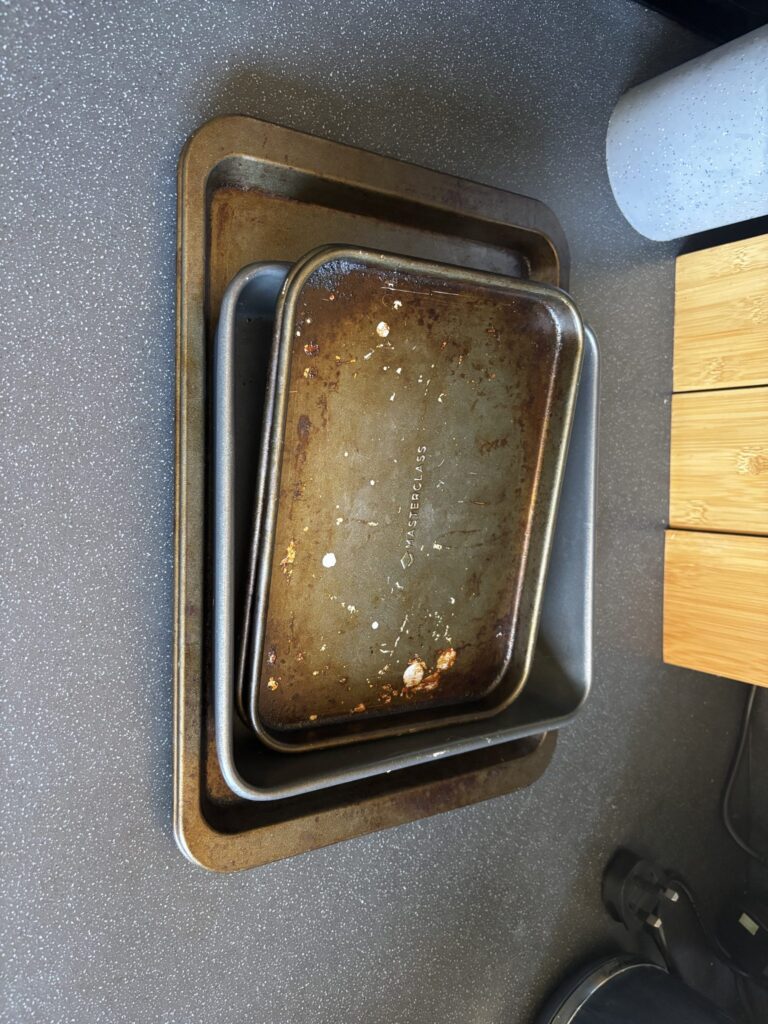
Look at the base rather than the rim. The pale rings and patches above are where the surface has been in fiercest contact with the shelf and the food, and they map the spots that run hottest — which is the same unevenness that eventually shows up as a buckle. A thin tray gives you that pattern faster because there is less metal to spread the heat sideways. It is also why a tray that has started to bow will often bow again in the same place after you have flattened it.
Why do cheap baking trays warp and buckle?
It comes down to gauge — the thickness of the metal. A thin pressed-steel tray (around 0.4mm) heats unevenly and expands faster than its own frame can cope with, so it tents up and pops with a bang in a hot oven. A heavy 1mm carbon-steel sheet or a thick aluminium pan with a reinforced rim has enough mass to expand evenly and stay flat. If a tray flexes when you press it in the shop, it will warp in the oven — no coating fixes thin metal.
Flat baking sheet or rimmed tray — which do I need?
A flat sheet has a rim on only one or two sides, which is ideal for biscuits, pastry and anything you want good airflow around or need to slide straight off. A rimmed tray has sides all the way round, so it contains fat, batter and juices and handles roasting and traybakes too. If you only buy one, make it a rimmed sheet-pan — it does more jobs. Ideally own both, since each is genuinely better at its own.
Non-stick or uncoated aluminium — which is right for a home baker?
Both, for different reasons. Non-stick is convenient and needs little oil, but the coating is a consumable — it degrades over time and above roughly 230°C, so treat it as a tray that will eventually wear out. Uncoated aluminium is permanent, conducts heat superbly and browns more evenly, but you bake on parchment or a silicone mat because bare metal isn’t non-stick. Coated for everyday convenience, aluminium for a tray that lasts a lifetime.
Are Nordic Ware aluminium sheets worth it over a £5 tray?
For a serious or frequent baker, yes. A £5 pressed-steel tray is thin, warps quickly and has a coating that wears out, so you replace it every year or two. The Nordic Ware is thick, uncoated aluminium with a steel-reinforced rim — it won’t warp, has no coating to fail, browns more evenly and is essentially a buy-it-for-life pan. Spread over a decade it costs less per year, though you do bake on parchment. If you bake rarely, the cheap tray is fine.
What size and how many baking trays should I own?
For most homes, three trays cover everything: one rimmed workhorse (a large ~39x27cm sheet-pan) for everyday baking and roasting, one flat sheet for biscuits and pastry, and one deep-sided roasting tray for fat, juices and traybakes. Before buying the biggest tray on the shelf, measure your oven and leave a 2–3cm airflow gap around the tray — a sheet jammed against the oven walls browns unevenly. A good nesting set is the tidiest way to get all three at once.
Which baking tray should you buy?
For most UK kitchens, the MasterClass Non-Stick is the one to get — heavy 1mm carbon steel that sits flat and won’t buckle, a big surface and a clean-releasing finish, and nothing dearer bakes meaningfully better. Baking a lot of biscuits and pastry, add the Tala Performance flat sheet; wanting a warp-proof pan for life, the Nordic Ware Half Sheet in uncoated aluminium; roasting and traybakes, the deep Wiltshire Easybake; and if you’re fitting out a whole cupboard at once, the nesting MasterClass Smart Space set is the best value. Choose on gauge first — that’s what actually decides whether your tray lasts twenty years or one month.
Kitting out the rest of the baking cupboard? Our best loaf tins and best cake tins guides are the natural next stops — and if you’re just getting going, how to start baking bread is where I’d begin — or let a machine take the strain with our best bread makers guide.
— Gareth
Was this useful?