Knowing how to read your energy bill properly — rather than just wincing at the total — can help you spot errors, understand your usage, and avoid overpaying. Most people ignore the detail, but it’s genuinely worth a few minutes. For official guidance on billing disputes, Citizens Advice has a clear energy bill explainer.
This guide explains what the main elements of a UK energy bill mean, what to look for, and what you can actually do with that information.
The unit rate — the most important number on your bill
Your unit rate is the amount you pay for each kilowatt-hour (kWh) of electricity or gas you use. The Ofgem price cap for October–December 2026 sets the average electricity unit rate at approximately 26.32p per kWh. Gas is capped separately and is far cheaper per unit, at approximately 7.97p per kWh.
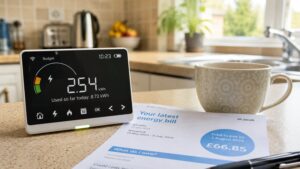
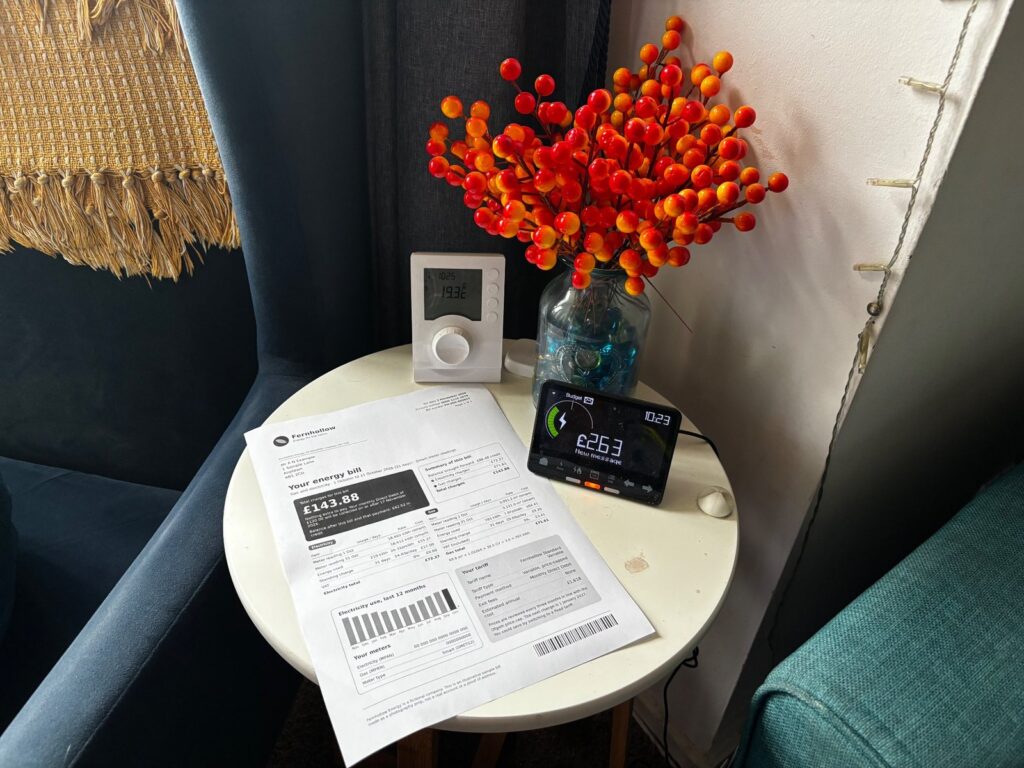
The photo at the top is a sample bill, printed for the picture (Fernhollow is a made-up supplier), set out at this winter’s capped rates: 26.32p per kWh and 54.83p a day for electricity, 7.97p per kWh for gas, and no VAT on electricity from October. Beside it is our own smart-meter display, showing £2.63 at 10:23 on 4 November 2026.
This single number is the basis for every running cost calculation in your home. A 2,200W oven running for one hour uses 2.2 kWh — that is 2.2 multiplied by 26.32p, or approximately 58p. A 300W heated airer running for three hours uses 0.9 kWh — approximately 24p. Once you know your unit rate, you can work out the cost of running any appliance in the house — or save yourself the arithmetic and use our UK Home Running Costs Index, which has already done it for 34 of them at this exact rate.
The cheapest line item to act on is usually the draughtiest door — our draught excluder picks start at £8 and pay back inside a fortnight.
The standing charge — the cost of being connected
The standing charge is a daily fixed fee that you pay regardless of how much energy you use. The current Ofgem cap sets it at approximately 55p per day for electricity and 30p per day for gas. Over a year, that is approximately £200 in standing charges for electricity and £108 for gas — a total of around £308 before you use a single unit of energy.
The standing charge is not something you can reduce by using less energy, which surprises many people. It is the cost of maintaining your connection to the grid and network. What it does mean is that households with very low usage still face a significant fixed cost, which is worth being aware of when comparing tariffs.
Actual vs estimated reads — and why they matter
Energy bills are sometimes based on estimated meter readings rather than actual ones, particularly if you haven’t submitted a reading recently. An estimated bill can be significantly wrong in either direction — overcharging you and building up a credit balance, or undercharging you and building up a debt that appears as a larger-than-expected bill later.
Submitting an actual meter reading at least once per quarter — either online or via your supplier’s app — ensures you are billed accurately. If you have a smart meter, this happens automatically. Check your bill to confirm whether readings marked “A” (actual) or “E” (estimated) are being used.
Your average daily usage — the number worth watching
Most energy bills include a section showing your average daily usage over the billing period, compared with the previous period. This is the most useful diagnostic number on the bill. An increase in daily usage against the previous year’s equivalent period might reflect a cold snap, a new appliance, or a change in household behaviour. A decrease reflects the cumulative effect of efficiency measures — draught proofing, a heated airer replacing the tumble dryer, better heating schedules. If your bills are high, draught-proofing is often the cheapest fix.
Watching this number over time, rather than just reacting to the total bill, gives you a clearer picture of what is actually driving your costs.
Your account balance — credit vs debit
If you pay by direct debit, your supplier collects a fixed amount each month and applies it against your actual usage over the year. In summer, when usage is lower, you typically build up a credit balance. In winter, when usage is higher, that credit is drawn down. A large credit balance — especially in spring or early summer — suggests your direct debit may be set too high and can often be reduced by contacting your supplier.
Conversely, a debit balance going into winter suggests your direct debit may be too low and a shortfall is coming. Better to address it in October than face an unexpected catch-up charge in February.
The Danbury Dispatch this week
This week’s Dispatch includes a one-page household energy tracker — a simple template for recording your monthly unit usage and spotting trends across the year. Join free here to receive it directly.
Related reading
If you found this useful, the slow cooker electricity cost guide puts the unit rate to practical use with real running cost comparisons, and the draught proofing guide covers one of the most effective ways to reduce usage.
🏠 From the D&L Shop: Making your home warmer this winter? Our Winter Home Survival Guide covers heating, draught-proofing, condensation, energy bills, and keeping comfortable through the cold months — 11 pages, £8.99. Also free: the Sunday Reset Checklist (a calm weekly home reset, instant download). Browse the full shop →
Further Reading
🛡 Our standards: How we research · Editorial policy · Affiliate disclosure · Corrections · Last reviewed: April 2026

About Gareth
Gareth Isherwood is the editor of Danbury & Lovejoy. He has baked bread at home for 25+ years and has 15 years of growing experience across gardens, containers and other growing spaces, including an East Sussex allotment for the past three years. Read his full story →
Was this useful?