Some of the links below are affiliate links: if you buy through them we may earn a small commission at no extra cost to you. As an Amazon Associate I earn from qualifying purchases. We only suggest things we would recommend to a friend — see our affiliate disclosure and how we research.
✉ Join the Dispatch — a calm weekly note, every Thursday. Free.
July is when the plot stops being polite. The growth rate is at its peak, the harvest is in full swing, and the work shifts almost entirely from planting to keeping up. Everything you need for the growing year is in our Garden & Outdoor hub. There’s a sweet spot in the middle of July when the plot looks like the picture-book version of itself — and a fortnight either side when it looks like work.
The two big jobs this month are watering and harvesting, and they tend to compete for time. After fifteen-plus years of growing summers in East Sussex, three of them on the allotment, my July rule is: do the picking first, the feeding second, and the watering last (when it’s coolest). Anything started in the wrong order takes twice as long.
Watering: The Daily Rhythm
Watering becomes daily work in July — at least for anything in pots, grow bags, or recently planted out. The borders and beds can usually be left two to three days between proper soaks, but only if you’ve mulched and only if it’s not blowing sustained heat.
- Water early or late, not midday. Evaporation in midday sun wastes a third of what you put on. Early morning is best — gives plants water before the day’s stress.
- Tomato grow bags need a minimum of two litres a day per plant in real heat — three if they’re cropping. A daily, consistent rhythm prevents blossom end rot and split fruit. It’s the irregular watering that does the damage, not the volume.
- Cucumbers and courgettes show stress immediately. Wilting leaves at midday in full sun isn’t necessarily a problem — they often perk up by evening. Wilting at 7am is.
- Newly sown salad rows need a fine spray daily until germinated. Use the rose, not the open spout.
If you’re planning a holiday this month, see our guide to keeping the allotment alive while you’re away, and our notes on watering through a heatwave when the rota slips.
Feeding: When the Plant Starts Carrying Fruit
Once a plant is putting on flowers and setting fruit, it needs more potassium than nitrogen. Switch from any general feed to a high-potash tomato feed for:
- Tomatoes — once flowering. Feed weekly at the recommended dilution; twice-weekly during heatwaves when plants are working harder.
- Peppers and chillies — same rhythm.
- Cucumbers — yes, despite being a fruiting plant, they like the same potash boost.
- Courgettes and squash — once you’re seeing the first fruits set, a fortnightly feed keeps them productive.
- Strawberries (everbearers and perpetuals) — for plants in pots, weekly tomato feed extends the season into August.
Comfrey tea is a free homemade alternative if you’ve got a corner of comfrey somewhere. Steep leaves in water for three weeks and dilute 10:1. It smells appalling but it works.
Sowings in July: Thinking About Winter
July is when you start sowing for autumn and winter — counter-intuitive when the plot is already overflowing, but the windows are short.
- Spring cabbage — sow in modules for planting out in September. Without a July sowing, no spring cabbage.
- Winter purslane and lamb’s lettuce — direct sow late July for late autumn salads.
- Spring onions — keep going. A late July sowing gives spring onions through November.
- Pak choi and oriental greens — late July is ideal; sown in summer they bolt fast.
- Carrots for autumn — last sowing window. Use a fast-maturing variety.
- Salads — keep up the fortnightly succession. Use heat-tolerant varieties (mizuna, mibuna, lollo rosso) over standard butterhead lettuce, which bolts in heat.
- Strawberry runners — peg down healthy runners from main plants into pots filled with compost. Detach when rooted in a few weeks for next year’s bed.
The Peak Harvest Window
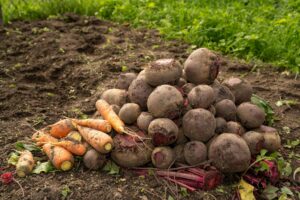
The plot is generous in July. Pick often — most things crop better the more you take, and almost everything tastes better the day it’s picked.
- Courgettes — pick at 15cm. Miss two days and you have a marrow. Pick every other day at peak; daily in real heat.
- Peas and broad beans — peaks finish through July. Pick young rather than old.
- French and runner beans — first cropping starts mid to late July. Pick young (15cm or so) and they keep producing.
- New potatoes and second earlies — lift as needed.
- Garlic — finish lifting and dry in a single layer somewhere airy.
- Onions and shallots — when the tops fall over and start to yellow, ease them slightly out of the soil to dry.
- Soft fruit — strawberries finishing, summer raspberries in full swing, currants and gooseberries ready.
- Tomatoes (under glass) — first ripe trusses from mid-July.
- Cucumbers — pick at full size before they yellow; they keep producing.
For the inevitable courgette glut and the early raspberries, see the wider Summer Outdoor hub for cooking with what’s coming in.
Pinching, Pruning and Tying In
- Tomatoes (cordon) — keep pinching out side shoots. Once four or five trusses have set, pinch out the growing tip too. Tie in the main stem every fortnight.
- Cucumbers — pinch out the growing tip when it reaches the top of its support; train side shoots horizontally.
- Strawberries — cut off runners you’re not using for propagation. They drain energy from the parent plant.
- Summer raspberries — cut fruited canes down to ground level once they finish, leaving this year’s new green canes for next year’s crop.
- Lavender — light trim after flowering to keep plants compact.
- Sweet peas — pick every two or three days to keep them flowering.
Pests and Problems in July
- Powdery mildew — particularly on courgettes, squash and cucumbers. Water deeply at the roots, mulch, and remove badly affected leaves.
- Tomato and potato blight — watch for warm, wet weather. Brown patches on leaves spreading fast = blight. Outdoor tomatoes are most vulnerable. Cut off affected foliage and bin (don’t compost).
- Cabbage white caterpillars — if mesh netting failed, pick off eggs (yellow clusters) and caterpillars by hand. Cabbage caterpillars strip a leaf in a single afternoon.
- Carrot fly — second generation in late July. Keep mesh in place when thinning carrots; the smell of bruised foliage is the lure.
- Aphids — on almost everything. Strong jet of water; encourage ladybirds.
- Slugs (still) — particularly after rain. See our guide to organic slug control that actually works.
Quick Picks

KOTARBAU® Watering Can - Galvanised Steel - 10 L (2.2 Gallon) - Silver - Removable Rose for Indoor and Outdoor Plants - Durable Metal Watering Can for Garden and Houseplants

Levington Tomorite Liquid Tomato Food, Concentrate, 1L, Red

VELCRO Brand ONE-WRAP Plant Ties Tape, 12mm x 5m, Green - Reusable, Plant-Friendly Secure Solution For Tree Ties Straps, Plant Clips, VEL-EC60202,package may vary
July Jobs at a Glance
- Daily watering of pots, grow bags and tender crops
- Weekly potash feed for tomatoes, peppers, cucumbers
- Pinch out tomato side shoots; tie in stems
- Pick courgettes, beans, peas every other day
- Sow spring cabbage, winter salads, late carrots
- Cut down fruited summer raspberry canes
- Watch for blight on tomatoes; remove and bin affected foliage
- Lift garlic, onions, shallots when tops yellow
- Set up holiday cover before you go away
- Take strawberry runners for next year
July is exhausting and brilliant. Looking back at June’s jobs if you’re catching up — many July tasks are continuations rather than new ones. August follows here as the harvest deepens and the first preserving begins.
You’ll find more growing guides and seasonal advice in our Garden & Outdoor hub. Good luck out there — drop me a note about your courgette count this week.

Selections Natural Willow Garden Trug Storage Harvesting Basket with Folding Handles
Last reviewed: May 2026
🛡 Our standards: How we research · Editorial policy · Affiliate disclosure · Corrections · Last reviewed: May 2026

About Gareth
Gareth Isherwood is the editor of Danbury & Lovejoy. He has baked bread at home for 25+ years and has 15 years of growing experience across gardens, containers and other growing spaces, including an East Sussex allotment for the past three years. Read his full story →
Was this useful?