A crumble is the most forgiving bake in the British repertoire. The fruit can be almost anything in season. The topping has three ingredients and takes five minutes to make. You cannot really get it wrong, and it is almost always exactly what’s wanted.
The crumble sits at the centre of British home baking in a way that’s easy to underestimate until you’ve made one properly and understood what you’re dealing with. It’s not a recipe you follow — it’s a method you absorb and then apply to whatever the season puts in front of you. Rhubarb in spring. Gooseberries in early summer. Apples and blackberries in autumn. Plums in September. Once you know the proportions for the topping and the basic logic of the fruit layer, a crumble is something you can produce in under an hour with minimal thought.
This guide covers two versions in detail — apple in autumn, rhubarb in spring — and the general principles that let you apply the method to anything else.
Apple Crumble
Bramley apples tossed with cinnamon and lemon under a butter-rubbed topping. No pre-cooking, no fuss — ready in under an hour.
Ingredients
- Bramley apples, peeled, cored, cut into 2cm chunks800 g
- Caster sugar2–3 tbsp
- Ground cinnamon1 tsp
- Ground ginger½ tsp
- Lemon, juice only½
- Plain flour150 g
- Cold unsalted butter, cubed75 g
- Demerara sugar75 g
- Pinch of fine salt
Method
- Preheat: heat oven to 190°C / fan 170°C.
- Fruit layer: toss apple chunks with caster sugar, cinnamon, ginger and lemon juice in a 20–24cm ovenproof dish. Don’t pre-cook — they’ll cook fully in the oven.
- Topping: rub cold butter into flour with your fingertips until the mixture resembles coarse breadcrumbs — a few larger lumps are fine. Stir in demerara sugar and salt.
- Assemble: spread topping loosely over the fruit. Don’t press it down — a loose topping crisps better.
- Bake: 35–40 min until topping is golden and fruit is bubbling at the edges. Cover with foil if the topping browns before the fruit is cooked.
The topping: the constant
The topping doesn’t change with the season. The ratio is the thing to learn:
For a crumble topping (serves 4–6):
- 150g plain flour
- 75g cold unsalted butter, cut into small cubes
- 75g demerara sugar (or golden caster sugar — demerara gives more texture)
- Pinch of fine salt
Rub the butter into the flour with your fingertips until the mixture resembles coarse breadcrumbs — some larger lumps are good, not everything needs to be fine. Stir in the sugar and salt. That’s the topping. It takes five minutes and can be made in advance and kept in the fridge for three days, or the freezer for three months.
Variations worth knowing: Replace 30g of the flour with ground almonds for a more complex, slightly richer topping. Add 50g of rolled oats for a more textured, slightly flapjack-like result. Both work especially well with apple and with rhubarb. A teaspoon of cinnamon in an apple crumble topping is not optional.
Apple crumble (autumn)
The autumn version. Bramley apples are the standard for crumble — they cook down to a soft, slightly tart purée that contrasts well with the sweet topping. Cox or Braeburn apples hold their shape better if you want distinct apple pieces rather than a purée.
Fruit layer
- 800g Bramley apples (about 3–4 medium), peeled, cored and cut into rough 2cm chunks
- 2–3 tbsp caster sugar (Bramleys are quite tart; adjust to your taste)
- 1 tsp ground cinnamon
- ½ tsp ground ginger (optional but good)
- Juice of half a lemon
Toss the apple pieces with the sugar, spices and lemon juice in a 20–24cm ovenproof dish. The lemon juice stops the apples browning and adds brightness to the finished dish. Don’t pre-cook the fruit — it will cook fully in the oven under the topping.
Rhubarb Crumble
Tart rhubarb with vanilla, ginger and orange under the same butter-rubbed topping. A February-to-June staple that collapses into a jammy layer under a crisp crust.
Ingredients
- Rhubarb, cut into 3cm pieces700 g
- Caster sugar100 g
- Vanilla extract1 tsp
- Ground ginger1 tsp
- Orange, zest only½
- Cornflour (optional, to thicken juices)1 tbsp
- Plain flour150 g
- Cold unsalted butter, cubed75 g
- Demerara sugar75 g
- Pinch of fine salt
Method
- Preheat: heat oven to 190°C / fan 170°C.
- Fruit layer: toss rhubarb with sugar, vanilla, ginger and orange zest. Leave 30 min, then drain off most liquid — or stir in 1 tbsp cornflour instead. Tip into a 20–24cm ovenproof dish.
- Topping: rub cold butter into flour until coarse breadcrumbs. Stir in demerara sugar and salt.
- Assemble: spread topping loosely over the rhubarb. Don’t press down.
- Bake: 35–40 min until topping is golden. The rhubarb will collapse almost entirely — this is correct. Serve with custard or cream.
Assembly and baking
Spread the topping evenly over the fruit. Don’t press it down — a loose topping crisps better than a compacted one. Bake at 190°C (fan 170°C) for 35–40 minutes until the topping is golden and the fruit is bubbling at the edges. If the topping is browning before the fruit is cooked, cover loosely with foil and continue.
Serve with custard, double cream or vanilla ice cream. The custard argument is the right one.
Apple and blackberry: Add 150g of fresh or frozen blackberries to the apple layer. Don’t add extra sugar — the blackberries add enough juice and sweetness. The combination is better than either alone, and blackberries from a hedgerow (or your allotment — see the allotment guides for what grows well in British plots) are one of the finest free things about autumn.
Rhubarb crumble (spring)
The spring version. Forced rhubarb (the pale pink, indoor-grown variety) arrives in January and lasts through March — sweeter and more tender than outdoor rhubarb, and a vivid colour that’s a genuine pleasure in a grey February. Outdoor rhubarb follows from April through June — greener, more tart, equally good.
Fruit layer
- 700g rhubarb, cut into 3cm pieces
- 100g caster sugar (rhubarb is considerably more tart than apple)
- 1 tsp vanilla extract or the seeds of half a vanilla pod
- 1 tsp ground ginger (rhubarb and ginger is a classic pairing)
- Zest of half an orange
Rhubarb releases a significant amount of liquid as it cooks. To prevent a watery crumble, either: toss the rhubarb with the sugar and leave it for 30 minutes, then drain off most of the liquid before assembling; or add a tablespoon of cornflour to the fruit layer to thicken the juices in the oven.
Assembly and baking
As per the apple crumble — topping over fruit, 190°C, 35–40 minutes. The rhubarb will collapse almost entirely; this is correct. You’re not looking for distinct pieces — you’re looking for a jammy, flavourful layer under a crisp topping.
Rhubarb and strawberry: In late spring when the first strawberries arrive (May–June), add 200g of halved strawberries to the rhubarb layer. Reduce the sugar slightly. The combination is excellent, particularly with a ground almond topping.
The general principle
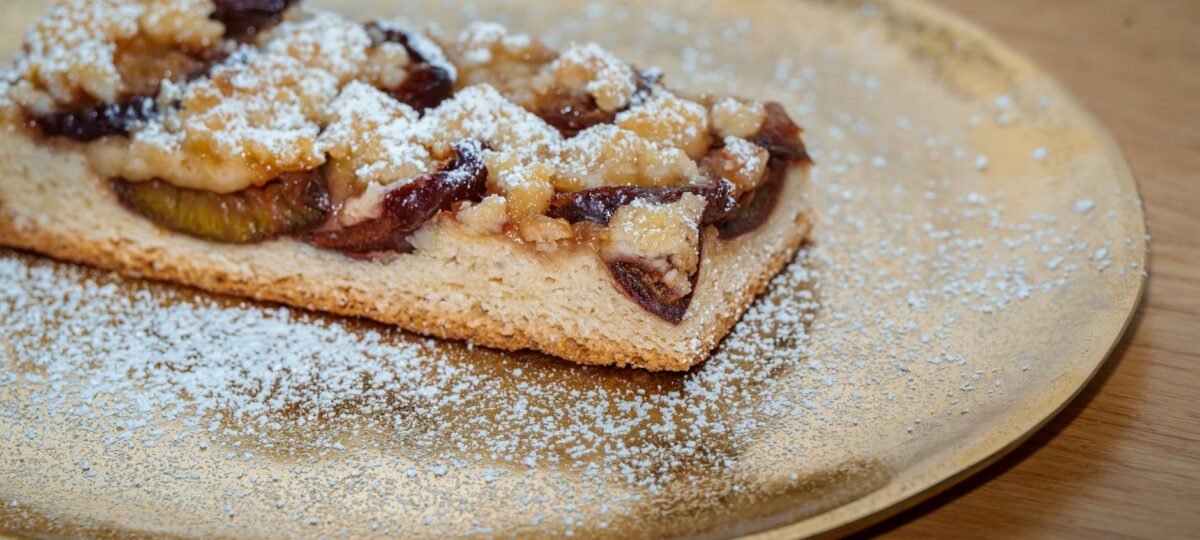
The method scales to almost any fruit. Gooseberries need extra sugar (they’re very tart). Plums benefit from a small amount of cinnamon and benefit from halving and stoning rather than rough chopping. Pears are best mixed with something more assertive (ginger, or some dried fruit) as they can be mild. Stone fruits — peaches, nectarines — make excellent crumbles but work better lightly sugared and left slightly underripe so they don’t turn to mush.
The ratio to remember: roughly 800g fruit, 3 tbsp sugar (adjust to tartness), same topping every time. That’s the crumble. Everything else is seasonal variation.
For more on seasonal baking and what the British kitchen calendar looks like through the year, the baking hub covers the full picture — bread, biscuits, preserving and the buying guides. The spring recipes guide connects the cooking side to the seasonal angle.
🛡 Our standards: How we research · Editorial policy · Affiliate disclosure · Corrections

About Gareth
Gareth Isherwood is the editor of Danbury & Lovejoy. He has baked bread at home for 25+ years and has 15 years of growing experience across gardens, containers and other growing spaces, including an East Sussex allotment for the past three years. Read his full story →
Was this useful?