A hygrometer tells you your home humidity level. In the UK, this small device genuinely changes how you manage damp, condensation, and comfort. For what numbers to aim for, our guide to ideal humidity levels explains what is healthy and what is not. If condensation is the issue, our guide to tackling window condensation has practical fixes. A dehumidifier often works alongside a hygrometer — we compared the best dehumidifiers for laundry.
✉ Join the Dispatch — a calm weekly note, every Thursday. Free.
Prices and stock checked 1 November 2026. Every pick below was re-checked against live Amazon on this date — figures shown were correct when checked; tap through for the current price.
Part of our Draught-Proofing Hub — the complete UK guide to doors, windows, letterboxes, chimneys, radiators and the cheap fixes that actually warm a home.
Wet bedroom windows on a winter morning look like a ventilation problem, but a humidity sensor tells the real story: often the air is simply too humid, which calls for a dehumidifier, not just more window-opening. Our flat is damp without one (we run a Duux), and I now keep two sensors in the flat. If you live in a damp-prone home — especially near the coast — you need to know your numbers.
A hygrometer tells you the humidity level in your home. In the UK, where condensation and damp are persistent problems, this small device can genuinely change how you manage your indoor environment. Rather than guessing whether your home is too damp, you’ll know.
Why Track Humidity?
The ideal home humidity range is 40–60%. This range keeps you comfortable, protects your belongings, and prevents both mould and the discomfort of overly dry air.
Too high (above 65%): Condensation forms on windows and cold surfaces, mould develops in bathrooms and bedrooms, and respiratory issues become more likely. Mould particularly loves bedrooms, where temperature drops at night and humidity rises. It is usually where mould shows first, and we’ve seen it ourselves in a damp spell.
Too low (below 40%): Your skin dries out, airways become irritated, and static electricity becomes annoying. In winter with heating on, indoor humidity can drop to 25–30%, which is genuinely uncomfortable.
Tracking humidity helps you know when to run a dehumidifier, when to open windows, and when your home is at its most comfortable. Without a number, you’re guessing. With one, you’re making decisions.
What to Look for in a Hygrometer
Accuracy: Look for ±3% accuracy; ±5% is acceptable. Budget hygrometers can be wildly inaccurate — cheap no-brand units often read 8–10% off a calibrated reference. For something you’re relying on to make decisions about your home, that matters.
Temperature reading: Useful year-round for understanding your home’s thermal comfort alongside humidity. Seeing 62% RH at 16°C tells you something different than 62% at 20°C.
Display size and clarity: You’ll check it regularly, so it should be easy to read at a glance. A unit on a bedside table or a kitchen shelf needs to be readable from a few feet away — or, if you would rather not add another display to the room, an app-based sensor moves the reading to your phone instead.
Memory/min-max reading: Useful for spotting patterns. If your bedroom humidity consistently hits 75% overnight, you know you need better ventilation or a dehumidifier running on a timer.
Battery life: Most run on AAA batteries and last 12–18 months. Check before buying if battery life matters to you.
Top Picks for UK Homes
What I recommend
1. ThermoPro TP49 — the bestselling budget pick for good reason. Accurate, simple, clear display. Shows humidity and temperature. No app, no fuss. The display is large enough to read across a room, which makes it the one to choose if you want the number visible without reaching for your phone.
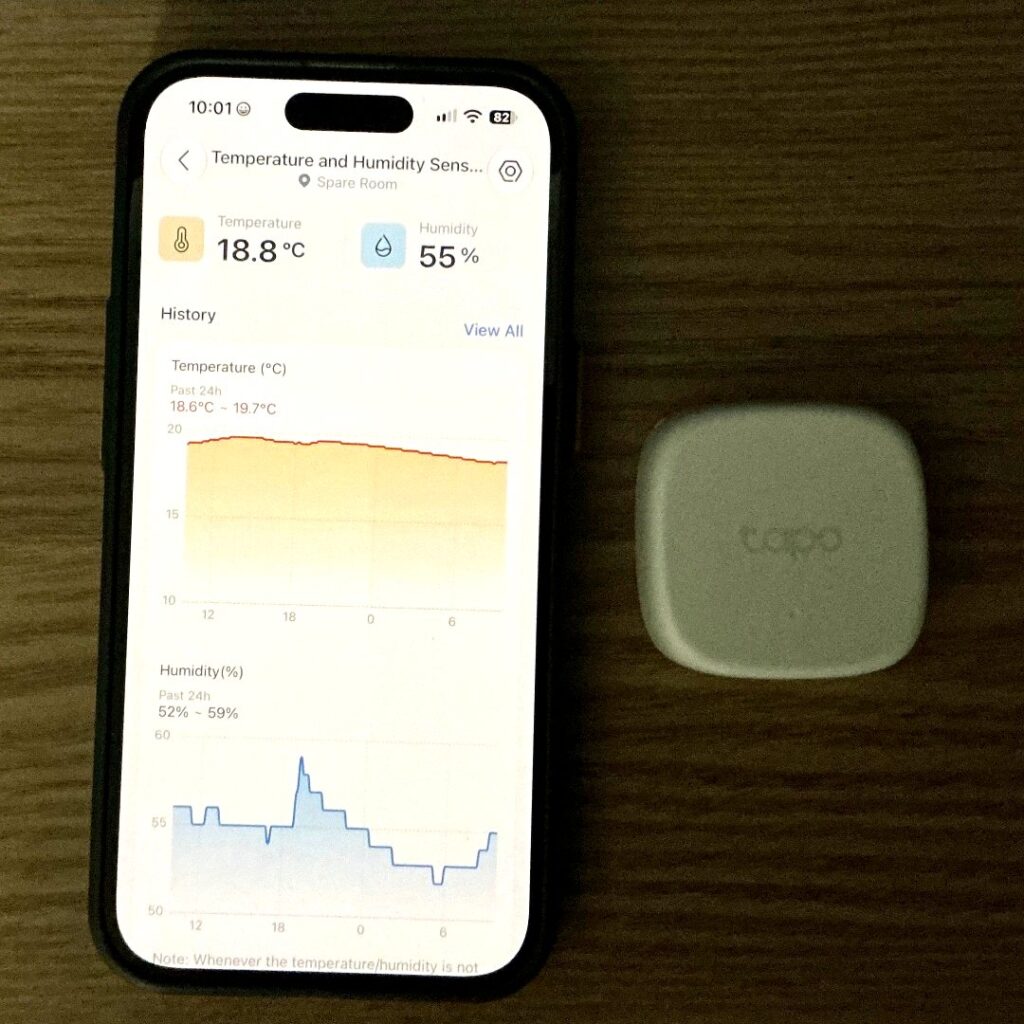
2. Tapo T310 — the one we use at home. We have two of these app-only sensors, and the one in our spare room logged every month from November to March last winter (it is the sensor in the photo at the top). It has no screen, so you read it on your phone, with graphs of the past day and alerts when the humidity passes a level you set. Accurate to ±3% RH, Tapo says. It needs a Tapo hub to work, sold separately (ours runs through a Tapo H100), so it makes most sense if you already have Tapo kit at home.
3. Govee Bluetooth Hygrometer — if you want data on your phone. Logs temperature and humidity over time, sending alerts if humidity gets too high. Accurate to ±3% RH, Govee says. Good if you want to track patterns over weeks rather than just checking in the moment.
4. Inkbird IBS-TH2 — small, accurate, Bluetooth-enabled. Another good option if you want mobile alerts without paying premium prices.
For most UK homes, the ThermoPro TP49 is the sensible choice — cheap, reliable, and doesn’t need batteries replaced constantly. Buy two or three and put them in the rooms that matter most.
If your hygrometer reveals high humidity levels: The next step is tackling the source, and for most homes that means a dehumidifier. Meaco’s MeacoDry ABC 12L is a good place to start; it is sold direct by Meaco at £149.99 (in stock when we checked on 6 October 2026). Your hygrometer will then show you whether it is working.
How to Check Your Hygrometer Is Accurate
Before you trust a reading, it is worth knowing whether the device itself is honest — and you can check any hygrometer at home with nothing more than ordinary table salt. It is called the salt test:
- Put about a tablespoon of salt in a small bottle cap or dish and add a few drops of water to make a thick paste — damp, not dissolved.
- Seal the dish and the hygrometer together inside a zip-lock bag or an airtight tub, without the two touching.
- Leave it somewhere at a steady room temperature for about six hours.
- A saturated salt solution holds the air around it at almost exactly 75% relative humidity, so a healthy hygrometer should settle on 75% (±3%). If yours reads 70%, it is running about 5% low — note that offset, or adjust the calibration if the model allows it, and read it accordingly from then on.
It is the same principle laboratories use with saturated salt solutions, just scaled to your kitchen table. Do it once when a hygrometer is new and you will know whether to trust it for years. Unbranded units are the ones most likely to fail this test — another reason to stick to recognised names.
Where to Place Them
Bedroom: Mould risk is highest in bedrooms overnight, so this is priority placement. A hygrometer by your bed tells you immediately if humidity is becoming a problem. I discovered my worst readings were in the bedroom — not the bathroom — which surprised me.
Kitchen and bathroom: These rooms generate moisture, so tracking humidity here helps you know when to open windows or run extraction fans. Cooking a big meal can push kitchen RH above 70% quickly.
Any room where you dry laundry: If you’re using a heated airer indoors, humidity will spike — a hygrometer tells you when to run a dehumidifier alongside it. I aim to keep the drying room below 70% during active drying cycles.
A simple approach: buy two or three cheap hygrometers (they’re under £15 each) and place them in the rooms where damp is most likely. You’ll quickly build up a picture of your home’s humidity patterns across the day — and across the seasons.
The photo at the top is our own Tapo sensor in the spare room, beside its app on 4 November 2026: 55% humidity at 18.8°C, and 52% to 59% over the previous 24 hours. It has no screen of its own; it is pick 2 above.
Acting on the readings
Once you know the humidity and temperature in a room, the numbers tell you what to do next:
- Humidity above about 60–65%: ventilate more, dry less laundry in the open, and tackle the moisture at its source.
- Steady condensation on the windows: look at window insulation film or thermal curtains.
- A room colder than the thermostat suggests: look for draughts; our draught-proofing guide goes room by room.
- Laundry drying indoors: a dehumidifier in a closed room brings the humidity down and dries clothes faster.
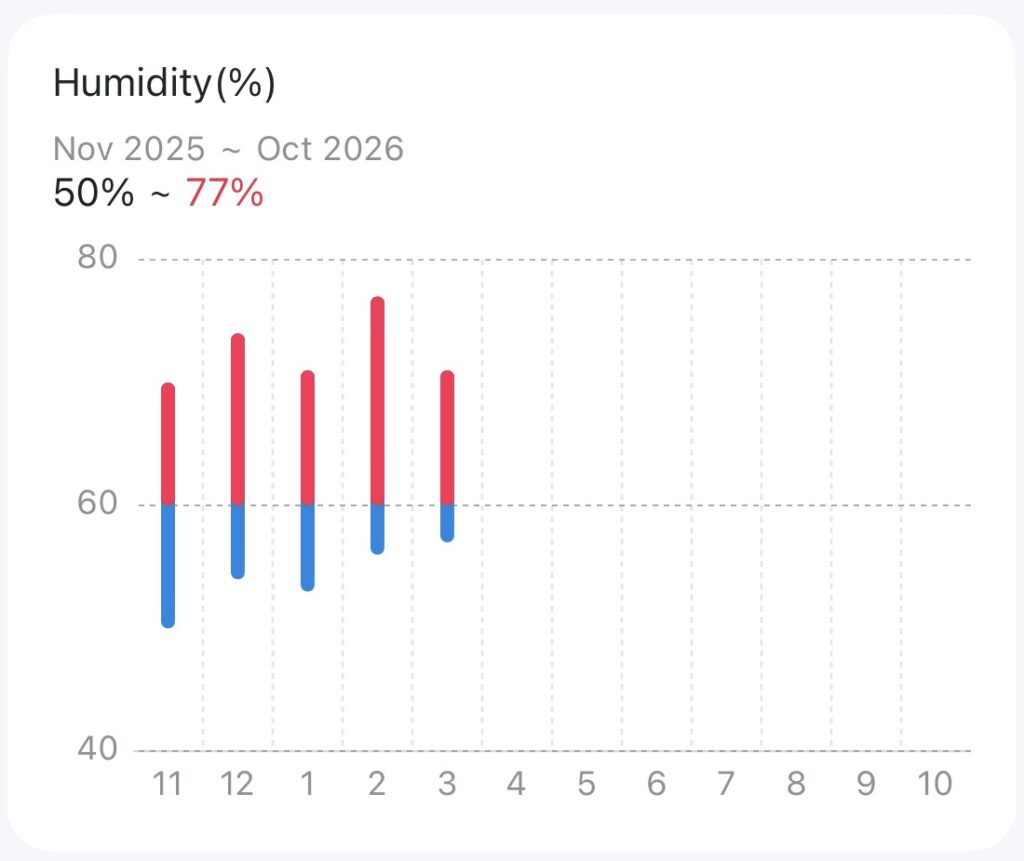
To see where moisture gathers inside one room, compare a reading near the window with one from the middle of the room.
FAQ
What is a good humidity level for a UK home?
40–60% is the sweet spot. Above 65% consistently is where you start to risk condensation and mould. Below 40% and you’ll notice dryness, particularly in winter with the heating on. My target is 50–55% in bedrooms and living areas.
Where should I put a hygrometer in my house?
Put it in the room where you suspect damp or condensation problems — usually a bedroom, bathroom, or kitchen. Keep it away from direct heat sources, windows, and exterior walls so it reads the room’s overall humidity rather than a cold or warm spot.
Can a hygrometer tell me if I need a dehumidifier?
Absolutely. If your readings are consistently above 65%, a dehumidifier will help. Track humidity for a week and you’ll have clear evidence of whether you need one — and you can track the improvement once you start running it. Our flat is damp without a dehumidifier; running one (ours is a Duux) is what keeps it in check.
Do I still need a hygrometer if I already have a dehumidifier?
Yes — a hygrometer tells you when to run the dehumidifier and when you can switch it off. Many dehumidifiers have a built-in sensor, but an independent hygrometer in another room gives you a fuller picture of the whole home rather than just the air by the machine.
Do I need a smart hygrometer or is a basic one sufficient?
A basic hygrometer is sufficient for most homes. The data isn’t complex — you just need to know if humidity is high or normal. A smart one is nice if you want historical data or phone alerts, but the basic ThermoPro TP49 does the job perfectly. I’d buy two basic ones before buying one smart one.
How accurate are cheap hygrometers?
Variable. Named brands such as Govee and Inkbird state ±3% RH on their listings. Unbranded units can be 8–10% off, which makes them nearly useless for informed decision-making. Stick to recognised names — and if in doubt, check yours with the salt test above.
Do I need to track temperature as well as humidity?
It helps. Temperature tells you whether the heating is doing its job; humidity tells you whether moisture is a problem. Most hygrometers show both, and in UK homes the humidity reading is usually the more surprising one.
How often should I check the readings?
Morning and evening in winter is plenty. The morning reading captures the moisture that builds up overnight, and the evening one the peak from cooking, showers and laundry. The pattern across a week tells you more than any single reading.
For more detailed guidance on managing your home’s humidity, see our full guide to healthy humidity levels in UK homes.
How We Research and Choose
Our recommendations come from living with hygrometers in a damp-prone UK home over several seasons, read alongside verified owner reviews and manufacturer specifications. We weigh accuracy, how easily you can read the display at a glance, battery life, and whether a unit reliably helps you catch damp problems before they take hold. Where a pick rests on owner reviews and published specs rather than day-to-day use, we say so — and we would sooner recommend a cheap hygrometer you will actually check than a clever one you will not. A hygrometer that gives you a false sense of security is worse than not having one.
Hygrometer comparison: best options for UK homes
| Model | Price (approx.) | Accuracy | App / Alerts | Best for |
|---|---|---|---|---|
| ThermoPro TP49 ★ Our pick | Check price | Not stated on the listing | No | Most homes — simple, reliable, clear display |
| Tapo T310 (the one we use) | Check price | ±3% RH | Yes — app only, needs a Tapo hub | Logging a room right through winter, homes with Tapo kit |
| Govee Bluetooth Hygrometer | Check price | ±3% RH | Yes — logs data, sends alerts | Tracking patterns over time, damp-prone rooms |
| ThermoPro TP358 | Check price | ±2% RH | No | Higher accuracy without an app |
| Inkbird IBS-TH2 Plus | Check price | ±3% RH | Yes — Bluetooth | Bluetooth, with an external temperature probe |
| La Crosse Technology | Check price | ±2% RH | No | Precision monitoring for instruments or wine storage |
Last reviewed: July 2026
🏠 From the D&L Shop: Making your home warmer this winter? Our Winter Home Survival Guide covers heating, draught-proofing, condensation, energy bills, and keeping comfortable through the cold months — 11 pages, £8.99. Also free: the Sunday Reset Checklist (a calm weekly home reset, instant download). Browse the full shop →
Further reading: our guides to the best air purifiers.
A hygrometer tells you the number; acting on it is the next step. When a heatwave drives both heat and humidity up, see our best portable air conditioners — the ones that dehumidify as they cool.
— Gareth
Sources
Accuracy tolerances, measurement ranges and display specifications are taken from manufacturer datasheets and cross-checked against verified UK buyer reviews. The relative-humidity ranges referenced in this guide, and the health case for monitoring them, follow the UK Government’s guidance on the health risks of damp and mould.
🛡 Our standards: How we research · Editorial policy · Affiliate disclosure · Corrections · Last reviewed: July 2026

About Gareth
Gareth Isherwood is the editor of Danbury & Lovejoy. He has baked bread at home for 25+ years and has 15 years of growing experience across gardens, containers and other growing spaces, including an East Sussex allotment for the past three years. Read his full story →
Was this useful?