✉ Join the Dispatch — a calm weekly note, every Thursday. Free.
A mixing bowl is the most-used and least-thought-about thing in a baking kitchen. You reach for one every single time you make anything — and yet most of us own a random assortment picked up over the years, half of them too light, too shallow or too slippery to actually be pleasant to work in. This guide covers the best mixing bowls you can buy in the UK in 2026, from a budget stainless nesting set to a space-saving Joseph Joseph prep system, and — just as usefully — which material suits which job.
I’ve been baking bread at home for twenty-five years, which has taught me one thing about mixing bowls that the shiny sets never mention: for dough, weight is a feature. When you’re kneading a stiff bread dough by hand, a light bowl skates across the worktop and you spend half your energy chasing it — whereas a heavy ceramic bowl sits dead still and lets you actually work the dough. That’s the whole reason bakers love a weighty Mason Cash. If you’re just starting out, this pairs naturally with our how to start baking bread guide; for the tins themselves, our best loaf tins and best cake tins round-ups are next door.
The best mixing bowls UK 2026, at a glance
| Mixing bowls | Best for | Material | Rough price |
|---|---|---|---|
| Wildone Nesting (Set of 5, lids) | Best overall | Stainless steel | £28.04 |
| CafeTEq Stainless 3-Pack | Best budget | Stainless steel | £11.99 |
| Mason Cash Cane (29cm/4L) | Best ceramic for dough | Earthenware | £20.00 |
| Pyrex Prep & Store 3-Piece Glass (with lids) | Best glass | Borosilicate glass | £24.69 |
| OXO Good Grips 3-Piece | Best plastic set with grips | Plastic + grips | £36.54 |
| Joseph Joseph Nest 9 Plus | Best premium / space-saving | Plastic prep set | £44.99 |
subject to change
Product prices and availability are accurate as of the date/time indicated and are subject to change. Any price and availability information displayed on Amazon.co.uk at the time of purchase will apply to the purchase of this product.The one to buy for most kitchens is the Wildone stainless nesting set. Stainless bowls are the professional default — light, indestructible and non-reactive — and this set adds the things that earn their place on a worktop: airtight lids, grater inserts and measurement marks inside the bowls. If money is tight, the CafeTEq set gets you most of the way. Either way, add a heavy ceramic bowl for dough.
The picks
Best overall
Wildone Stainless Nesting Bowls (Set of 5, with lids)

Wildone Stainless Nesting Bowls (Set of 5, with lids)
This is the set to buy for most kitchens: stainless, nesting, and doing the most jobs from one box. You get five nesting stainless bowls rather than three, and the extras earn their place: airtight lids turn any bowl into a fridge storage container so you can prove dough overnight or park a marinade, grater inserts handle zesting and shredding straight into the bowl, and measurement marks inside save you a separate jug. Stainless is the professional default for good reason — light, hard-wearing and non-reactive, so it will not stain or hold flavours the way plastic can. It undercuts most three-bowl sets while covering mixing, prepping and storing in one system.
Best budget
CafeTEq Stainless Steel Mixing Bowls (Set of 3)

CafeTEq Stainless Steel Mixing Bowls (Set of 3)
If you want the professional-kitchen material without the professional-kitchen price, this is the one. You get three stainless bowls that stack inside one another — 18cm (1.5 litres), 22cm (2.5 litres) and 26cm (4 litres) — so the largest is a genuinely useful size for a cake mix or a batch of dough. Stainless won’t stain or hold onto smells, it is non-reactive so it won’t taint an acidic mix or a meringue, and CafeTEq gives the bowls a rolled edge to grip and a depth it says suits an electric hand mixer. Stainless has a hidden trick, too: chill the bowl in the fridge first and it helps stiffen cream and egg whites when you whip them. Two catches. There is no non-slip base, so on a smooth worktop a damp tea towel underneath helps; and you can’t see through metal to watch a batter come together — for that, buy glass. CafeTEq is a little-known brand, but this is still the cheapest way into a proper stainless set.
Best ceramic for dough
Mason Cash Cane Mixing Bowl (29cm/4L)

Mason Cash Cane Mixing Bowl (29cm/4L)
Every baker should own one big heavy ceramic bowl, and the Mason Cash Cane — that cream-and-embossed design first made in 1901 — is the one. Its whole point is weight: it’s heavy enough to sit dead still on the worktop while you knead a stiff bread dough by hand, so you can actually work the dough instead of chasing a skittering bowl. The wide, shallow shape gives your hands room, the earthenware holds a steady temperature for proving, and the gripped patterned rim lets you get a firm hold when you tip the dough out. It is heavy when full and, like all ceramic, it can chip if knocked or crack from sudden temperature change — so no straight-from-the-freezer-to-hot-oven treatment. But for a genuine kitchen heirloom, nothing serves rising dough better.
Best glass
Pyrex Prep & Store Glass Bowls with Lids (Set of 3)

Pyrex Prep and Store Glass Bowls with Lids (Set of 3)
Glass is the material to choose when you want to see what’s happening. These Pyrex bowls are borosilicate glass, made in France, so you can watch a batter come together, check whether the flour is fully worked in, or judge a caramel by colour from the side. Pyrex rates them from −40°C to +300°C, and for thermal shock up to 220°C; the glass is non-porous, so it won’t carry the taste of a garlicky marinade into a sweet mix, and the bowls and lids go in the dishwasher. What sets this set apart is the lids: each bowl closes for the fridge or freezer, with a writing area on top for a date, so a marinade or a bowl of prepped ingredients goes straight into storage. The sizes are 0.5, 1 and 2 litres — small for a mixing set, so pair it with a bigger bowl for bread dough. The trade-offs: glass is the heaviest of the four materials, and it can be slippery to grip when wet. It is a see-everything set that doubles as storage.
Best plastic set with grips
OXO Good Grips 3-Piece Mixing Bowl Set

OXO Good Grips 3-Piece Mixing Bowl Set
The OXO set is plastic, not stainless — worth saying plainly, because it is often shelved alongside the steel sets. What you are paying for is handling rather than material. The non-slip bases mean the bowl stays planted while you whisk or beat, so you’re not clamping it with one arm; and the soft, comfortable handles plus a pour spout let you hold, mix and tip one-handed, which you’ll appreciate the moment you’re folding a batter with a spatula in the other hand. Three nesting sizes cover everything from a salad dressing to a cake mix, and they store inside each other. Choose it if you want the nicest set to use and don’t mind plastic; choose stainless above if you want a bowl that will outlast the kitchen it lives in.
Best premium / space-saving
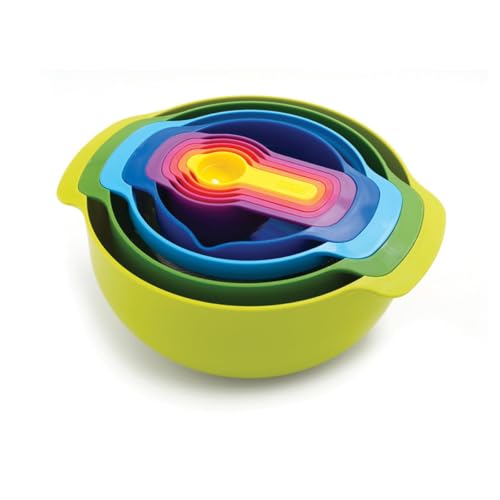
Joseph Joseph Nest 9 Plus Prep Set
Joseph Joseph Nest 9 Plus Prep Set
If your problem is cupboard space rather than mixing itself, this is the clever answer. The Nest 9 Plus packs nine pieces — a set of mixing bowls, measuring cups, a sieve and a colander — that all nest neatly inside one another to take up a single bowl’s footprint on the shelf. Pull it apart and you’ve got most of a baking-prep kit in one buy; slot it back together and it disappears. The bowls are plastic, which keeps the whole thing light and is the sensible choice for a secondary prep set — just remember plastic scratches over time, can hold onto strong smells, and isn’t heatproof, so it’s not the bowl for melting or for kneading heavy dough. It’s the premium pick, but for a small kitchen the space it saves is worth it.
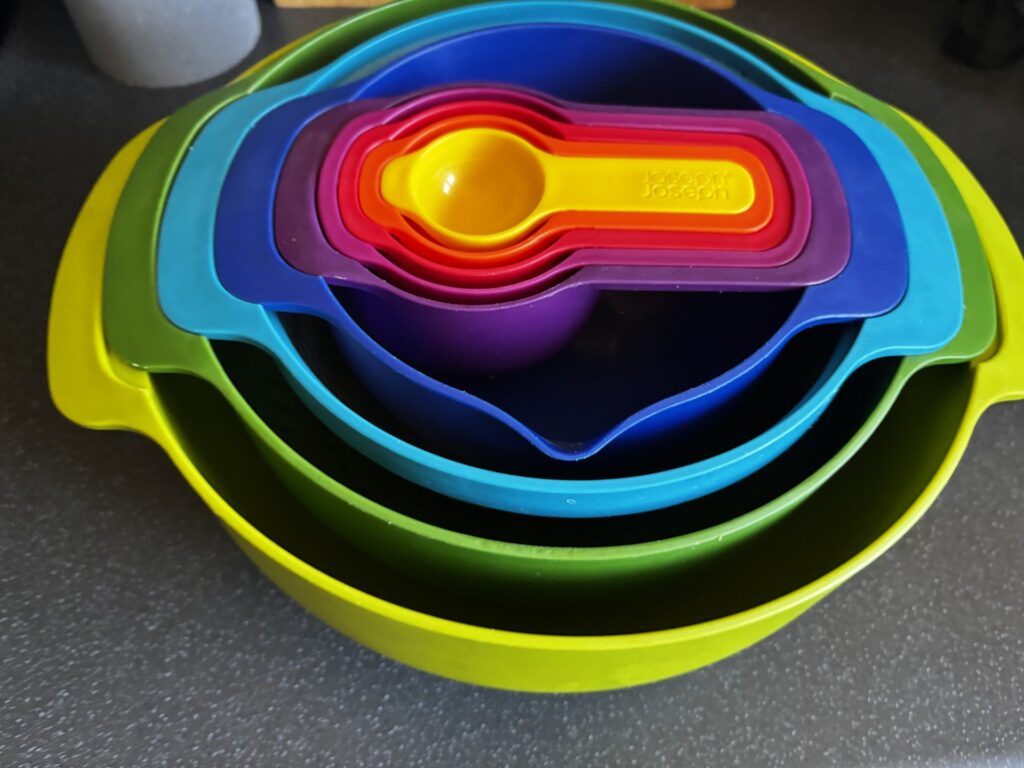
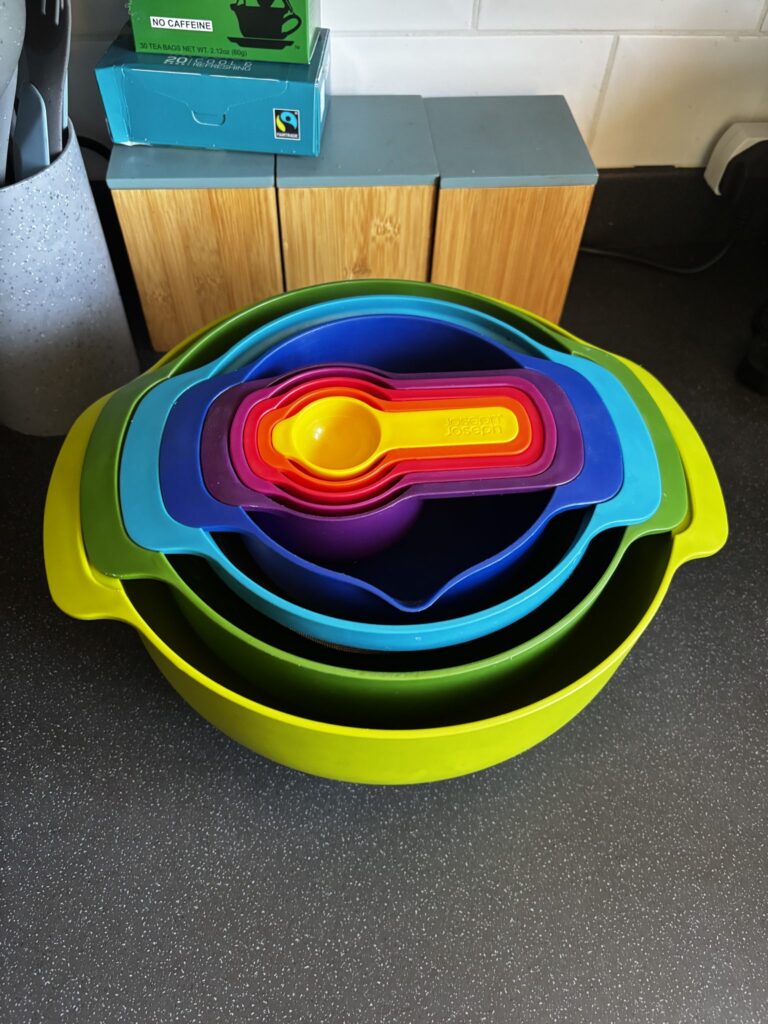
That is the argument for a nesting set in one photograph: bowls, measuring cups and a measuring spoon collapsed into the footprint of the largest bowl. The set above is the Nest 9 Plus in our own kitchen — the same nine pieces as the pick above, sieve and colander included, in the multicolour finish — which, since 11 September, is the one we link as well. What a photograph shows and a specification list cannot is how the pieces seat: every item has a moulded lip and a flat tab, so each one sits on the rim below rather than wedging inside it, and the stack comes apart in a single pull. If the binding constraint in your kitchen is cupboard depth rather than budget, that is the thing you are actually paying for.
One thing worth knowing before you buy this one: on the Nest 9 Plus, the colour is the price. The set is sold in half a dozen finishes and they are the identical nine pieces, but when we checked in September the dearest finish cost almost four times the cheapest for the same bowls. We link the cheapest finish that is genuinely in stock, not the one we happen to own. Whenever you come to buy, open the colour options on the listing and sort them on price before you choose: the gap moves around, but it is always there, and it is far larger than the difference between this set and its rivals.
How to choose a mixing bowl: material matters most
Ignore the marketing and choose on two things: material (which decides weight, whether it’s heatproof, and whether you can see through it) and set size. Here’s how the four materials actually compare in the kitchen.
- Stainless steel — the pro default. Practically indestructible, non-reactive (safe with acidic or egg mixes), light to lift, and it chills in the fridge to help whip cream and egg whites. The one drawback: you can’t see through it to watch a batter.
- Ceramic / earthenware — the baker’s favourite for dough. Its virtue is weight: it stays planted while you knead stiff dough, the wide shallow shape gives your hands room, and it holds a steady temperature for proving. The trade-off: heavy when full, and it can chip or crack from sudden temperature change.
- Glass — the see-everything option. Heatproof, non-reactive, and transparent so you can watch what’s happening; microwave- and dishwasher-safe. But it’s the heaviest material and can be slippery when wet.
- Plastic — the lightest and cheapest. Ideal as a secondary or prep set because it’s so light, but it scratches, absorbs odours over time, and isn’t heatproof — so not the bowl for melting or heavy dough.
Two more things worth knowing. For whisking and beating you want either weight (ceramic or glass sits still on its own) or a non-slip base (which is how a light bowl like the plastic OXO stays put). And mind the heat: stainless is not microwave-safe, while glass and ceramic must be spared sudden temperature swings to avoid thermal shock. On sizing, a useful trio is roughly 1L, 2–2.7L and 4–5L — small for dressings and eggs, medium for most batters, large for bread dough and folding.
Put simply: a nesting set of three to five bowls is the better buy for most people, and stainless with non-slip bases is the sweet spot. But do also own one big single ceramic bowl for dough — it’s the one job the sets don’t do as well.
How we chose
These picks are based on research — verified current UK availability and pricing, published specifications and materials, and the consensus of established kitchen reviews — rather than a hands-on test of every set in our own kitchen. What I can bring is twenty-five years of baking behind the recommendations: the reason a heavy ceramic bowl beats a light one for dough, or why a non-slip base changes how a stainless bowl feels to whisk in, comes from doing the work, not from a spec sheet. Every bowl here was confirmed in stock at the time of writing, and where a material’s weakness matters — plastic near heat, ceramic and thermal shock — we’ve said so plainly.
Frequently asked questions
What size mixing bowl do I need for baking bread?
For a standard loaf, a large bowl of around 4 to 5 litres is ideal — big enough to let the dough double in size as it proves without climbing over the rim. The 29cm Mason Cash Cane (4L) is that size in heavy ceramic, and its weight keeps it still while you knead. If you can only own one bread bowl, size up rather than down: a bowl that’s too small forces a messy prove, while a roomy bowl never causes a problem.
Ceramic, glass, stainless or plastic — which mixing bowl is best?
It depends on the job. Stainless steel is the best all-rounder — light, tough, non-reactive and it chills for whipping. Ceramic is the baker’s choice for dough because its weight keeps it still while you knead. Glass wins when you want to see the mix or melt chocolate, as it’s heatproof and see-through. Plastic is lightest and cheapest, best kept for prep rather than heat or heavy dough. Most kitchens are happiest with a stainless set plus one big ceramic bowl.
Why do bakers swear by a heavy Mason Cash bowl?
Because when you knead a stiff bread dough by hand, a light bowl slides all over the worktop and you waste effort holding it steady. A heavy earthenware bowl like the Mason Cash sits dead still, so you can put your weight into working the dough. The wide, shallow shape gives your hands room, the thick walls hold a steady temperature for proving, and the gripped rim helps you tip the dough out cleanly. The weight isn’t a flaw — it’s the whole point.
Are mixing bowls dishwasher and microwave safe?
It depends on the material. Glass is generally both dishwasher- and microwave-safe, and ceramic is usually dishwasher-safe too. Stainless steel is dishwasher-safe but must never go in the microwave, as metal and microwaves don’t mix. Plastic bowls vary — many are dishwasher- and microwave-safe, but check the maker’s guidance, and avoid microwaving anything not rated for it. With glass and ceramic, also avoid sudden temperature changes, which can cause thermal shock.
The honest answer is that it depends on how you cook rather than on the bowls. A nesting set wins on storage and loses on simultaneity: the moment you need two bowls at once — dry ingredients in one, whisked egg in the other — you have unstacked the tower and it is occupying more worktop than two separate bowls would. For one-bowl baking and everyday prep it is the better buy. For anything where you are running several components at once, a couple of plain stainless bowls you can leave out will serve you better.
Is a nesting set better than single bowls?
For most people, yes. A nesting set of three to five bowls covers small, medium and large jobs, stores inside itself to save cupboard space, and works out cheaper per bowl than buying singly. It’s the sensible core of any baking kitchen. The one exception is bread: a good nesting set is usually stainless or glass, and for kneading dough you really want a single heavy ceramic bowl. So the ideal answer is both — a nesting set for everyday mixing, plus one big ceramic bowl for dough.
Which mixing bowls should you buy?
For most UK kitchens, the Wildone stainless nesting set is the one to get — five bowls with lids, grater inserts and measurement marks that cover mixing, prepping and storing. On a budget, the CafeTEq stainless 3-pack does the essentials. Want non-slip bases and comfortable handles, the plastic OXO Good Grips 3-piece; want to watch your batter or melt chocolate, the see-through Pyrex glass set; short on cupboard space, the space-saving Joseph Joseph Nest 9 Plus. But whatever set you pick, add the heavy Mason Cash Cane — for kneading bread dough, its weight is the one thing a light bowl can never give you.
If you bake your own, our how to start baking bread guide plus our best loaf tins and best cake tins round-ups fill out the rest of the baking kit — and if you’d rather a machine did the kneading, our best bread makers guide is next door. For a first bake in a new bowl, our Victoria sponge recipe is an easy place to start.
— Gareth
Was this useful?